
The Jesuits in Asia Pacific 2026
Synergy from the Mission for the Marginalised

Education
FyA Cambodia holds its first General Assembly

By Mark Lopez SJ
FyA Cambodia National Director
Pilar Lopez-Dafonte, FIFyA Asia Regional Manager, co-wrote this story.
On the morning of 5 December, FyA Cambodia gathered representatives of all Jesuit-related institutions and partners working for education in Cambodia for its inaugural FyA Assembly. All in all, 16 institutions were represented by 44 participants, of whom 13 were Jesuits from India, Indonesia, Korea, Spain, Thailand, and the Philippines. Among those present were Fr Oh-Chang Kwon SJ, Delegate of the Korean Provincial for the Cambodia Mission and Msgr Enrique “Kike”Figaredo SJ, Apostolic Prefect of Battambang, as well as Br Noel Oliver SJ, Fr Jub Phoktavi SJ, and Sr Denise Coghlan RM—three of the four members of the brave pioneering group who started the Jesuit Mission here in 1990.
The purpose of the meeting was threefold: i) to generate greater interest, enthusiasm, and ownership among members of education-related Jesuit institutions for the FyA movement that is now locally known as សហគមន៍អប់រំដោយក្តីស្រឡាញ់ (Sahakum Oprum Daoy Kdei Srolaiyn); ii) to reflect together on emerging synergies among these institutions; and iii) to be guided by the Educational Needs Diagnosis facilitated by FyA Cambodia (through the support of Jesuit Mission Australia and the FIFyA).
The educational involvements of the assembly’s participants ranged widely from running student hostels for rural high school students from isolated village communities, to managing scholarship programmes for underprivileged university students in Phnom Penh, to administering programmes that provided bikes and books for children in the villages. Despite the wide range and varying nature of their engagements, those present had three unifying beliefs: that education continued to be a great source of hope for Cambodian society; that our shared mission was to serve the most vulnerable; and that our educational engagements, in order to be worthwhile, must be transformative, changing the quality, cultures, and systems of education that have become marginalising or oppressive.

Among the main presenters for FyA milestones were the pioneering Cambodian teachers of the FyA-Community Learning Center (CLC) Program for primary school children in Phnom Bak Village. Mr Huon Han, an English teacher, was the master of ceremonies, while Ms Dam Lada, who teaches Khmer Literacy and Creativity, and Mr San Longkot, a computer teacher, led the main presentations and facilitated the small-group sharing session. Mrs Phlam Rany, who has served as assistant to four successive Jesuit directors of FyA Cambodia, coordinated the logistics and helped present the key findings of the Education Diagnosis, together with me, as National Director, and Pilar Lopez- Dafonte, the Asia Regional Manager.
After the presentations on FyA’s milestones in Cambodia and as the plenary assembly broke into smaller groups for sharing by mid-morning, the collective mood in the room began to change. From initial curiosity and interest in understanding the purpose of the assembly, the participants became celebratory, joyful, and full of promise filled with a shared desire to advance popular education together.

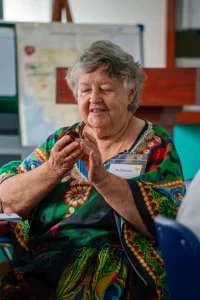 Sr Denise, an educator for many years in the Papua New Guinea missions before coming to Cambodia and a Nobel laureate for her work in the campaign to ban landmines, posed a heartfelt question to the assembly while leading the opening prayer: “What might the Christ presence of the child in the manger be whispering to us who have come together this morning?” Towards the end of the assembly, she was heard commenting enthusiastically how happy she was to be part of the meeting, saying, “The energy in this group today reminds me of the energy our first Cambodian team members had when we came in the 90s—young, eager and fired-up for the mission.”
The presence and contributions of people like Sr Denise and Bp Kike, spiritual leaders for so many members of the Cambodia mission through the years and both with a long-standing commitment to the Cambodian people, added a sense of spiritual depth and profound continuity to the gathering. To conclude the meeting, Kike led a moving final blessing, sprinkling water over all the participants—a traditional and symbolic gesture that refreshed their spirits and signified a shared commitment to wash away barriers and grow together in mission.
Days after the assembly, however, the FyA Cambodia team faced one of the most challenging periods of its operations. On 9 December, Thai military operations brought the long-standing border conflict with Cambodia to FyA’s doorstep. For almost three weeks, explosions from the shelling of areas 30-40 kilometres away could be heard and felt from the school. On two occasions, F16 fighter jets that had been bombing several military camps along the border throughout those three weeks, attacked a camp that was only 5 kilometres from the FyA office.

In the first week of the conflict, FyA team members evacuated their families to nearby provinces. Working remotely, they began planning how to pivot towards emergency education operations and providing humanitarian assistance to students in camps for the internally displaced. When it was deemed safe to return to Banteay Meanchey and it became apparent that civilian areas were not among the military targets, they reconvened and began to mobilise.
Over a two-week period, the team was able to prepare school packets, containing notebooks, colouring books, art materials, and a storybook, for distribution to schoolchildren in the IDP camps. Volunteer teachers and students from Xavier Jesuit School helped to assemble packs for 2,000 children. We also purchased and dispatched several sets of books for two mobile libraries for children of displaced families while Teacher Longkot volunteered to be relocated to Knach Romeas village to set up and teach basic computer classes for children in a parish, where displaced families were being housed. FyA also supported small-scale humanitarian relief efforts in areas where our partners were already operating, providing supplementary provisions that meaningfully improved the welfare of the children.

The CLC team, upon resumption of classes, piloted an ongoing series of check-ins with the children to help develop their emotional intelligence and support their mental health. The teachers are being guided by Pilar, whose extensive experience from FyA operations in Haiti and training in Education in Emergencies (EiE) have become invaluable resources for the Jesuit Mission in Cambodia.
Although these initiatives had only a limited impact at the national level, considering that hundreds of thousands of families were displaced, the conflict period taught the FyA team critical lessons in service delivery and allowed us to be more prepared to engage education in emergencies within our context.
As of this writing, the ceasefire of 27 December has been upheld, but prospects for a sustainable peace remain uncertain. Several villages which used to be part of Cambodia have now been fenced-off and blockaded by the Thai military, leaving hundreds of families unable to return to their homes and several questions about the peace negotiations between the two nations unanswered. Whether in peace or wartime, however, the FyA Cambodia team has seen and demonstrated how clarity of purpose, flexibility, creativity, and magnanimity of spirit in responding to the educational needs of the most vulnerable can carry us far forward.
Next Article: The Autobiography of Novel Club