
The Jesuits in Asia Pacific 2026
Yet We Still Dare to Hope

A guide’s reflections on facilitating the apostolic planning review for the Myanmar Jesuit Region

By JP Villanueva
JCAP Planning Consultant
Engaging with a Jesuit region to review its existing apostolic plan amid a nation gripped by civil war, social upheaval, and calamity was an eye-opening and deeply spiritual journey. It left me in silent awe at the work of the Lord even in this deeply wounded situation. In his homily at the Third Meeting of Major Superiors in Rome in October, Fr Girish Santiago SJ echoed the communal experience of the region during the apostolic planning review: “Our communities have rediscovered what mission really means – to become smaller, simpler, poorer. In that poverty, not structures but presence; not efficiency but fidelity; not numbers but witness.”
Prior to facilitating the review, I had reservations on the fruitfulness of the undertaking, given the depth of the woundedness. I learnt much from my initial survey of members of the regional community, but what I experienced transformed the way I now understand discernment in common and apostolic planning. I would like to break this down into 10 key takeaways.
1. Everything begins with a shared encounter with the compassionate Jesus Christ
When the community began the review with a three-day silent retreat, they stumbled upon a God already with them, deeply united in their suffering—a God who leads, inspires trust, and heals. They found the Lord in all things, even the incomprehensible societal and spiritual impasse. It was a communal Ignatian repetition of the First Principle and Foundation and the Contemplation to Attain Love that led them to receive the grace of reorientation and the desire to collaborate. From this came renewed inspiration and motivation to move forward in mission, with better listening, greater forgiveness, a deeper trust, and the capacity to adapt in these uncertain times.
“The three-day silent retreat enabled us to relax in God’s hands. It allowed us to take a good look at our entire mission from God’s perspective. At the same time, it opened our eyes to see one another’s generous contributions in the mission.”
Fr Titus Tin Maung SJ

2. Keeping Jesus at the centre of discernment in common
The apostolic planning was a pilgrimage with the Lord, starting with confronting suffering squarely and progressing towards learning how to walk together while carrying their collective cross, finding grace and loving kindness, and becoming a community of compassion and peace. This journey was sustained by continually “sensing Christ” and relishing the movements of the Spirit through daily reflections, personal prayer, spiritual conversations, and plenary sharing of the fruits of prayer.
3. Discerning and walking together as one Body
Walking together required significant shifts for the community:
- From setting goals and targets to discerning hope in darkness,
- From fixing systems or growing their mission impact to staying present to communal suffering,
- From controlling outcomes to allowing the Paschal Mystery,
- From managing programmes to protecting fragile signs of life, and
- From optimising their mission operations to cultivating spaces of listening, prayer, and solidarity.
“Instead of being anxious about the seemingly endless sufferings of the people, I began to see the blessing and sign of God’s presence in the people’s resiliency. The sympathy, unity, and mutual support among the displaced people are, indeed, genuine expressions of love they shared among themselves. God truly is in their midst in the form of this kind of love. In this way, my hope is born anew.”
Fr Titus Tin Maung SJ
4. Moving forward through holistic transformation of persons and communities
It became clear to the community that they are called to be wounded healers. But healing has to happen holistically—spiritual, social, and human. Healing includes justice and peace. Dialogue and peacebuilding must begin within each person before it can expand to social justice, care for the environment, reconciliation, formation and education, and preserving human dignity.

5. Witnessing through communion
Communion gives birth to mission, and mission nourishes communion—a dynamic rediscovered during the review and amplified when spiritual conversation becomes the way of proceeding. It is through this that the regional community is able to embrace synodality through conversion of relationships. In the process, they become credible evangelisers by the witness of their lives deeply rooted in finding God in all things and in one another.
6. Detachment, interior freedom, dialogue, and deep respect as main ingredients of mission planning, execution, and governance
The grace to listen more deeply in order to discern the Lord’s desires for the community shone throughout the review. As they identified priorities for the next three months, listening became central to the accompaniment of the displaced, youth, and regional community itself.
“Decision-making is less about the ‘what to do?’ and more about the ‘how to do?’ Decision-making is not so much about what I want to do in the mission; it is, indeed, more about being able to identify what the Lord is already doing among the displaced people and to ‘surf along’. Metaphorically, I am to be a good surfer who can ride on the spiritual currents of the suffering people. Often times, noticing the silver lining in a dark cloud keeps one motivated in life.”
Fr Titus Tin Maung SJ
7. Reshaping the mission that takes flesh in the local context
Even before the annual community retreat, preparatory prayer attuned participants to the community’s reality. Drawing from Christina Kheng’s Welcoming the Spirit: A Communal Approach to Pastoral Planning, they reflected on their realities, graces, challenges, and personal invitations as members and collaborators of the region. This enabled a deeper reading of the signs of the times and further grounded their discernment in common in context for greater fruitfulness.
“To say ‘Peace’ today means to accompany the displaced and the hungry, to speak truth even when it costs, and to refuse to give in to hatred or revenge.”
Fr Girish Santiago

8. Prioritising those on the peripheries
A thorough review of scenarios, supported by emergency and steady services, sharpened the focus on how to care for the displaced and youth. A collaborative network (Jesuit Refugee Service, other Jesuit organisations, NGOs) needs to be in place for cycles of assessment, emergency management, and programme deployment, enabling the mission to adapt to shifting social directions and remain resilient and sustainable.

9. Relying on the Holy Spirit to lead continual conversion
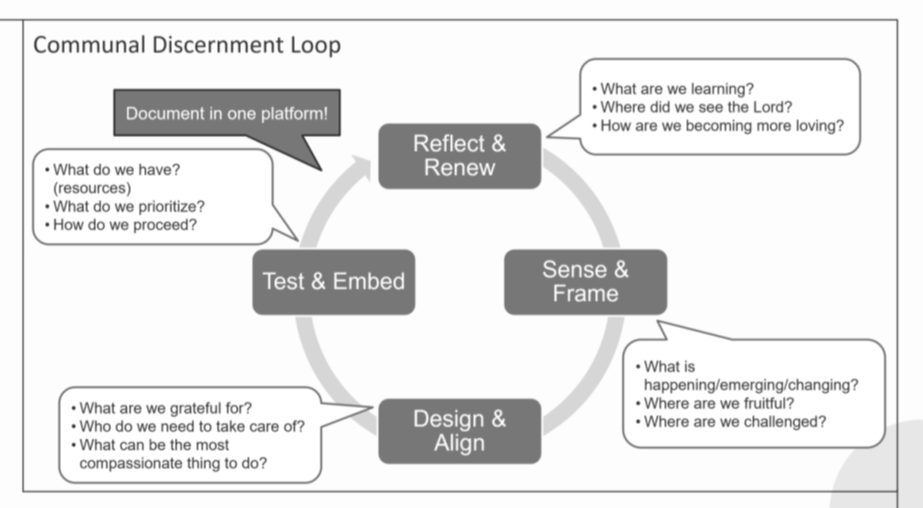
Apostolic planning is an ongoing discernment-in-common. In their volatile context, the community embraced cyclical mission examen—using the simple guide below every three months or in moments of social shifts—to sense the Spirit’s lead.
10. Continuing the communal pilgrimage in hope.
Going forth with deeper trust in the Lord and in one another—committing talent, treasure, time, and togetherness to be creative in mission, continually reading the signs of the times, and making Christ tangible through compassionate witness—is a quiet force of hope for the people of Myanmar. May this hope give rise to a deeply joyful mission.
“We are sent as lambs—fragile but free, poor but bearing peace. When we have no power, God’s presence becomes our power. When we have no voice, His Spirit speaks through our witness.”
Fr Girish Santiago SJ
This experience of guiding the Myanmar Jesuit Region’s apostolic planning review has convinced me even more deeply that apostolic planning is a synodal pilgrimage of encountering Christ together, letting him define the future, listening to the Spirit in one another, discerning together what God desires, discovering hope and joy as one body, and witnessing together the breadth and length and height and depth of the love of Christ.
Next Article: Becoming neighbours