
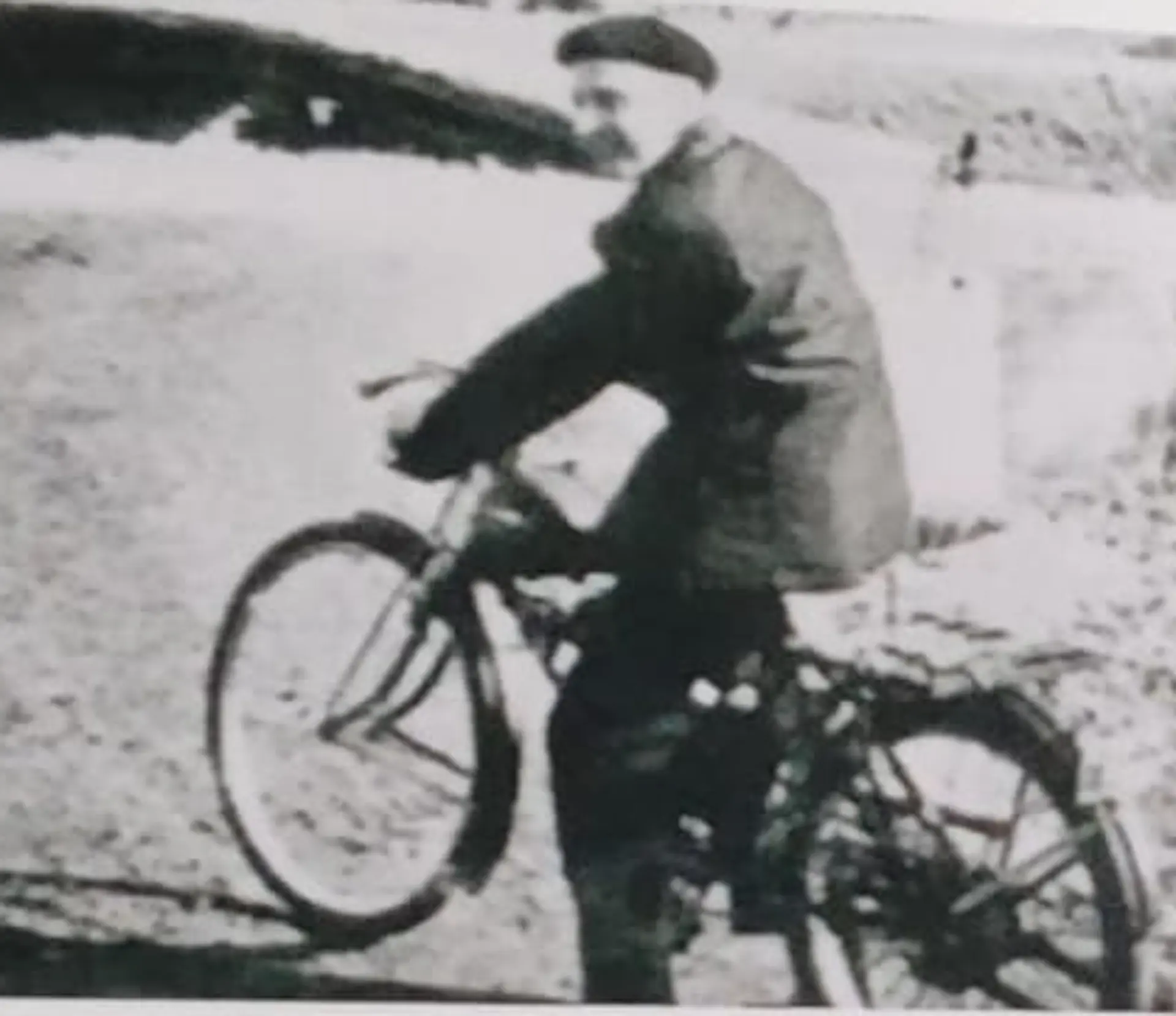
Fr Pedro Arrupe in Nagatsuka
Six and 9 August mark the 80th anniversary of the atomic bombings of Hiroshima and Nagasaki in 1945. We remember not only the lethal blasts but also the resilience of human civilisation. The world, reeling from polycrisis, once again “re-members” the survivors and victims of the past and the progeny of today.
Their wailing voices beckoned me to visit Hiroshima and Nagasaki, to bear witness to the hideous horror that wounded Mother Earth and all living beings in those once devastated places, now memorialised as the Hiroshima Peace Memorial Park and the Nagasaki Peace Park.
What struck me most after seeing the ghastly exhibition and reading the narratives of the survivors at the Hiroshima Peace Memorial Museum was the sombre faces of hundreds of visitors, seated and looking spaced-out, weighed down by the collective guilt of humanity’s barbarity in this historic genocidal crime.
In the midst of this melancholy, my mind flashed back to the heroic leadership of Pedro Arrupe. Five kilometres from the hypocentre of the atomic bomb—which exploded 800 metres over Hiroshima on 6 August 1945 at 8:15 am—he promptly converted the novitiate at Nagatsuka into a “field hospital” to treat the wounded. A medical student in Spain before entering the Jesuit novitiate, Arrupe later wrote these words forever etched in my heart:
“It is at such times that one feels most a priest, when one knows that in the city there are 50,000 bodies which, unless they are cremated, will cause a terrible plague. There were besides some 120,000 wounded to care for. In light of these facts, a priest cannot remain outside the city just to preserve his life. Of course, when one is told that in the city there is a gas that kills, one must be very determined to ignore that fact and go in. And we did. And we soon began to raise pyramids of bodies and pour fuel on them to set them afire.”
Standing before the Genbaku Dome, the epicentre of Hiroshima’s destruction, the Tres Amigos (Fr Alex Varickmackal SJ, Fr Phan Duc Dinh, and I) offered humble gratitude for the City of Peace’s tribute to Fr Hugo LaSalle SJ—a German Jesuit who became a naturalised Japanese citizen, known as Makibi Enomiya. At 47, he experienced the bombing while inside a Catholic church in Noburi-cho, 1,230 metres from the hypocentre. Although glass fragments penetrated his back, and his left leg was severely injured, he escaped from the fire to Senei Garden’s riverbank (now Shukkeien), where he was rescued and nursed back to health by German priests from the Nagatsuka Novitiate. After the war, he devoted himself to building the Memorial Cathedral for World Peace, a place to mourn the victims and pray for a peaceful world.
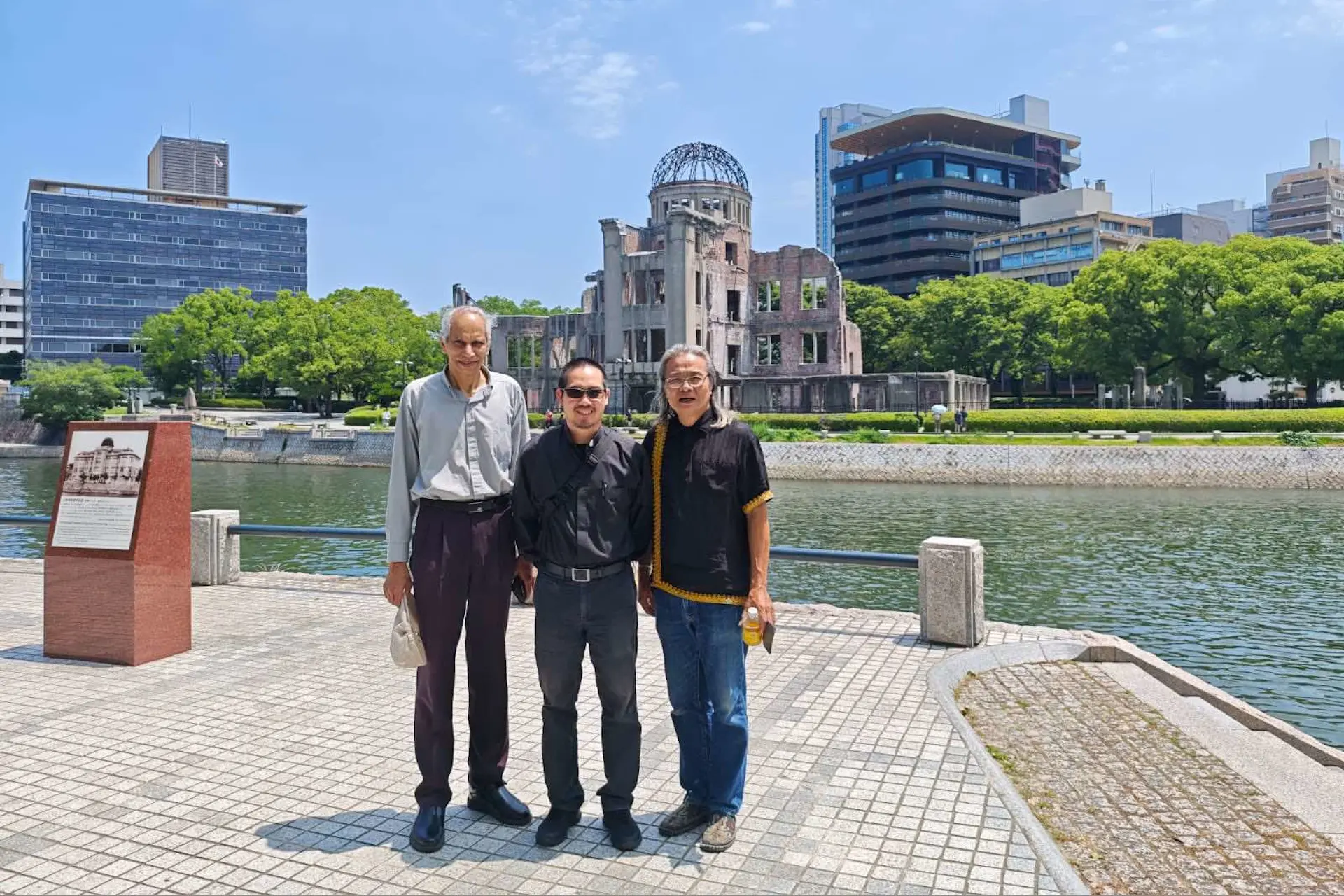
The Tres Amigos at the Hiroshima Peace Memorial Park
With fondness of heart, I read the plaque dedicated to the memory of Pope Francis, who visited the Hiroshima Peace Memorial Park on 24 November 2019. He attended peace gatherings, offered flowers at the Cenotaph dedicated to the A-bomb victims, listened to survivors’ stories, and then delivered a speech calling for peace. He wrote in the museum’s guestbook: “I have come as a pilgrim of peace, to grieve in solidarity with all who suffered injury and death on that terrible day in the history of this land. I pray that the God of life will convert hearts to peace, reconciliation, and fraternal love.”
At the Nagasaki Peace Park, I was enveloped by a surreal tranquillity, as I relished the lush lawn, flowers, plants, and trees. It felt surreal, because 80 years ago, on 9 August 1945, at 11:02:35 am, the atomic bomb detonated just 500 metres above Matsuyama, close to the Peace Statue. In front of it, I reflected on the words of its sculptor, Seibo Kitamura, written in the spring of 1955:
After experiencing that nightmarish war,
that blood-curdling carnage,
that unendurable horror,
who could walk away without praying for peace?
This statue was created as a signpost
in the struggle for global harmony.
Standing ten metres tall,
it conveys the profundity of knowledge and
the beauty of health and virility.
The right hand points to the atomic bomb,
the left hand points to peace,
and the face is in solemn prayer for the victims of the war.
Transcending the barriers of race
and evoking the qualities of both Buddha and God,
it is the symbol of the greatest determination
ever known in the history of Nagasaki
and the highest hope of all mankind.
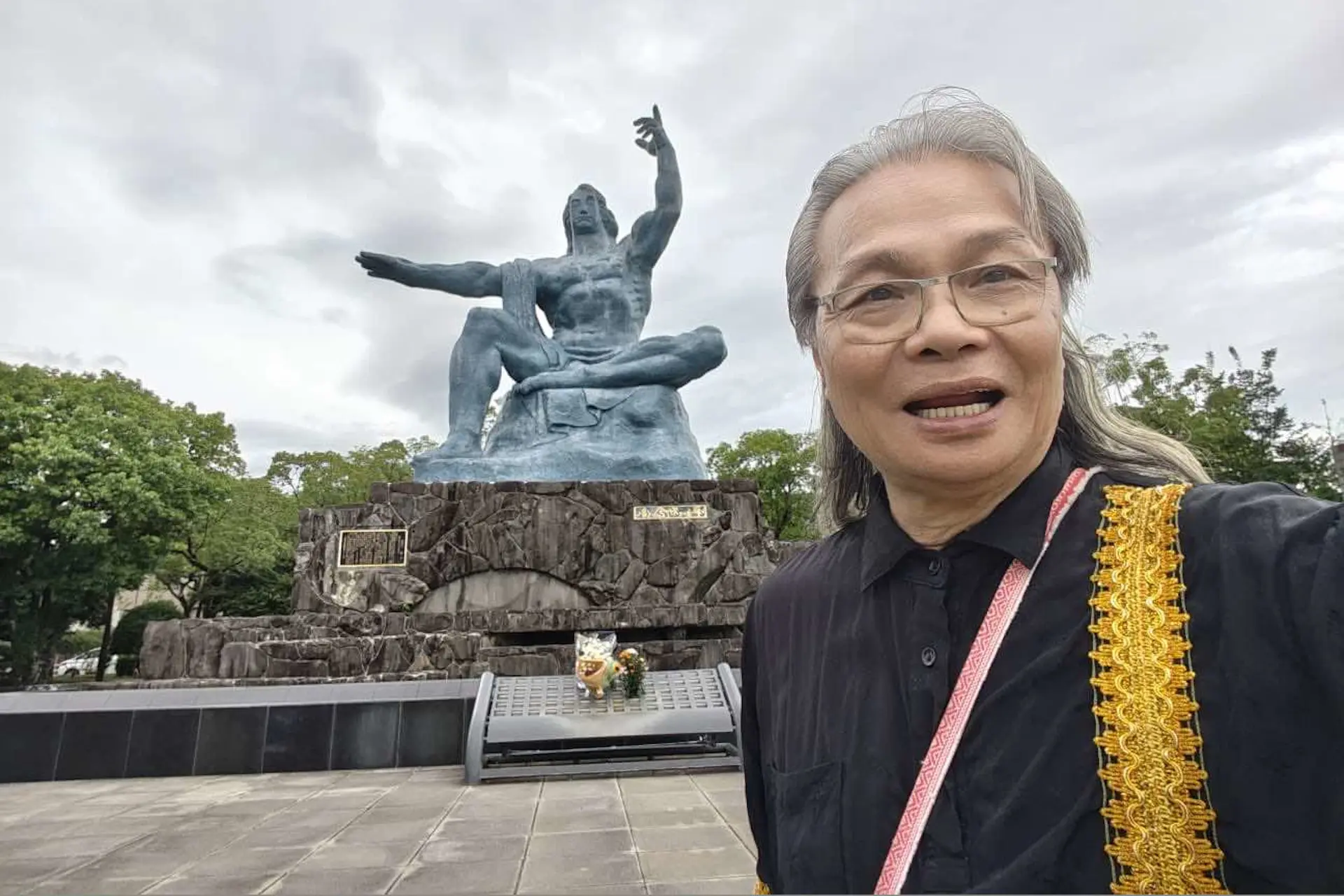
In front of Seibo Kitamura’s Peace Statue
I walked away wrapped in an “unsilienceable silence,” akin to the ghostly aftermath of the blast, awash in the raw emotions evoked by Seibo’s words, convicted yet re-convinced that world peace is never optional.
Descending the spiral staircase to the basement of the Nagasaki Atomic Bomb Museum, I followed the timeline of events leading to the detonation. The towering figure of Dr Takashi Nagai, who suffered from leukaemia before the bombing, and his resilience was most awe-inspiring. The rosary of his wife, Midori, whose ashes greeted him upon the ruins of his home, and the words on his prayer card, entitled “Grant us Peace!” moved me profoundly:
The person who prays for peace
must not hide even a needle…
for a person who possesses weapons is
not qualified to pray for peace.”
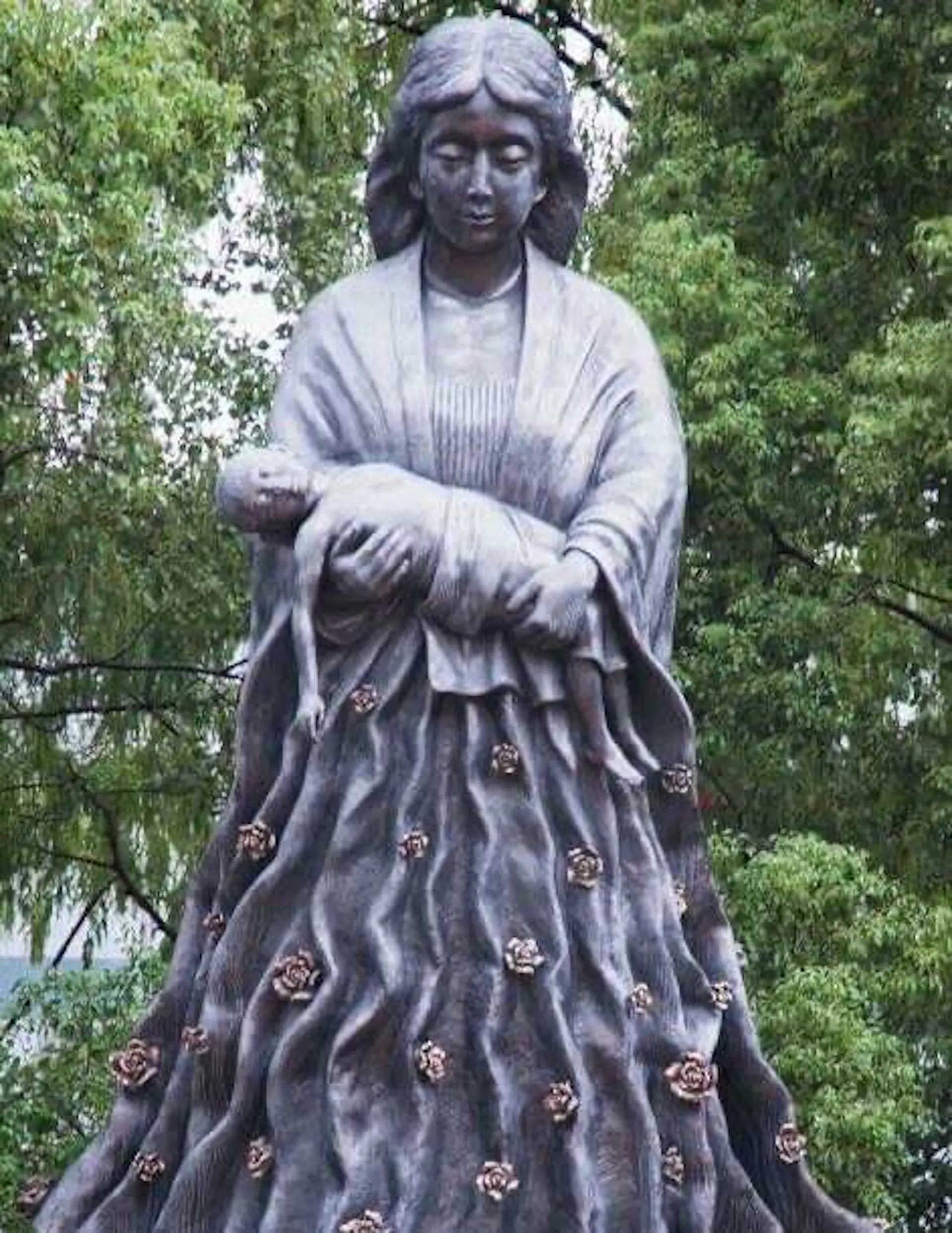
Woman with a dead child monument at the Nagasaki Peace Park symbolises the suffering of the victims of the atomic bombing
On this 80th anniversary, Nihon Hidankyo—the Nobel Peace Prize-winning grassroots organisation of atomic bomb survivors (Hibakusha) from Hiroshima and Nagasaki—along with a coalition of peace movements, has launched the Pax Jubilee Campaign, a global youth initiative that aims to collect one million signatures with concrete actions for justice, peace, and care for creation. The effort began on the Catholic World Day of Peace in the Jubilee Year (1 January 2025) and will culminate at World Youth Day in Seoul (3-8 August 2027) and the International Day of Peace (21 September 2027). The petition will be presented to the Pope at World Youth Day and to the President of the UN General Assembly during the third UN Summit on Sustainable Development Goals.
For our genocidal violence against Mother Earth and innocent lives, the Nagasaki statue depicting a woman with a dead child stands as a haunting emblem. Let us be remorseful and become pilgrims of hope, advocates for a nuclear-free world. Let us all declare, “Indeed, 80 years is enough! Never again!”