
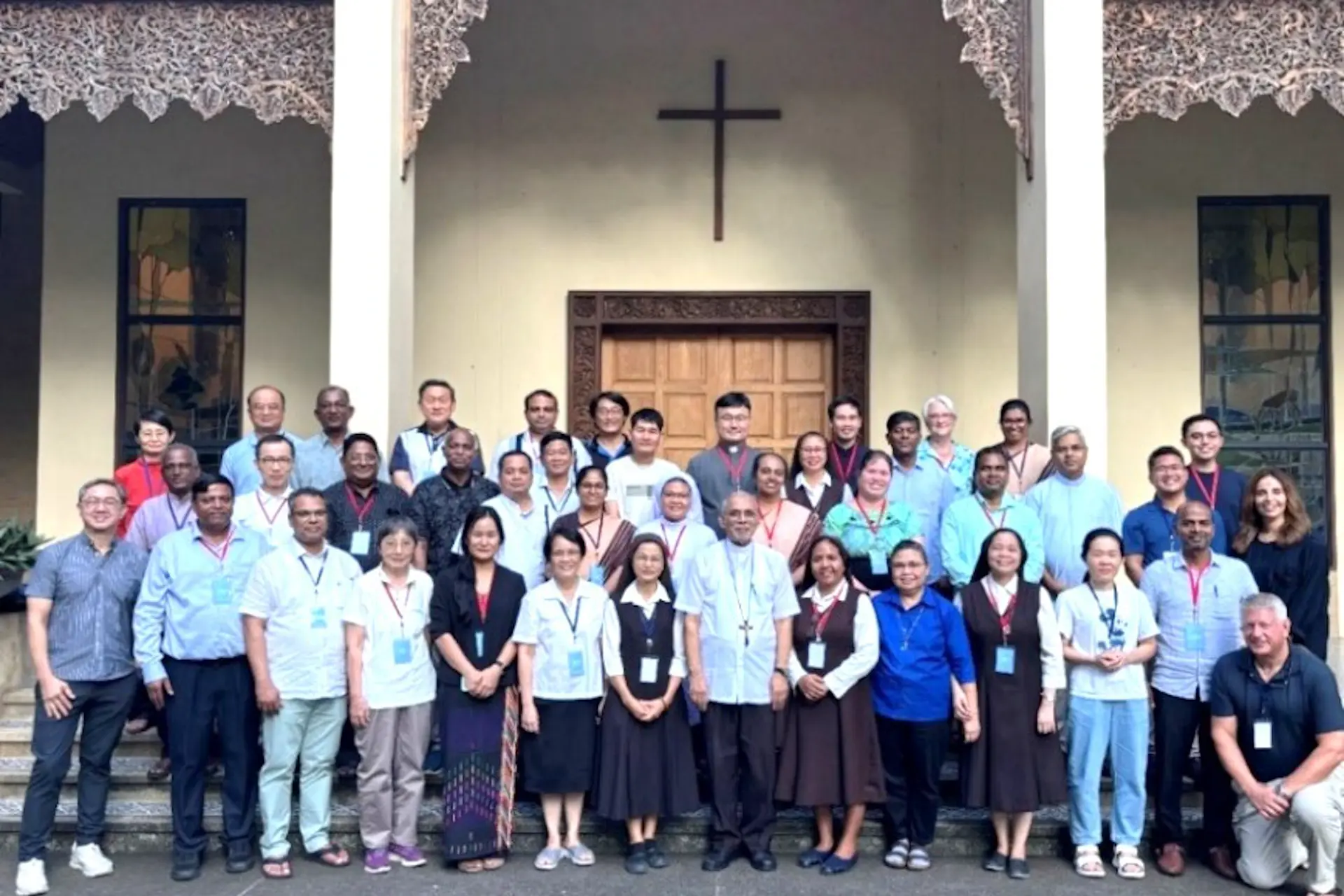
 Jesuits and lay partners from across Asia Pacific engaged in deep study and prayer on synodal and discerning leadership during the Discerning Leadership Asia Pacific training programme held in Chiang Mai, Thailand, from 21 to 26 September. It brought together 36 participants from 11 countries, many of whom have long served in leadership roles within religious congregations or educational institutions.
The central theme focused on how to discern the guidance of the Holy Spirit in order to journey together as a community within the context of today’s world—a world often described by the acronyms VUCA (Volatility, Uncertainty, Complexity, Ambiguity) and BANI (Brittle, Anxious, Non-linear, Incomprehensible).
The training offered a fresh perspective on the fundamental distinction between “authority” and “power” in leadership. Power, in itself, is an essentially neutral energy. It was affirmed that the authority entrusted to a leader is a gift—not to be used as “power over” others for the sake of domination, but rather as “power with or for” others to empower and serve them as we journey together.
Another notable takeaway was the distinction between “problem” and “polarity”. Unlike a problem, which can be solved, polarity, such as “tradition vs innovation” or “action vs contemplation,” involves elements that should not be mutually exclusive but rather held in balance. The process emphasised here is “discernment in common,” a way to transcend conflict and discover a “third way” revealed by the Holy Spirit. It was reaffirmed that the Jesuit traditions of spiritual conversation and discernment are essential to the synodal journey of the contemporary Church.
What I learned most profoundly from the training is the importance of a leader’s inner freedom, detachment, and a willingness to be led.
When faced with challenges, we often unconsciously attempt to control the situation through our own ego or personal strength. However, true leaders are called to let go of the assumption that they must “have all the answers,” to acknowledge their own vulnerabilities, and to remain open to being guided by God and others. It is about becoming “detectors of grace”—learning to recognise the grace of God at work within other people. I learned that instead of trying to dominate a situation, intentionally choosing to “pause” creates the necessary space to receive guidance.
What emerged from the training is a profile of a “discerning leader” within the contemporary synodal Church.
Discerning leaders are neither “puppet masters” seeking to control everything, nor are they paralysed by the inherent ambivalence of authority. Rather, such leaders act as “dance partners,” sensitively responding to God’s guidance. They view the authority entrusted to them as a gift—not a tool for domination, but a means to empower others. Furthermore, recognising that in a rapidly changing society, one’s mission can become a “moving target,” they intentionally slow their pace and step back to observe the situation. They bring to light the “elephants in the room”—issues that everyone is aware of but chooses to ignore—and, while maintaining a balance between firmness and kindness, they provide a clear pastoral direction that respects the unique character of the local community. In this way, the community as a whole responds to God’s ever-evolving call.
The challenge is to apply these valuable insights to our future work in mission and pastoral ministry.