
 Jesuit schools in Asia Pacific are committed to growing green campuses in response to the Society’s growing ecological concern. As a group, the members of the Association of Jesuit Colleges and Universities in Asia Pacific (AJCU-AP) recognise the need to develop ways to reduce consumption of waste material and to find a means to recycle them. They deem it essential to lessen the consumption of energy, paper and water, and instead make use of clean energy to minimise the emission of greenhouse gases. They have also considered how architecture can be helpful to cut energy needs and save on water costs.
“We engage vigorously in environmental protection as it is inseparable from the promotion of faith that does justice, cultural sensitivity and interreligious dialogue,” said AJCU-AP Chairperson and President of Ateneo de Davao University Fr Joel Tabora SJ in a recent lecture on Laudato si’ at his university.
Since the release of the document “We Live in a Broken World: Reflections on Ecology” in 1999, Jesuit communities have been called to discern the management of their institutions and to develop more ecologically sustainable lifestyles. In addition, the AJCU-AP campuses encourage student involvement in caring for their green areas through planting native species. They also teach students how to better reconcile with creation.
Fu Jen Catholic University in Taiwan implements an energy conservation and environmental protection programme, while Jesuit universities in the Philippines, such as Ateneo de Naga, focus on the faith dimension of environmental protection.
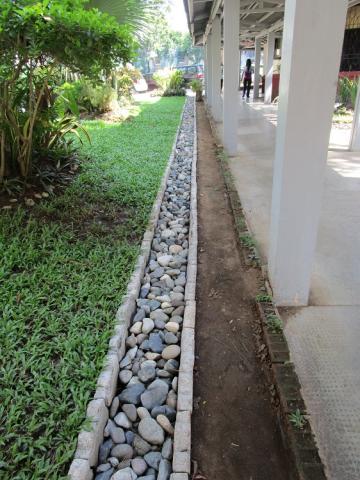 Xavier University – Ateneo de Cagayan works with biopori technology. A biopori is a one-metre deep pipe installed in mostly gravel-filled holes. The technology was initiated by a student from the Akademi Tehnik Mesin Industri (ATMI) Surakarta Polytechnic and is designed to hasten infiltration of storm water from the surface to help reduce water runoffs.
In Ateneo de Davao University, there is “Ecoteneo”, an institutionalised ecology advocacy programme that pushes environmental responsibility on campus. It also publicly opposes economic projects that endanger the environment.
Evaluation of the success of the greening initiatives is important. Ateneo de Manila University will be contributing its expertise in assessing sustainable campuses by sharing their sustainability report template with AJCU-AP members. The management of each green campus will be centred on a baseline study of the current housekeeping or “ecology-keeping” factors of each campus, covering all areas of waste production and energy consumption. It will enable the university management to weigh the institution’s capacity level, measure which plans to change and share the results with others involved in management of the campus.
During the AJCU-AP meeting in Melbourne in July, the association also agreed to use and adopt the “Healing Earth” e-textbook, a living environmental science e-textbook put together by about 90 scholars from Jesuit universities. It was developed to increase awareness of environmental issues from the added standpoints of ethics, spirituality and action. AJCU-AP agreed to give feedback to the authors after using the e-textbook, which is free online for first year university students, fourth year secondary school students and adult learners.
Individual schools are encouraged to find ways to use it, and Sanata Dharma University has already made the material available in an elective course.
 As part of the AJCU-AP plan, member institutions commit to maintaining its environmental protection and awareness programmes in materials (waste) management; education, information and faith; utilities, energy and motor fleet conservation; and the promotion of “green” offices and operations. They will also improve the implementation of their environmental curricular content as a basic mode of instruction.
The AJCU-AP is a voluntary association of Jesuit higher educational institutions and Jesuit higher educational endeavours in the Jesuit Conference for Asia Pacific. It supports and promotes Jesuit higher education in the region, providing the structure for the higher educational apostolate in Asia Pacific. www.ajcu-ap.org.
Related story: Statement on Laudato si’
Photo caption: Solar panels at the Ateneo de Davao University