

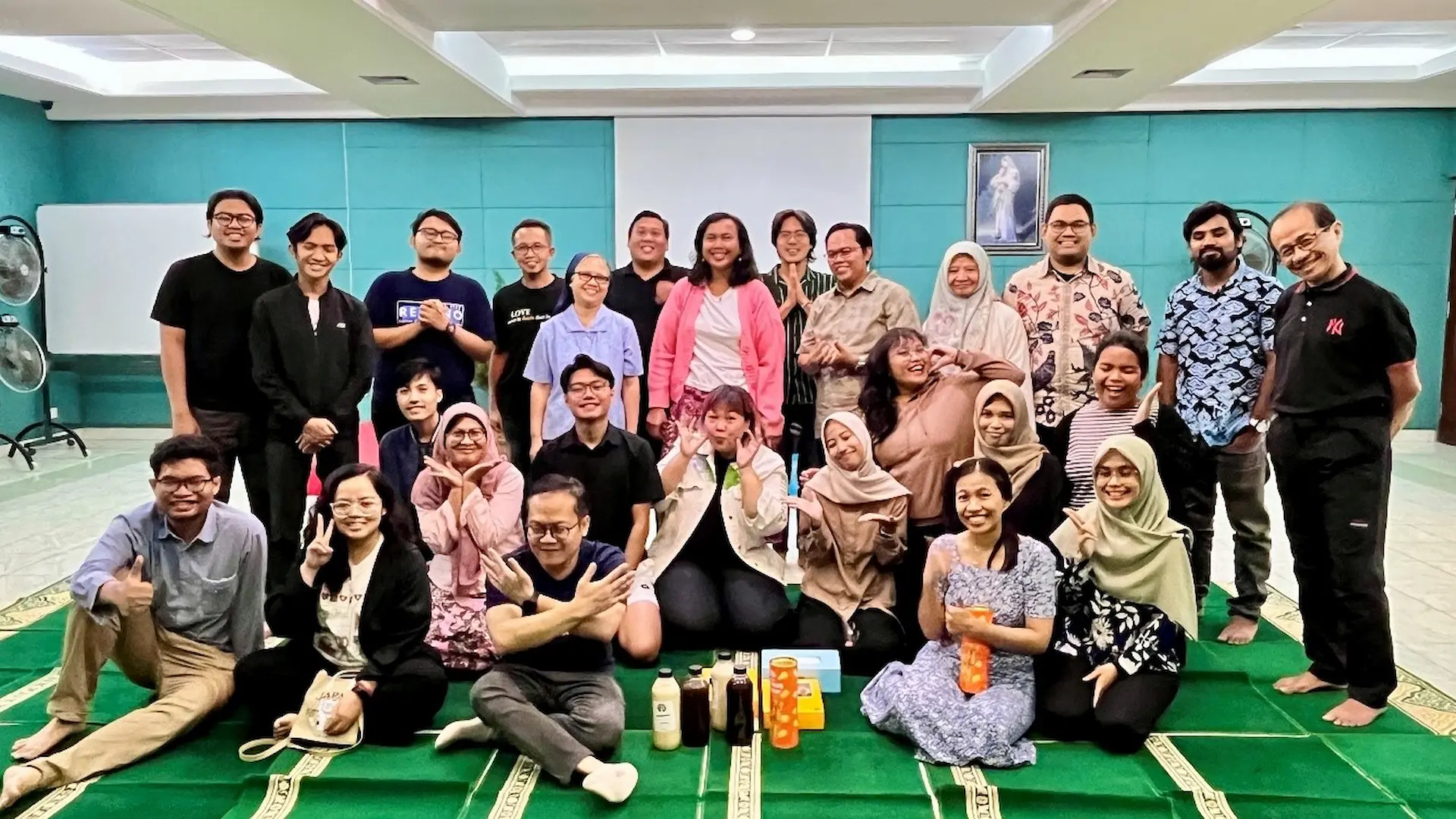
 Professionals and students from Catholic and Muslim backgrounds convened in East Jakarta to reflect on the enduring influence of Indonesia’s former President Abdurrahman Wahid, more popularly known as Gus Dur, in building bridges across religious boundaries.
Titled “Interfaith Conversations: The ‘Magis’ Legacy of Gus Dur,” the event combined theological discussions with a lived experiment in interreligious discernment in common. I participated as a lecturer in the Sociology Department at Universitas Nasional, Jakarta.
Fr Greg Soetomo SJ, coordinator of the Jesuit Conference of Asia Pacific (JCAP) Dialogue with Islam, opened the gathering by urging us not only to remember but also embody Gus Dur’s legacy of nurturing a love for Indonesia through unity in diversity and practising interfaith engagement grounded in mutual respect and intellectual exchange. “It takes courage and sincerity,” Fr Soetomo said, “to open our hearts and minds to the path of dialogue.”
Fr Soetomo, alongside Fr Alexander Koko Siswijayanto SJ of the JCAP Youth Ministry and Dr Zacky Khairul Umam of the Abdurrahman Wahid Center for Peace and Humanities, hosted the event held from 10 to 12 May at the Santa Maria Guadalupe House of Prayer.
Over three days, the 31 participants, consisting of 14 Muslims and 17 Catholics, explored the theological and methodological foundations of our faith traditions. It was a unique experience of interreligious dialogue enriched by the Ignatian practice of discernment in common carried out through spiritual conversations.
The diversity in the room enabled us to better understand each other’s philosophical and theological perspectives on Gus Dur’s vision of pluralism and religious tolerance.
Dr Umam traced Gus Dur’s journey from his formative years to his role as a revered national figure and “Guru Bangsa” (Teacher of the Nation). He described Gus Dur as a “complete human being” who embraced diversity without the confines of ethnic, religious, or racial labels. “Gus Dur taught us that honouring God can be done by honouring humanity—by humanising our fellow human beings,” he said.
Aman Aslam, a Jesuit from Pakistan studying at Driyarkara School of Philosophy in Jakarta, captured the spirit of the dialogue: “At its core, religion teaches us to respect one another and to learn from the differences that exist among us.” His poignant words sparked a series of heartfelt responses as Gus Dur’s philosophy of religious tolerance and interfaith dialogue came to life among us.
The lively exchange of ideas created an atmosphere that was not only intellectually engaging but also spiritually moving, evoking the living presence of the late president. It was as if his “spiritual and ideological children” were gathered in a sacred circle to continue his unfinished mission. We found ourselves enlightened on the inner barriers that often prevent genuine acceptance of diversity. We pledged to become humanists in the footsteps of the revered Guru Bangsa, who consistently taught that to honour humanity is to honour God, regardless of one’s identity.
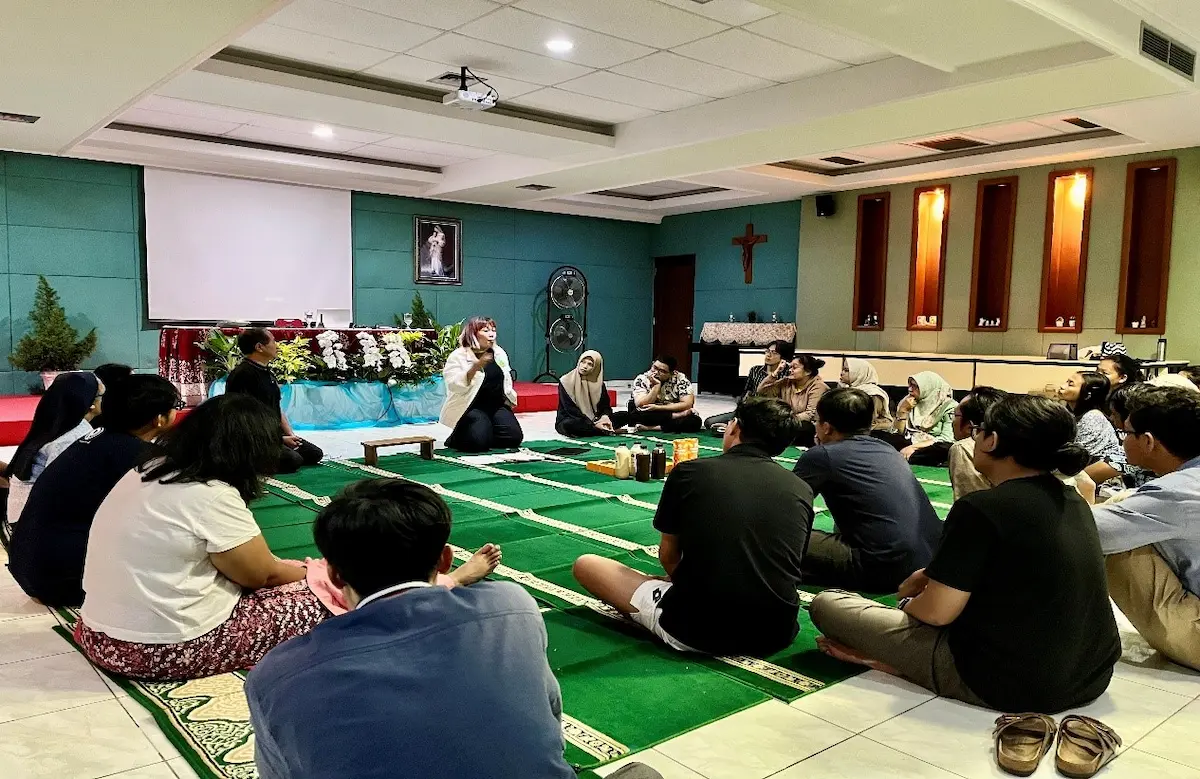
Inayah Wahid talks about her father Gus Dur
In a much-anticipated session, Inayah Wahid, the youngest daughter of Gus Dur, joined us to explore her father’s vision of religious tolerance and what it means to “humanise humanity”. We began to internalise Gus Dur’s unwavering commitment to religious freedom, his defence of marginalised groups, and his courage to challenge social and political discrimination.
Donda Hasian Tumpalina Sihite (Donda) of Magis Yogyakarta asked: “What gave Gus Dur the courage to fight for humanity?” Wahid responded that her father was raised in a family steeped in the values of compassion, social sensitivity, and tolerance. His wide-ranging social interactions, unbound by religion, ethnicity, or social class, shaped him into a deeply humanist figure.
Nur Laeliyatul Masruroh (Laeliya), a Gusdurian activist, was curious to know how Gus Dur taught his daughters to do good and uphold religious tolerance. Wahid’s response was deeply moving: “My father taught us not through words but through his actions—especially in how he stood up for minorities. Gus Dur saw himself as a parent to all Indonesians, without exception.”
We realised then that continuing Gus Dur’s work requires more than intellectual understanding but wisdom and the will to serve others without asking who they are or what reward may come in return.
Our experience reached a milestone when we visited Ciganjur to meet Hajjah Sinta Nuriyah Wahid, Gus Dur’s widow and tireless advocate of human rights and pluralism. Seated in an atmosphere of warmth and familial intimacy, we listened as she shared personal stories of Gus Dur as a “national thinker, people’s teacher, and friend of the marginalised”.
I asked Hajjah Sinta, “What gave Gus Dur the strength to keep defending the socially excluded? And why did he love this nation so much?” She replied, “Gus Dur drew his courage from his faith. He believed that religion clearly instructs its followers to side with the oppressed, no matter what religion they belong to.” It was a call for us to become peacemakers and stewards of interfaith harmony in our lives.
We ended our gathering by singing the national anthem, “Satu Nusa, Satu Bangsa” (One Archipelago, One Nation). As our voices rose in unison, it was as if we were sending a message to the spirit of Gus Dur: “Beloved Gus Dur, we will carry forward your legacy. We will keep the flame of religious tolerance alive, as an essential expression of our shared humanity.”