

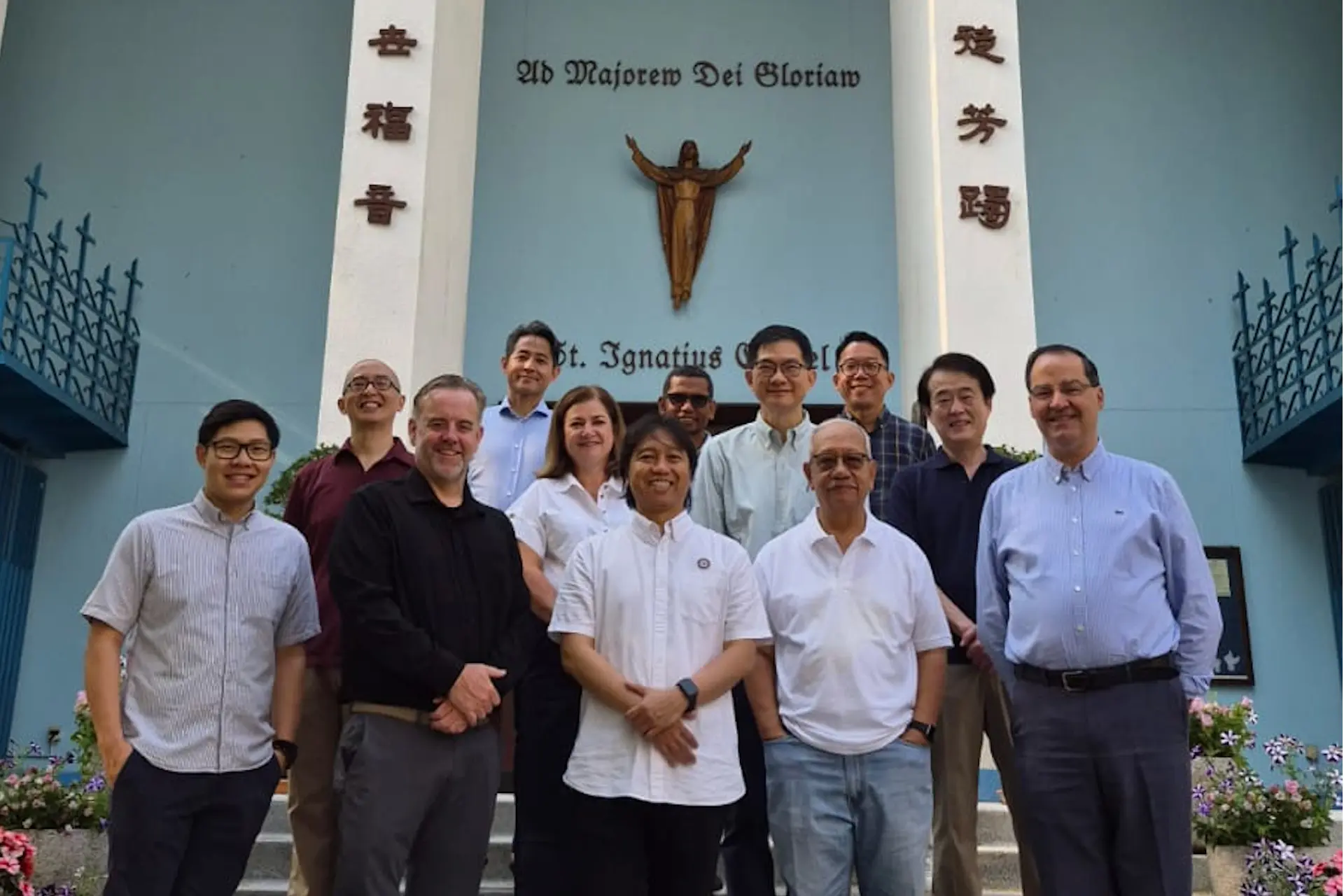
 The Education Delegates meeting at Wah Yan College, Kowloon, Hong Kong, from 8 to 11 April brought together key leaders in Jesuit education across our Jesuit Conference of Asia Pacific (JCAP) for dialogue, collaboration, and strategic planning to advance Jesuit education across diverse contexts. The participants included Father General’s Secretary for Secondary and Pre-Secondary Education Fr Jimmy Bartolo SJ; his JCAP counterpart Fr Bambang Winandoko SJ; and delegates from Indonesia, Japan, Cambodia, the Philippines, Malaysia-Singapore, Timor-Leste, Micronesia, the Chinese Province, and Australia. Online participation from Fr Riyo Mursanto SJ of the Pakistan Mission and David Smith of Educate Magis further enriched the discussions.
Fr Bartolo SJ opened with an update on preparations for the JGNS II Congress: JESEDU Montréal 2027. This congress will conclude the second cycle of the Jesuit Global Network of Schools, building on milestones, including the 2012 Boston Colloquium, the 2014 Sipei Seminar, the 2017 JESEDU Congress in Rio de Janeiro, the 2019 Living Tradition document, the 2021 II Colloquium JESEDU-Global, and the 2024 II Seminar JESEDU-Jogja. The Montréal congress is expected to be a key moment for reflection, consolidation, and future planning, with all delegates encouraged to attend.
He also introduced the Task Force on Artificial Intelligence in Jesuit Education, an initiative designed to promote global collaboration with networks such as Educate Magis, Fe y Alegría, and the Jesuit Refugee Service (JRS). Over a 12-month period, the task force will conduct research, facilitate dialogue, and provide evidence-based insights, guided by Ignatian values such as cura personalis, discernment, and contemplation in action.
The Pakistan Mission’s situation was another major topic. Fr Riyo outlined the education ministry’s difficult realities, which deeply moved the delegates and inspired in them a shared commitment to provide concrete support. For instance, the Indonesian Province will assist in training scholastics in school management and the Philippine Province will help with organisational structures and resource sharing. JCAP also expressed its intention to continue dialogue with the Pakistan team to better understand their needs and identify appropriate areas of support. These discussions reflected a strong spirit of solidarity and collaboration across the region.
The Collaboration Committee raised concerns about Pakistan Mission’s leadership formation and recommended a focused meeting between Pakistan and JCAP. Key areas include governance, mental wellbeing, inclusivity, gender identity, staff management, strategic planning, teaching and learning, child safety, leadership roles, financial management, and fundraising. Given the breadth of these needs, the Committee urged prioritising one or two areas to ensure effective and sustainable implementation.
The Formation Committee shared results from its Survey of Needs, revealing the diverse contexts of JCAP schools, including differences in faith, language, culture, legal systems, political environments, and socioeconomic conditions. The findings emphasised clearer distinctions between Ignatian or Jesuit formation and professional formation, as well as better-defined formation initiatives at the JCAP, provincial, and school levels. Proposed actions include thematic formation programmes, post-workshop follow-ups to sustain learning outcomes, and regular coordination among delegates, provincials, and school principals. A formation workshop is planned for the end of October 2026 to advance these priorities.
In his concluding remarks, Fr Bartolo expressed gratitude for the opportunity to engage with the JCAP region and appreciated both the formal discussions and informal exchanges. He emphasised that apostolic effectiveness depends not only on careful planning but also on the energy and commitment to implementation through small and consistent steps, regular evaluation, and ongoing monitoring by Fr Winandoko. He also highlighted the importance of strong communication between provincials and delegates, noting that delegates’ feedback is essential for informed leadership. Finally, he referred to the Living Tradition document, which outlines 10 global identifiers and provides practical tools for evaluating and guiding Jesuit schools.


