

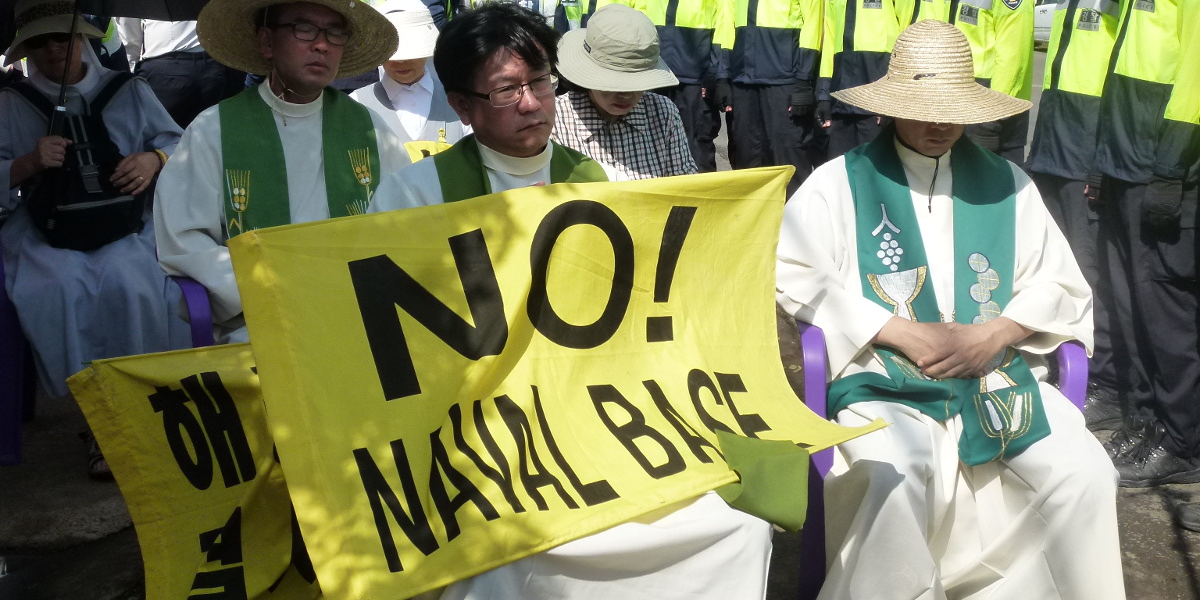
Resistance to the construction of a naval base at Gangjeong on Jeju Island, South Korea continues although the base is already under construction. The Jeju Volcanic Island and Lava Tubes are a UNESCO World Heritage site. The most recent significant effort was the Gangjeong Peace Conference and Peace Festival organized by the Jesuit Research Centre for Advocacy and Solidarity (JAS) at the Seoguipo Catholic Parish and Gangjeong Village. Fr Francis Mun-su Park SJ, director of JAS, said the conference was organized to reignite the peace action to resist the construction of the naval base, which had been “flagging” more than a year after protests began in 2012. JAS planned the conference in cooperation with the Jeju Catholic Diocese and Gangjeong peace activists, hoping that it would help gain renewed media attention for the cause.
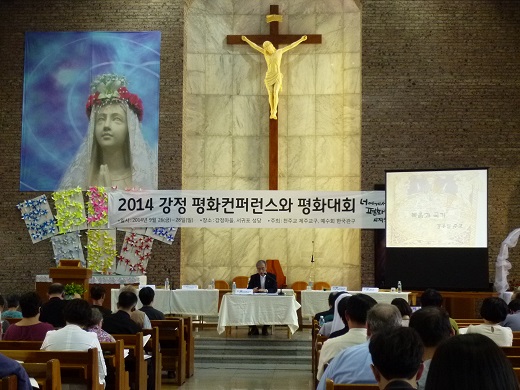 The conference, themed “Demilitarization and Peace in [Northeast] Asia – Theological and Social Analysis”, had three presenters: Bishop Peter Kang of the Jeju Diocese; Michele Naar-Obed, a faith-based peace activist; and Bishop Tani Daiji, a retired bishop committed to the demilitarization of Okinawa. Bishop Kang discussed how “people should realize that human rights are above the state, thus the citizens are above the state and the state rather exists to protect the human rights of the people.” Naar-Obed talked about her experiences in “prophetic faith-based action” and in her work with the Christian Peacemaking Team in Iraq, while Bishop Daiichi discussed how US military bases in Okinawa affect the locals and, with the possibility of new bases, affect the environment – a situation similar to what Jeju Island is facing today. From the speakers’ insights, Oh Hye-ran, a member of the solidarity for Peace and Reunification of Korea and one of the conference’s discussants explained the need for a common security agreement among the nations of Northeast Asia in order to solve the problem of [North] Korea’s nuclear weapon and the problem of the [United States] expanding its military to contain China.
Small group discussions were also held with approximately 30 peace activists and professionals. Their conversations led to recommendations for more efforts to educate Catholics about Catholic social teaching, peace, and the demilitarization of Jeju Island. The groups asked for more dialogue among Koreans on Jeju Island and for more efforts to bring the island’s issues toward media attention. The groups also recommended forming a network for collaboration and peace education among disarmament researchers, peace educators, professionals in security and diplomacy, and people in the peace movement.
The peace festival that took place throughout the conference had prayer walks, a music festival and art displays. The highlight was an opening mass at the gate to the construction site of the contested naval base in Gangjeong Village.
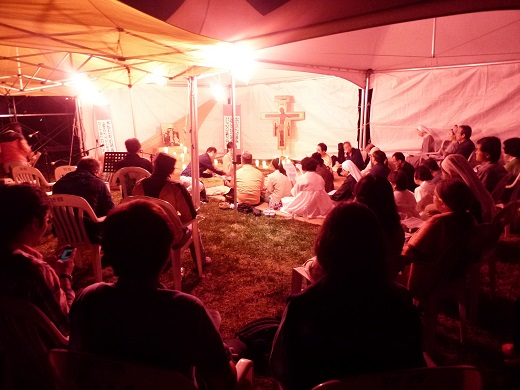 The three-day event held from September 26 to 28, 2014 saw 150 people attending the conference presentations, and about 500 people participating in the peace festival. It also gained some media coverage.
However, the organisers had hoped for a larger turnout and a greater result.
“It had been hoped that many more Catholics from Jeju parishes would attend the peace festival, but most of the Jeju Catholic Church participants came from only two parishes. From the 11 parishes that were represented mainly priest[s] and sisters attended”, said Fr Park. He also noted only a small number of Gangjeong residents, other than the peace activists who reside there, took part in the peace festival.
There is still more work to be done to keep the initiative going. “Participants were satisfied with the main speakers, the discussants, and the small group discussions, but we had hoped for more participation by Jeju Diocese Catholics”, said Fr Park.
He said that a second conference, which the small discussion groups had recommended having, must also get more media attention and more people interested in joining the peace festival.
Civic groups and Jeju Island villagers have been asking if the base is necessary and if its construction will harm the island and its environment since government announced its decision to construct the naval base in 2007. Groups are also concerned that building the base will increase tensions in Northeast Asia, especially after the South Korean ruling party decided to increase national security against North Korea.
The Jesuits in Korea have been working with civil groups and villagers to protest the naval base for some years. There is a small Jesuit community in Gangjeong Village that the three Jesuits in residence have named the ’Didimdol’ (‘Stepping Stone’) community. The Korea Province is in the process of building a residence so that they can move from the rented house they have been living in. It is expected to be completed by June.
At the peak of the protests in March 2012, four Jesuits on Jeju Island were arrested after they broke through barriers, went out on Gureombi rock and bodily hindered demolitions on Friday, March 9. This led to the serving of arrest warrants for Fr Joseph Chong-uk Kim SJ and Protestant Reverend Lee Jeong-hun on March 11. Another Jesuit, Fr John Young-chan Lee SJ, spent Christmas in jail after being arrested and denied bail that October. It was at this time that the Korean Province promised to support the Jesuits on Jeju Island by increasing awareness of the issues the island faces until today.


