

 With the cooperation and support of a considerable circle of lay experts as well as the advice of Jesuit educators in Asia Pacific, the Jesuits in Thailand are embarking on an ambitious education project to serve the poor, especially the indigenous communities in the northern mountains of the country. An assistant professor at Mae Fah Luang University in Chiang Rai has been hired to conduct a feasibility study that will help the Jesuits work out many of the details of the proposed college. It should be completed in August.
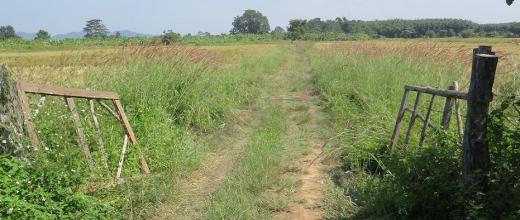
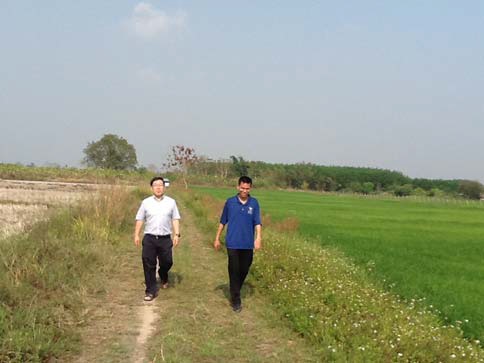
Meanwhile an 8.3-hectare (21-acre) piece of land has been acquired in Chiang Saen district of Chiang Rai, one of the four poorest provinces in Thailand, according to the 2014 UNDP Human Development Report. It is approximately 20 kilometres from the Golden Triangle, where Thailand meets Myanmar and Laos, and borders Bokeo, one of the poorest provinces of Laos.
Many of the students will come from the mountainous areas of Chiang Rai and neighbouring provinces, and most of the education project’s neighbours will be lowland rice farmers of northern Thai (Lanna) and Buddhist.
For the first two years, the Thai Jesuit education project will take the form of an informal private school that will offer a two-year diploma programme. It will serve as a residential learning centre and will not grant its own degrees. Instead, students will enrol at Sukhothai Thammathirat Open University for their bachelor’s degrees. After two years, the project will seek permission to extend the programme to become a four-year bachelor’s degree in liberal arts.
The Jesuits in Thailand see an opportunity to make the first Jesuit college in the country “green”. The institution will be designed as a boarding college with an emphasis on holistic formation in residential life. Liberal arts will be taught together with life skills. To be true to the Jesuit charism, the programme will include environmental concern both in the classroom and in personal life.
 As work commences on the curriculum and architecture, these questions are being asked: How can the school form young men and women to care for people as well as the rest of creation? How can it make a contribution to the communities where the students study and, later, to the students’ own people as well? How can a balance between academic and technical education be achieved? How can the Jesuits in Thailand make this education project inculturated, simple, efficient and sustainable rather than only cheaper to build and grandiose to look at?
The informal private school will have a two-year vocational orientation curriculum with interrelated courses. In addition to classroom work each day, students will have four hours of personal time in the afternoons for practical courses such as cooking and planting vegetables.
Once the initial curriculum design is complete, the curriculum team will design a teacher profile and a professional development plan. This will be followed by the recruitment of teachers who will undergo teacher training before they begin to develop lesson plans.
The project’s governing board anticipates that the school will open for its first intake in 2017 or 2018, at the latest. It will admit approximately 30 students annually for the first four years. [Ecojesuit, Jesuit Currents]


