

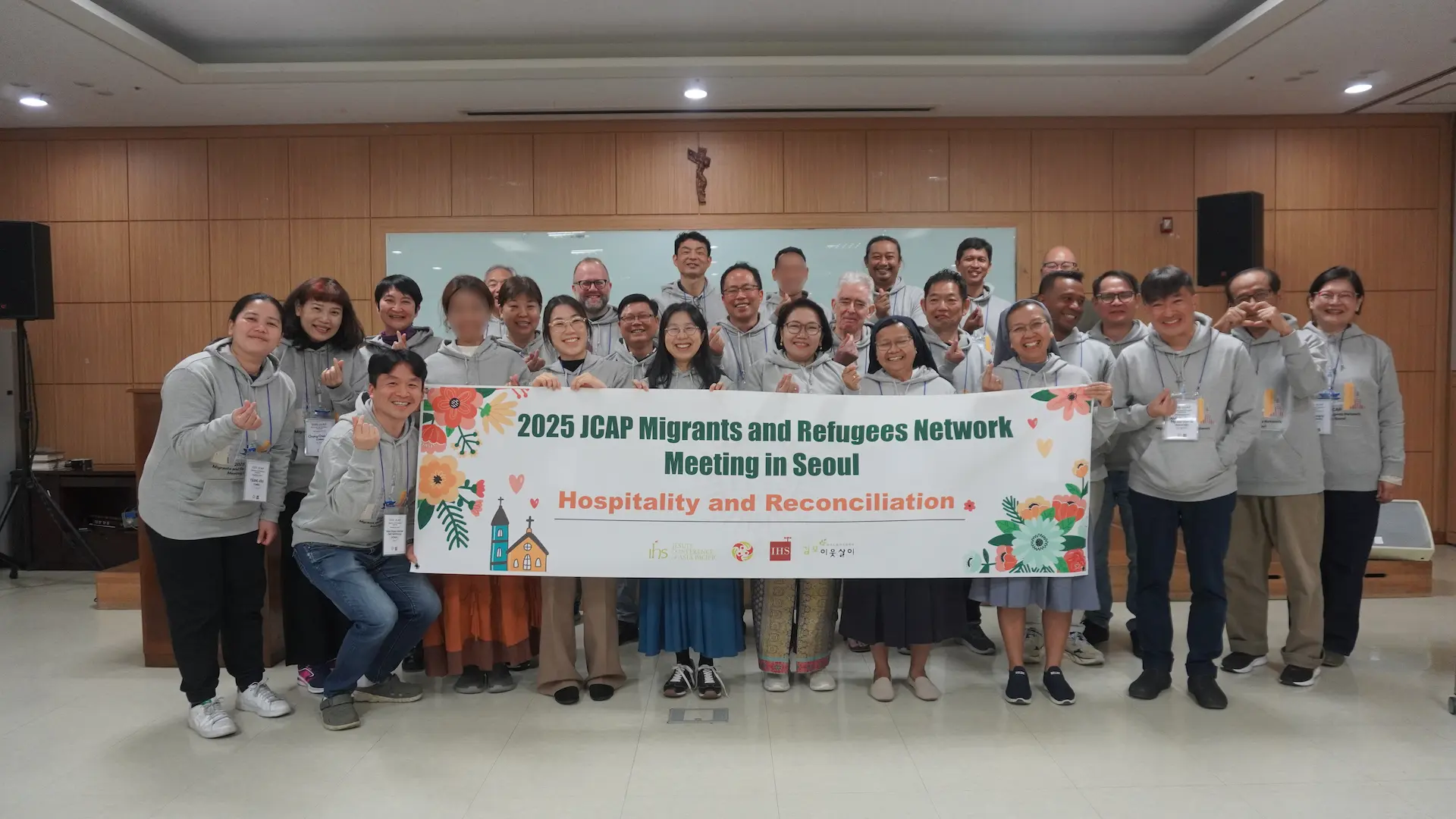
 The conference’s Migrants and Refugees Network (MRN) is made up of a diverse group of individuals, originating from various countries, with different backgrounds and working in various contexts, yet coming together in solidarity and commitment towards “promoting a culture of hospitality and reconciliation” in Asia Pacific. Priests, lawyers, social workers, volunteers—whether from Catholic orders, civil society, NGOs, or faith-based organisations—this dynamic network works together to answer the call to build a better future with migrants and refugees.
Recently, the network met in Seoul, South Korea, where they experienced firsthand the valuable work done by the Korean Province in the area of social justice. As Fr Kim Min SJ, chairperson of the province’s social apostolate committee, explained, social justice in their country reflects the uniqueness of Korean history. The expansion of the Korean Catholic church, which after the Korean War until the 1980s was a church for the poor, evolved alongside the growth of the country’s economic power. Today, a strong donor base has enabled the Jesuits in Korea to establish and run centres which provide social services, especially for migrant workers and refugees, and keep alive and well their advocacy work.
A highlight of the four-day meeting was a visit to Yiutsari Migrant Workers Center, which serves not only as a community centre for migrant workers and their families but also as a shelter for those in difficult situations. Fr Kim Juchan SJ organised a day for the participants to visit Shelter No 2, occupied by Filipino, Myanmarese, and Nepalese migrant workers, who warmly welcomed the participants into their home.
Only five minutes away was the main centre, where Fr Kim explained the work in more detail. “Migrant workers are like seasonal birds; they come and go, and they are the most vulnerable,” he said. “We want to lower the barriers for them,” shared Fr Kim. Aside from providing shelter and food, they also give language classes, labour law counselling, health care support, community support, and cultural activities for all those who come to the centre.
The participants also met with refugees from Myanmar and Afghanistan who have resettled in South Korea. With openness and generosity, these men and women shared their stories of survival and their desire to live freely and peacefully in a society that allows them to exist with equal rights and dignity—not just for themselves but especially for their children.
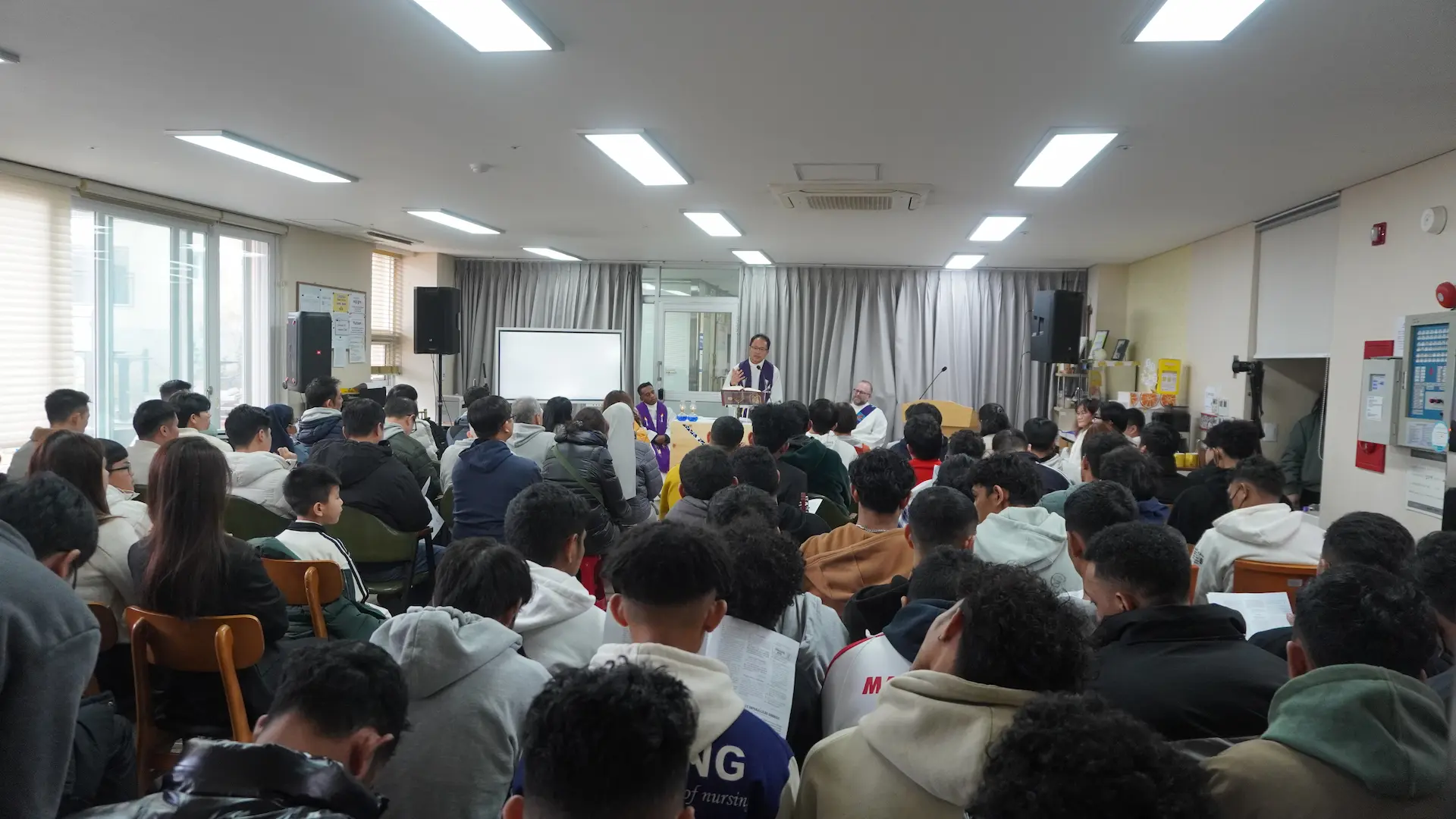 On the last Sunday of March, Fr Kim Juchan presided over the Mass along with concelebrants Fr Julio Sousa SJ from Timor-Leste and Deacon Shane Liesegang SJ, an American Jesuit studying in the Philippines and living in Arrupe International Residence. The first floor of the centre was packed with a truly international congregation, and while English was primarily used, singing in mother tongues, whether Filipino, Khmer, Vietnamese, or Tetum, lent a feeling of familiarity for the congregation. For once, language was not a barrier—not with music, much laughter, and food to bridge any gaps.
The meeting also featured several speakers whose personal experience and technical expertise brought not only insight and understanding but also a deeper compassion and stronger connection for the participants.
Pastor Kim Jongho, a Methodist pastor and chairman of the Northeast Asia Reconciliation Initiative, a Christian forum for reconciliation, shared his personal experience of hospitality. Typically understood as an acceptance of guests or visitors with food, drink, and accommodation, Pastor Kim defines hospitality further as “an act of giving oneself, crossing boundaries, and opening one’s heart”. Hospitality, according to Pastor Kim, carries risk because it invites the pain of others to enter into one’s life. Pain connects all of us and opens us up to the experience of another, creating solidarity instead of division. In a world marked by increasing movement and division, it is all the more essential to make a culture of hospitality part of our lives. “Hospitality is contagious,” said Pastor Kim, encouraging its practice.
Dr Hwang Pillkyu, Executive Director of the GongGam Human Rights Law Foundation, addressed the complex issues faced by migrants and refugees in Korea, especially on human rights amidst prevailing negative perceptions of migrants and refugees in Korean society. Son Keon-ung, a graduate student and a representative of the Eunpyeong Foreign Residents Center, spoke about his research work on migrant workers in Korea, where five percent of the total population is made up of foreign nationals. In Mr Son’s experience, migrant workers have the proactive energy to survive and flourish despite the many challenges they face in a society that is far from becoming multicultural.
From within the network, Gading Gumilang Putra’s presentation on Dignitas Infinita, the Vatican’s recent declaration on human dignity, framed with a rights-based approach, gave a clear and edifying reflection on the work with migrants and refugees. Among other issues discussed was an update from Fr Joe Hamspon SJ, regional director of Jesuit Refugee Service Asia Pacific (JRS AP) and Kunanyaporn Jirasamatakij, who handles communication and advocacy for JRS AP, on the deeply felt effect of funding cuts and its implications for the work of JRS that includes education, livelihood, health and psychosocial care, and emergency assistance. Looking at the institutional and human costs of these challenges is truly sobering.
Despite all the issues faced by those who work with migrants and refugees, there is an energy of hope shared by all who are part of MRN. This could be felt in the moments shared between people—in the willingness to translate into a language more easily understood, in the sound of voices singing together, in the sharing of food, in the experience of the Korean value of jeong, described as an affinity between people, a feeling of attachment or connection, a shared closeness nurtured by chicken and beer, friendship and community, a willingness to transform into a body of reconcilers in an ever-fractured world.


