

 In a land where freedom rapidly loses its spirit, the youth of Myanmar find themselves fenced in—not by mountains or rivers, but by fear and walls of control. The doors of opportunities are no longer open to them. The US has shuttered its visa doors, and the Myanmar regime has sealed our borders, not out of love for the land but for fear of losing its grip. Young hearts, full of dreams and fear, flock to Yangon International Airport in an attempt to escape, only to be sent back home by arbitrary law. Yet even in such times, when flights are denied and silence is demanded, seeds of growth are still sown.
At Campion, we believe that hope is still possible, that the shaping of minds and the kindling of spirits must not cease—especially when the world closes in. We began by turning inward and renewing our own. Teachers and staff, the backbone of our mission, completed a course on accompanying students with a psycho-spiritual approach—an invitation to be gentle companions in a violent world. In moments of burnout and burden, we found space for recreation and recollection, places to breathe, to remember, and to begin again.
Proudly, we supported teacher David on his journey through an international TESOL certification in Yangon. Lucia explored her gift in design, and Thomas trained in electrical wiring and control systems—small steps with long shadows. Through the Leadership Diploma Program at Myanmar Leadership Institute, some of our teachers stepped further into their call to serve not just with knowledge, but with heart.
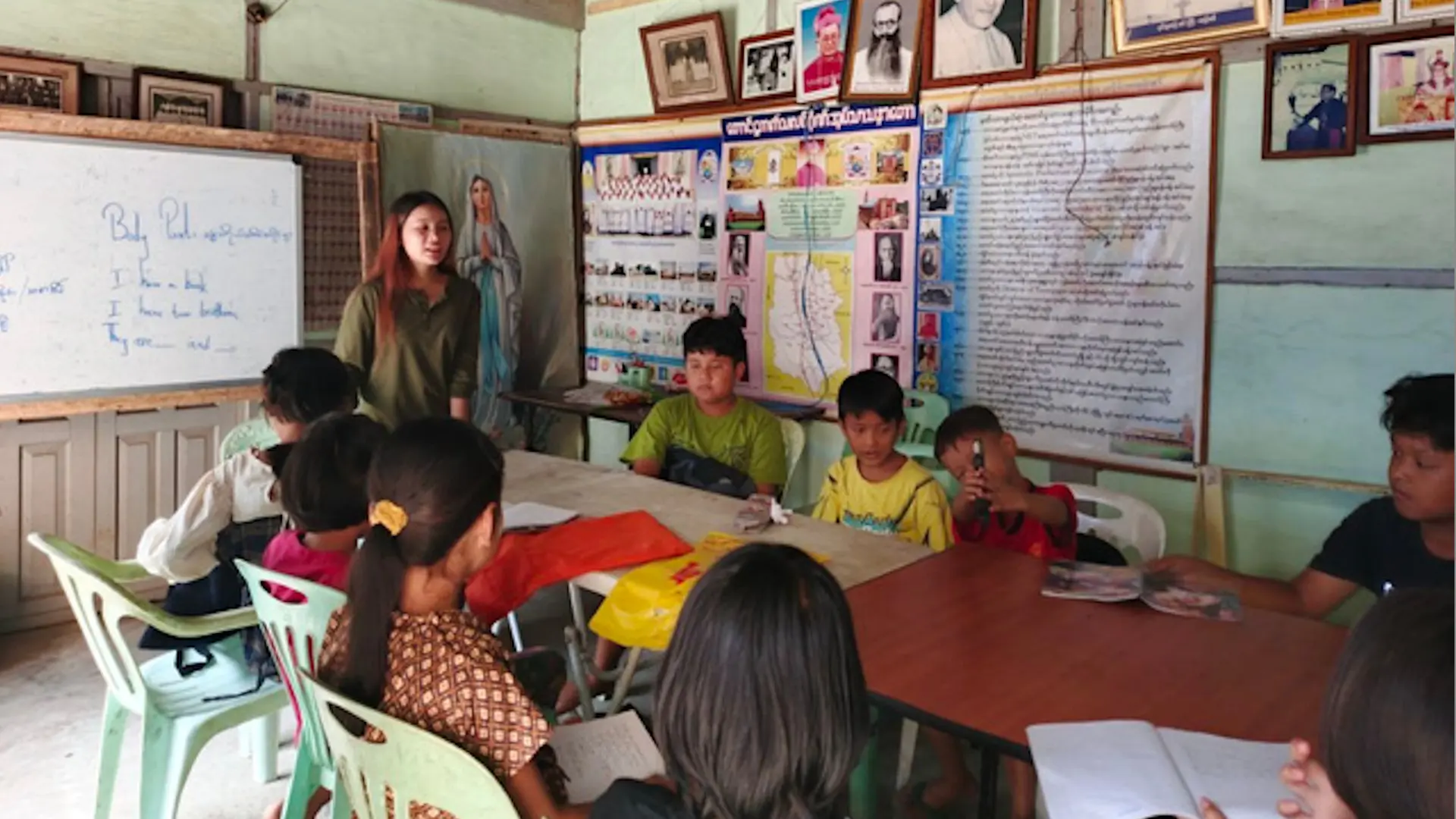
We reached beyond ourselves too. Two of our teachers offered a special English course and teacher training at a Catholic-run school in the Yangon region—planting skills and spirit among youth in the wider community. Our senior students, carrying the light of Campion, walked into rural spaces where English is rare and opportunity even rarer. In three regions, they taught not just language and life skills but the sacred lesson of presence. In that summer outreach, four future teachers were formed, and nearly 100 children were touched by their care.
 Then came the earthquake. The earth itself cried out in March. Houses crumbled, lives were shattered. And we, who had planned courses and curriculum reviews, paused. This time, not for professional growth, but in compassion. We turned our energies outward, not to build our own programmes but to stand with those who had lost everything—including one of our own.
As a community, we gathered with Teacher Rita’s family, held one another in silence and sorrow, and let her music echo through our prayers. In response to the earthquake, our students rose—class leaders and volunteers from every level—and together, we raised $5,000 USD (16,000,000 MMK). With this, we brought not just material aid—cash, rice, clothing, utensils—to 60 families and 200 individuals, but also a message: “You are not forgotten. We are one body.” Through this, we realised this summer was not for sharpening skills but for enriching hearts. In the ruins, we grew roots of solidarity. In our grief, we discovered the strength of community. Still, we carry burdens. Electricity remains unreliable; our generators run long into the night—each hour burning through our already strained budget. And though our hearts yearn to reach out further—to the poorest, the wounded, the forgotten—the regime’s gaze is unrelenting.
Our every movement is watched; every effort is regarded with suspicion. We are confined now to the small circle of Campion school and the church compound. But even a circle can be a sanctuary. And in that sanctuary, we persist. From 282 students in January to 356 in July, we continue to form, to teach, to love. Eleven students are now being trained as future English teachers and perhaps as future lights in dark places. In a country where the youth are caged, where aid is politicised, and where even mourning can be dangerous, we cling to the small graces: the joy of learning, the power of community, the dignity of service, and the sacred memory of a teacher’s song. Hope is not gone. It is simply quieter now. But still it sings.


