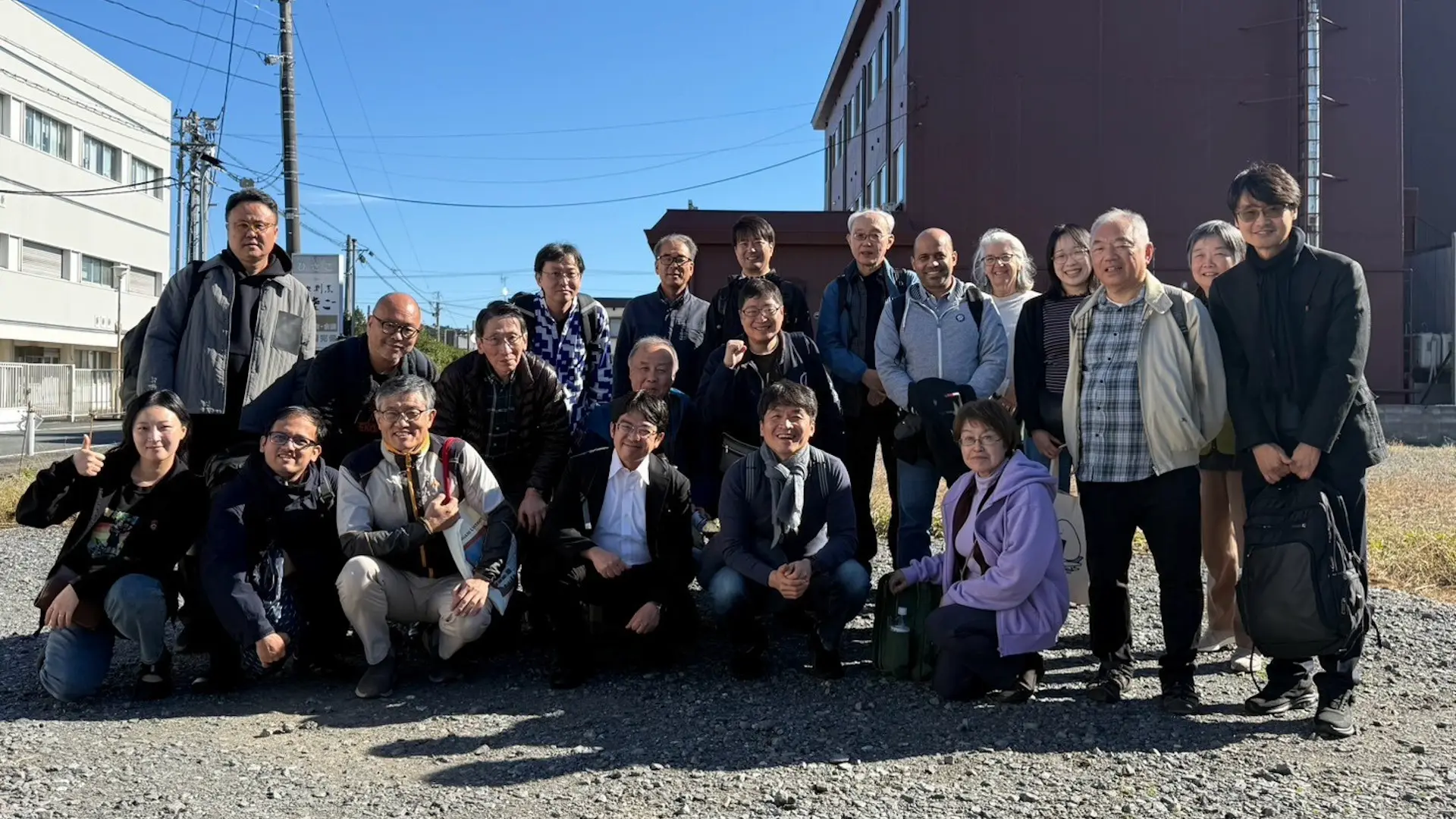
Members of the Japan-Korea Social Apostolate
At the beginning of November, members of the Jesuit Social Apostolate from Japan and South Korea visited Fukushima. Nuclear power plants are a common challenge for both Japan and South Korea.
Let me begin with my own story, which led me to Fukushima.
About a year ago, when I returned to my mother’s home, our conversation turned to her father, my grandfather. I knew he had passed away when my mother was still in elementary school, but I didn’t know the details of his life. My grandfather was a talented architectural engineer, and during World War II, his skills caught the eye of the Ministry of Home Affairs, which assigned him to the urban planning team.
My mother told me that, immediately after the US Military dropped the atomic bomb on Hiroshima on 8 August 1945, bringing the war to a fatal, the urban planning team entered the city. They walked every corner of the scorched wasteland to conduct a survey. Five years later, on 20 August 1959, he suffered consecutive episodes of heart failure and passed away.
“Your grandmother used to say there was no doubt the atomic bomb was the cause,” my mother said.
Hearing that story sent a shiver down my spine. It touched upon the mission I have been involved in at the Social Apostolate Center in Shimonoseki, a city in western Japan within the Diocese of Hiroshima. I have been actively supporting the diocese’s mission to abolish nuclear weapons. Bishop Alexis Mitsuru Shirahamathe of Hiroshima is passionately dedicated to that mission. I sense a grand plan connecting my grandfather’s history to my work in the Diocese of Hiroshima, and I feel that my grandfather has been watching over my work all along.
That was precisely why the Japan-Korea Social Apostolate Conference—which addresses the issue of the Fukushima nuclear power plant, a matter deeply intertwined with Hiroshima and Nagasaki—held such profound significance for me.
The Japan-Korea Social Apostolate gathering began in 2015 with a joint action opposing the construction of a naval base on Jeju Island. Since then, we have held these conferences annually in different locations, addressing common issues facing both countries, such military bases, poverty, and xenophobia. As colleagues who have deepened our bonds in this way, these annual reunions are also times of joy.
This year, we invited Julie Edwards from Australia, Secretary of the Jesuit Conference of Asia Pacific (JCAP) Social Apostolate. We had a clear purpose: we hoped that JCAP would become involved in the issue of nuclear power plants or, at the very least, raise awareness about it. The Japan-Korea Social Apostolate has transcended national borders, healing the wounds of history by deepening the bonds of solidarity between our communities. With Julie joining us, we hoped to encourage our JCAP colleagues to stand with us in solidarity on the issue of nuclear power.
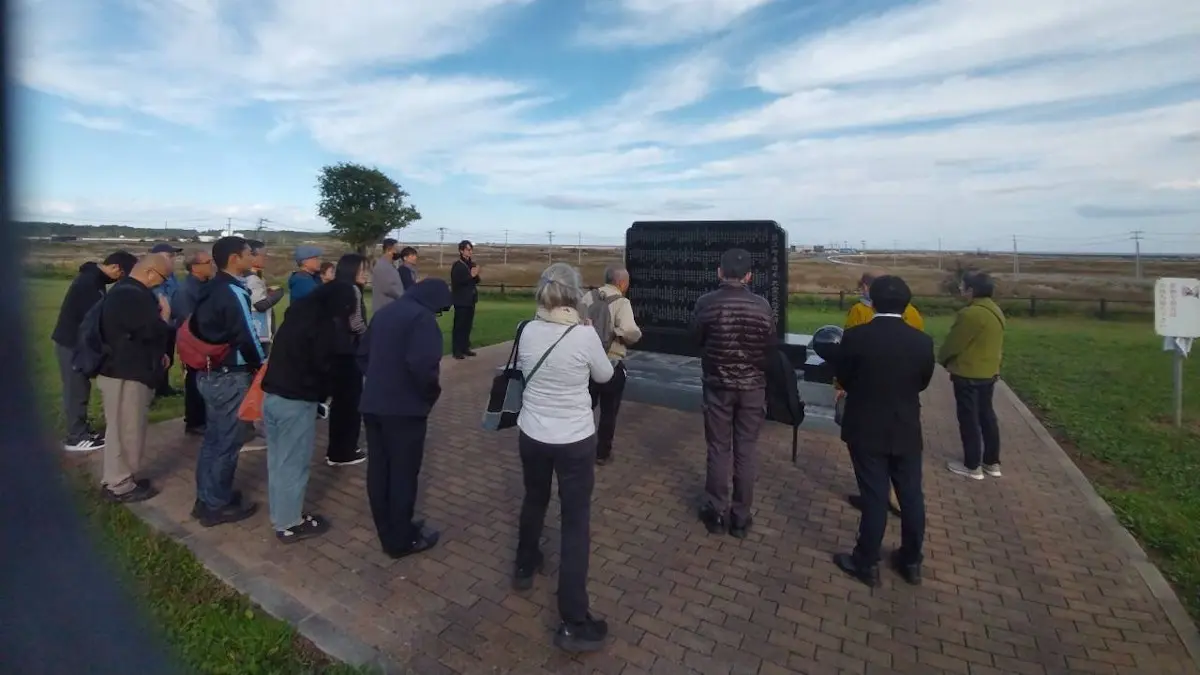
Participants at the monument for the victims of the earthquake and tsunami in Fukushima
Nuclear power is often considered a form of clean energy, and even in discussions about environmental initiatives, the issue of nuclear power is often overlooked. However, for us members of the Jesuit Social Apostolate in Japan and South Korea, it is one of the most critical issues we face.
For this session, we asked participants to read in advance “Abolition of Nuclear Power: An Appeal from the Catholic Church in Japan,” issued by the Catholic Bishops’ Conference of Japan in response to the Great East Japan Earthquake on 11 March 2011, and the accident at the Fukushima Nuclear Power Plant caused by the tsunami. The document has been translated into English and embodies the Bishops’ Conference’s desire to share this message with the entire world. (You can download the document here)
We attended lectures by three speakers, including Fr Hyun-chul Cho SJ from South Korea, who has been engaged in the issue of nuclear power plants for a long time. Their presentations deepened our understanding of the global and socio-structural issues underlying the nuclear power problem in both Japan and South Korea.
In particular, under the pretext of meeting the power needs of data centres that support AI, Japan and South Korea have increased their reliance on nuclear power even after the Fukushima accident. This runs contrary to the global trend of reducing dependence on nuclear power. It became clear that this reliance is driven not only by collusion between corporations profiting from the nuclear industry and the government, but also by a desire for power—specifically, the desire to retain the capability to develop nuclear weapons.
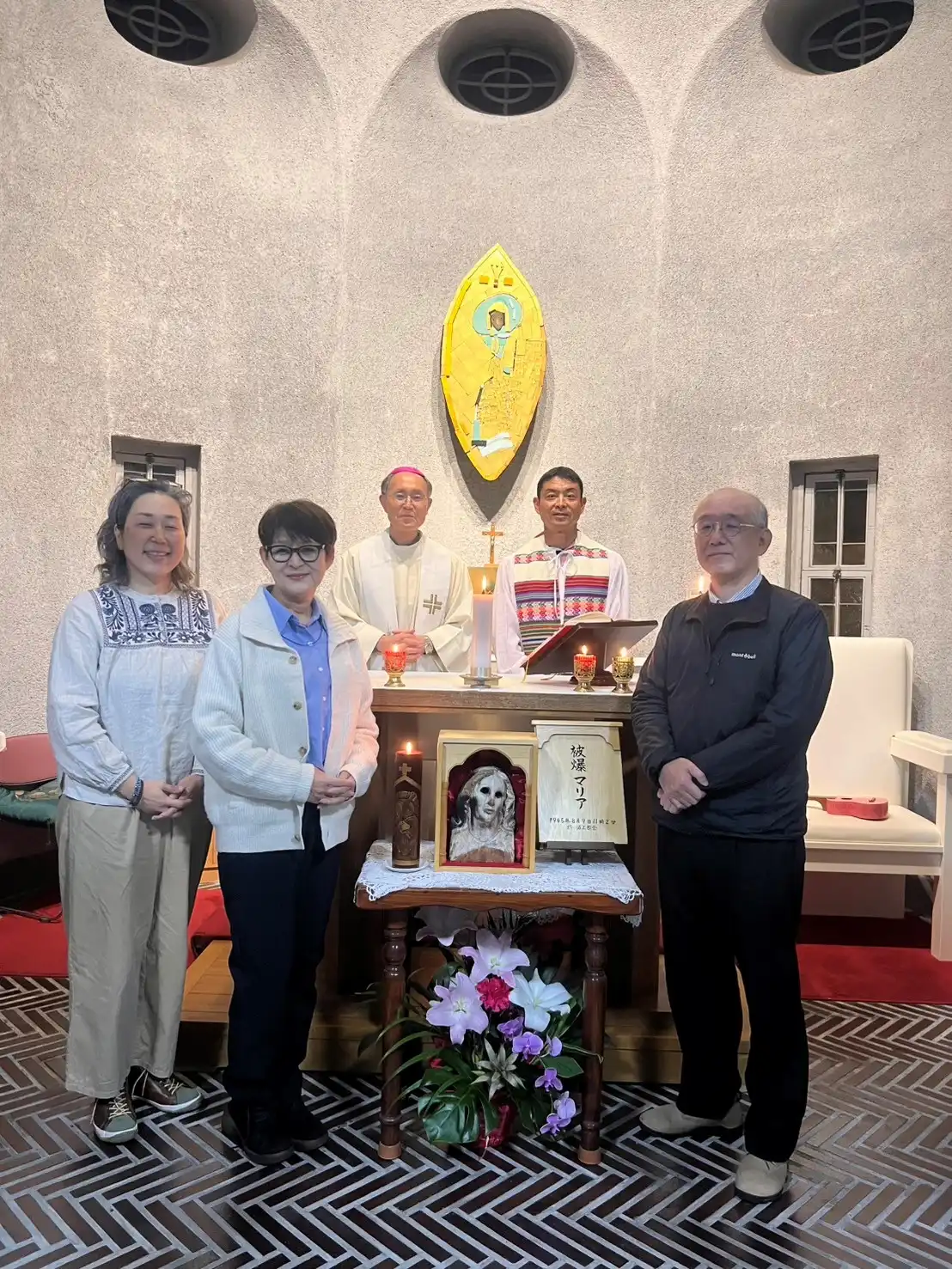
The delegates of the Hiroshima pilgrimage to the US with the head of the statue of the “atom-bombed” Mary in Nagasaki
During the fieldwork on the second day, we visited a memorial museum established by private citizens and one established by Fukushima Prefecture and an electric power company. By comparing the two, we were able to see how the government and the power company manipulate information to instill a false sense of safety about nuclear power generation.
What approach should we take in the face of these issues? Pope Leo XIV’s encyclical Magnifica Humanitas serves as a guiding light. We are faced with the question of how we can reclaim true humanity and foster a culture of nonviolence and encounter in the face of the lust for power underlying the government’s promotion of nuclear power—and the culture of violence that fuels it.
The issue of nuclear power is linked to that of nuclear weapons. Under the guise of the “peaceful use of nuclear energy,” nuclear power has been industrialised, used for military purposes, and has contaminated and harmed people and the land through radiation.
While the Catholic Church’s stance has shifted slightly, it has not issued a clear rejection of nuclear power or a definitive statement calling for its phase-out. However, as a local Church that experienced the atomic bombings and, through the Fukushima accident, experienced what may be called a third “atomic bombing,” we have a mission to speak out to the world. When we, in JCAP, work together to address ecological issues, we hope that we will also raise our voices on the issue of nuclear power.
This issue is also linked to US military strategy and politics. The Dioceses of Hiroshima and Nagasaki have deepened their partnership for peace with churches in the United States, aiming for a world without nuclear weapons. This partnership started when an archbishop from the Diocese of Santa Fe visited Hiroshima and Nagasaki.
This December, a peace pilgrimage delegation from Hiroshima and Nagasaki will visit the United States to further strengthen our solidarity. As I accompany that delegation, I hope to deepen and put into practice the mission guided and inspired by the life of my grandfather.