
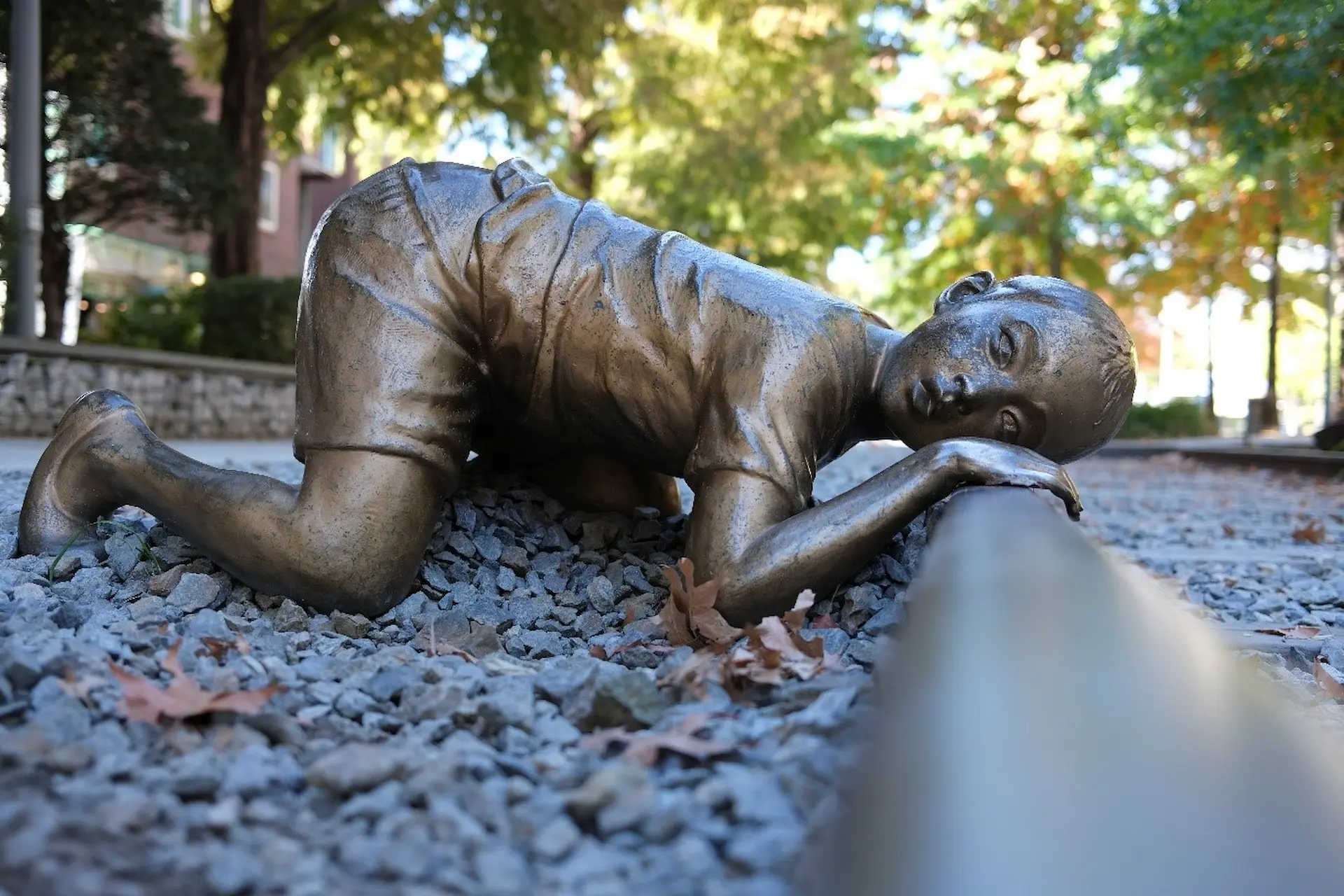
A bronze statue of a boy in Gyeongui Line Forest Park, Seoul, South Korea
Last week, safeguarding delegates from across the Jesuit Conference of Asia Pacific gathered in Seoul, Korea, for our annual meeting. Before saying anything else, I want to thank Fr Hwang Jeong-yeon Javier SJ, Provincial of the Korean Province, Fr Dong-il Andrew Kim SJ, and the Jesuits and lay colleagues of the Province for hosting us so generously. Hospitality is not a small thing in this work. A meeting like ours depends on trust, and trust grows more easily at a table where people have been made welcome. We were made very welcome.
On a walk between sessions, I came across a bronze statue of a boy in Gyeongui Line Forest Park (경의선숲길). He is kneeling in the gravel with his ear pressed to the rail.
I stopped, because I used to do exactly that as a child. Ear to the cold steel, holding my breath, waiting. You could hear a train through the rails long before you could hear it in the air and long before you could see it. First a faint hum, then a tremor, then certainty. By the time it came around the bend, you already knew.
There is something fitting about finding him there. The trains no longer run on that line. The track has been kept as a place to walk, rest, and remember, and the boy is still listening.
I thought about him for the rest of that day, and I have kept thinking about him since, because he is about as good a picture of safeguarding as I have found.
Listening early
Harm rarely arrives without warning. The signals are usually there well before anything is visible: a change in a child’s behaviour, a boundary that keeps being nudged, a concern raised sideways rather than directly, a silence where you would expect noise. Safeguarding is the work of putting your ear to the line early. It asks us to stay still long enough to notice and to take the faint vibration seriously rather than waiting for the headlight.
This is not a new idea for Jesuits. Ignatian spirituality has always placed great weight on attentiveness: to the movements of the heart, to what is happening beneath the surface, to the small signs that are easy to dismiss. The daily Examen is, in its own way, a practice of listening to the rail. It trains us to notice what we might otherwise pass over and to ask what it is telling us. Safeguarding asks for the same discipline, turned outward towards the children and adults at risk in our schools, parishes, universities and ministries.
The track sounds different in different places
Working across cultures adds another layer. The track sounds different in different places. How people raise a concern, whom they feel able to tell, what respect for authority looks like, what a family or community will and won’t say out loud, what silence actually means: none of it is the same everywhere. A signal that would be obvious in one setting can be almost inaudible in another. And a framework built in one country, however good, can end up listening for the wrong sounds in the next.
This is one of the great strengths of the delegates’ network across Asia Pacific. Each delegate knows how the track carries sound in their own Province or Region. They know the languages, the customs, the unspoken rules, and the places where concerns tend to go quiet. When we meet, we are not simply comparing policies. We are learning from one another how listening works in different contexts and where each of us might be missing something.
That kind of exchange is only possible face-to-face. It happens in the formal sessions but just as often over a meal, on a walk, or in a conversation that runs on after the agenda has finished. I am grateful to every delegate who travelled to Seoul and gave their time, experience and honesty to the meeting, and to the Provinces and Regions that released them to come.
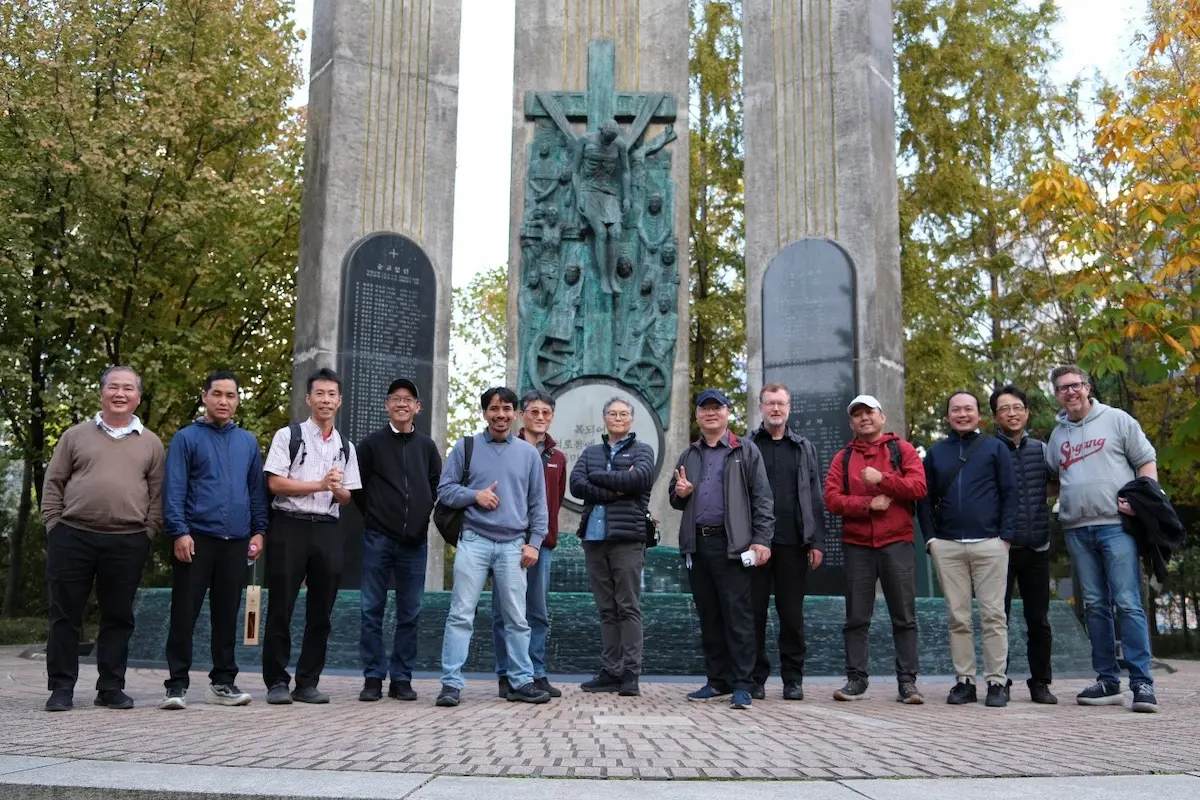
JCAP Safeguarding delegates in Seoul
Humility first
If there is a first principle of cross-cultural safeguarding, it is humility. Arrive as a listener, without judgment or preconceived ideas. Learn how this track carries sound before deciding what you are hearing. Ask the people who have lived beside it their whole lives.
None of this softens the core commitments. The principles hold everywhere: children and adults at risk deserve to be safe, to be believed and to be protected. Those commitments are not negotiable, and they do not change from one border to the next. But the listening has to be local. A safeguarding culture that does not understand its own context will hear only what it expects to hear.
Humility also applies to those of us who carry responsibility within the Society. It means accepting that we will not always recognise the signal the first time, that people who raise concerns often take real risks in doing so, and that our task is to make it easier, not harder, for them to speak. It means treating every faint vibration as worth our attention.
Still listening
The boy in the statue is doing something we would now quickly tell a child not to do. But the instinct behind it is still right. Get close. Be patient. Pay attention. Trust what the quiet signals are telling you.
The meeting in Seoul reminded me that across the Jesuit Conference of Asia Pacific there are many people doing exactly that, often quietly and without recognition: kneeling by the line in their own places, listening carefully, and taking seriously what they hear. Thank you to each of them, and thank you again to the Korean Province for bringing us together.