

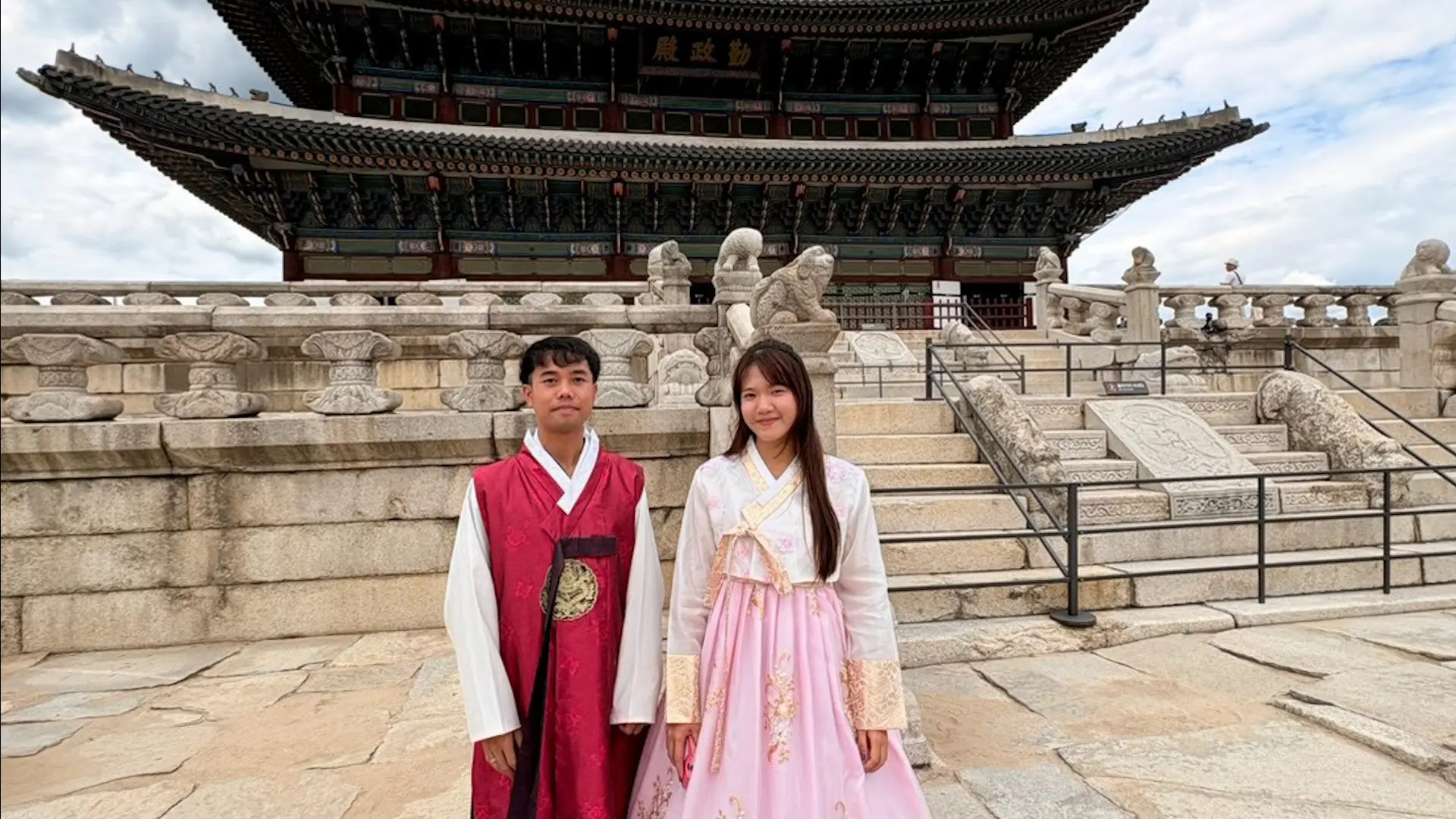
Phonephasit Xayyasen and Arisara Teangvised at Gyeongbokgung Palace
The Association of Jesuit Colleges and Universities – Asia Pacific (AJCU-AP) held the 16th Global Leadership Program at Sogang University in Seoul, South Korea, from 9 to 15 August. This year’s theme was “Global Citizenship and Higher Education.”
GLP aims to provide opportunities for students from Jesuit universities to discuss global issues and prepare them to become leaders with global insight. This week-long programme includes lectures, presentations, fieldwork, and cultural performances oriented towards fostering Ignatian Leadership.
Below are reflections by participants from Saengtham College, Xavier Campus (Xavier Learning Community) in Chiang Rai, Thailand.
I learnt about the origins of the idea of democracy and the impact that systems of government can have on the development of a country. In particular, the idea of “Power comes from the people” made me realise that people are truly the owners of power. It is not only about elections, but also about having the right to monitor, express opinions, and participate in society. I also began to see that leaders play an important role in the direction of a country. Even though many countries may have similar democratic systems, their results can be different because each leader has different visions, goals, and ways of making decisions. I therefore see a leader as being like a compass for a country because the decisions of one leader can affect the lives of millions of people. At the same time, I understand more that if leaders have responsibility and morality, a country has the opportunity to progress steadily. However, if decisions are not good, the whole country may have to bear the consequences.
Seeing the war tunnels at the DMZ made me question why humans need to hurt one another even if they were once part of the same nation. The decisions of leaders and political conflicts can affect the lives of millions of people, I think that separation is not always the answer to creating peace. Moving toward each other, talking, and respecting one another may be a better way to create understanding and peace.
Visiting the National Museum of Korean Contemporary History was another experience that deeply touched me. I read stories and saw pictures of people in the past and learned that, in order to become the South Korea we see today, the country had to go through many difficulties and sacrifices, especially during the period when Korea was ruled by Japan. It made me see that the progress of the country today did not happen easily. Behind it were the suffering, sacrifices, and lives of many people who fought for their country and their freedom. I feel that South Korea’s ability to become a country with an advanced economy, technology, and AI today has its roots in the efforts and sacrifices of the previous generations.
I was impressed that historical places, such as the Gyeongbokgung Palace, were still very well maintained. Even though they are old, their structures and identity are still well preserved. At the same time, Korea has been able to develop into a modern country with advanced technology. I learnt that modernity and cultural preservation can exist together. We do not need to abandon our roots in order to move forward.
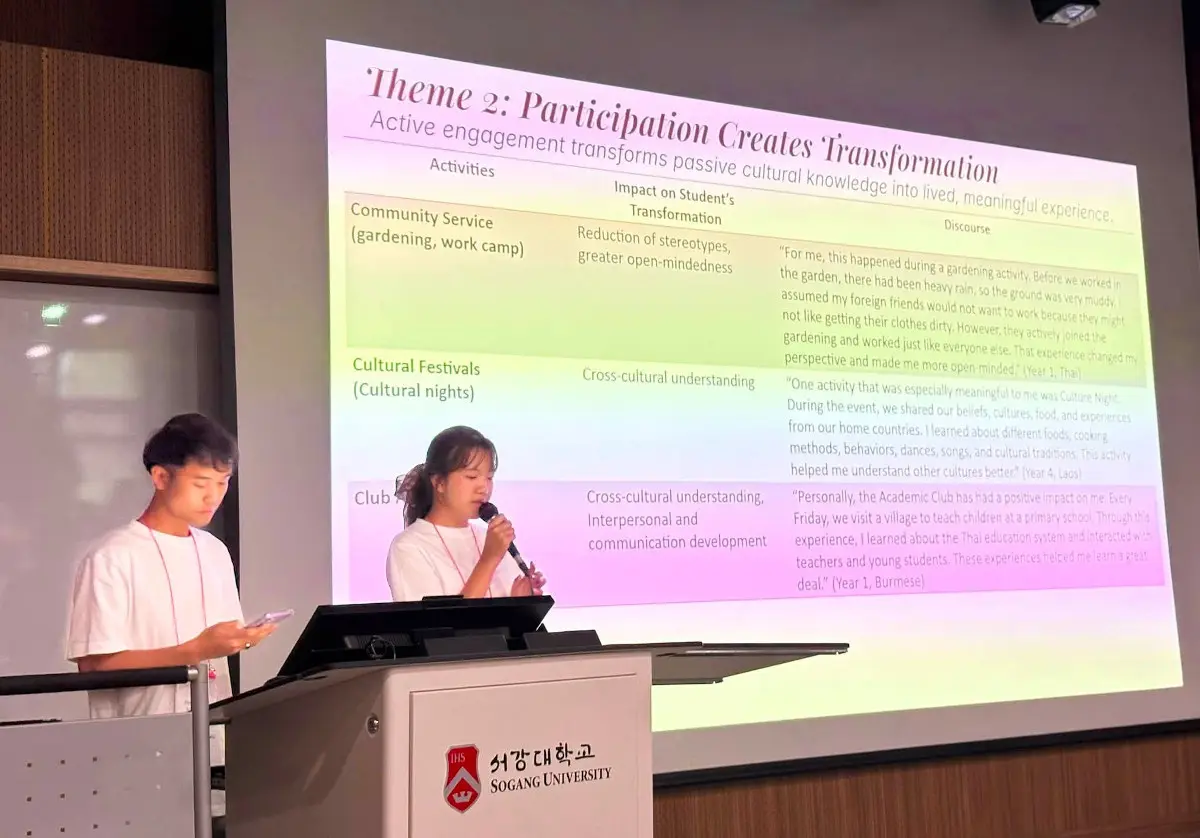 In addition, learning about AI from a Catholic perspective was new for me because it made me think that technology is not simply something we should develop or fear but something we must also think about using with ethics and responsibility. AI can help people work faster and analyse information well, but it cannot replace some human values, such as compassion, forgiveness, and making decisions based on morality.
Finally, what I gained from this programme was not only knowledge but also confidence and friendship. Doing the Final Presentation several times made me face my fear of speaking in front of many people, especially when some topics were new to me. However, preparing and working together with my friends helped me see that I could overcome my fear.
Global citizenship for me is not simply about travelling to another country or knowing people from different countries. It is about being open to learning, listening, and respecting differences while also knowing my own identity. I learned that order and responsibility can help create a good society. Democracy helped me understand the role of citizens and the responsibility of leaders. History and the DMZ helped me see the value of peace. Culture helped me understand the importance of preserving our identity. Technology made me think about the future and the responsibility of using AI. And friendship showed me that relationships between people can overcome differences in countries and distance.
Phonephasit Xayyasen (Laos)
4th year Bachelor of Arts in English for Education, Religion, and Culture
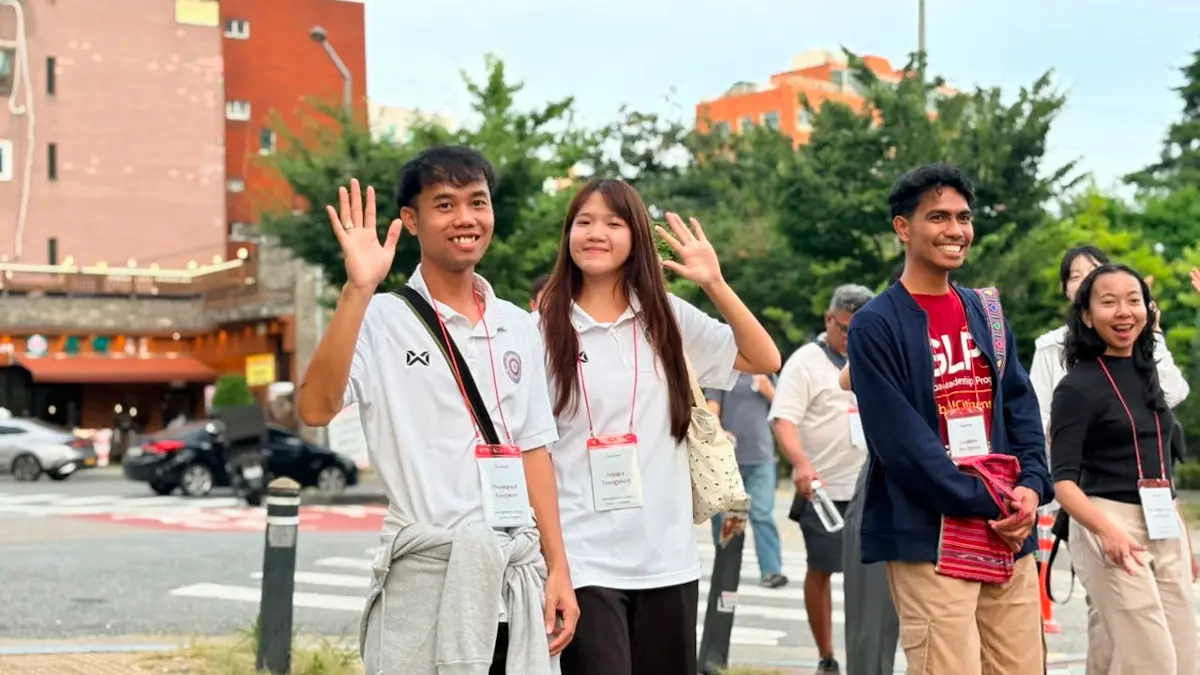 I knew about the division between North and South Korea mainly from history and the news. When I saw the border and the restricted areas with my own eyes, the situation became much more real to me. I thought about the families who have been separated and cannot freely meet or travel to the other side. This experience made me realise that political conflicts are not only about countries or governments. They can affect ordinary people. They are not just names in history. They are people with families, feelings, dreams, and hopes. This made me more empathetic towards people whose lives are affected by situations that they did not choose. It made me value peace, freedom, and humanity so much more.
The National Assembly also gave me another important perspective. I learned that Korean democracy was not achieved easily. People had to experience struggles and difficulties before gaining greater freedom and democratic rights. It made me think about how important it is for people to have the courage to stand up for what they believe is right.
After the GLP, I realised that my understanding of Korea had changed. Before the trip, I mainly associated Korea with K-pop, dramas, and modern entertainment. I realise now that there is much more to the country, including its history, traditional culture, political development, and people’s experiences. The GLP also helped me understand myself better. I learned that I can communicate and build relationships with people from different cultures even when we have different backgrounds. At first, I was nervous about speaking English, but I gradually became more confident by communicating with other participants. This taught me that I should not be afraid of making mistakes when I am learning something new. I also learnt that our differences do not have to separate us. Instead, they can help us understand the world from different perspectives.
I want to carry the lessons from the GLP into my daily life. First, I want to become more open-minded towards people and cultures that are different from my own. I also want to improve myself in small ways. For example, I want to be more punctual, follow rules, and take more responsibility for public spaces. More importantly, I want to practise empathy by trying to understand other people’s situations before judging them. I want to carry these values into my academic life, future career, and relationships with others. I hope to become a person who respects differences, understands others, and contributes positively to my community.
I do not want this experience to remain only a memory of travelling to Korea. I want to carry its lessons with me and become someone who understands others, respects differences, and contributes positively to my community.
Arisara Teangvised (Thailand)
4th year Bachelor of Arts in English for Education, Religion, and Culture


