

China’s karst landscape stretches through eight provinces in southern China – from Guangxi and Hubei in the east to Guizhou, Sichuan, Yunnan and parts of Tibet in the west. Unfortunately, this has also become the border of poverty, ecology, and opportunity in south-southwestern China. The karst belt is about 500,000 square kilometers with 8,200 million people living. In Yunnan Province, the karst landscape comprises nearly 44 percent of its total land area.
Karst is a geological structure formed by a process of rainfall infiltration where water rushes through thin soil and porous rock resulting to reduced surface river flow. It is a unique landscape often included in the list of ‘must’ places to visit. Significantly, it is relevant for people living in the karst region – mainly they rely on karst aquifer for drinking water. Communities living within this landscape however have difficulty, particularly in the drier season finding water; the dry season becoming drier and wet season becoming wetter.
The challenge of Luduke in Wenshan Prefecture, Yunnan Province is typical of the area and communities above 1000 meters elevation. The general area is karst where broader landscape has many dry valleys and dotted with sinkhole formations. The communityʼs water problem is not just how to build a reservoir but also to understand their water uses and perceptions and how their management practices can endanger or sustain their resource.
The large-walled reservoir in the village retains water only for a few weeks after the heavy rainy season. The area has no floor ceiling and is open to access by animals. According to an initial recounting of local history, it was a pool several decades ago but now covered with mud of about three meters thick. A walled area was further built upon sediment, which later extended to its present size. In this case, the area is likely subjected to sinkage due to material being filtered out underneath. Also, the total area, if cemented in a few years would probably be exposed to subsidence and fracture, which is very costly due to constant repairing.
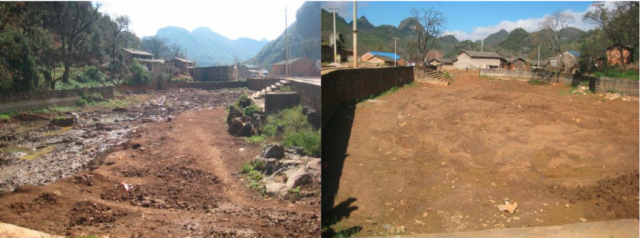
Domestic Water
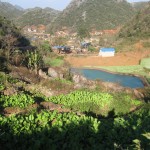
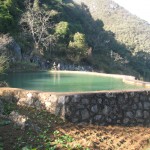 The catchment chosen for domestic water-use is the best in the area. There is one main spring (with two small ponds) that now provides trickles of water for the pipe going to the reservoir that is near full.
Soil is at a premium. Above the intake ground, seasonal crops grow, which potentially reduces infiltration and increases surface runoff through terrace. In time, this affects water quality.
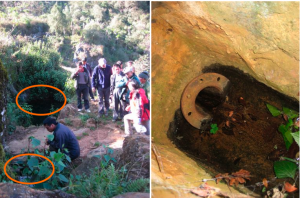 The stone-tank reservoir in the village fed by the spring from further up the catchment holds enough water for domestic use. However, it is not cleaned and pea-green in colour.
The water holding capacity of the ground specifically for animal use is very low in the village; this has become the focus of the community. Basically, they tap runoff water during rainy season but cannot contain the water for a longer period, presumably it has diminished and/or animals have increased.
Community Actions
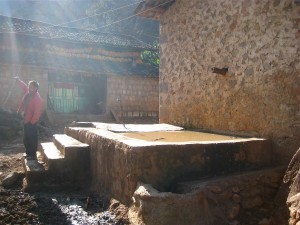 These problems are common in this landscape and the community knows that the responses are not simply technical but also social. They are already enhancing the surface drainage runoff so it does not affect the road and other buildings. Although people are used to the quality of their water, they consider cleaning the stone-tank when the next rains come and review its distribution to the different houses, their storage, and wastewater disposal. Also, they consider rehabilitating the land above the source by planting walnuts.
These efforts of protecting the source, cleaning the water system and reviewing the delivery are standard practices in community management. Community discussion and greater knowledge in terms of the number of their animals and water permits are needed before plans are undertaken. These activities hopefully bring about a greater consideration on how community need to act together and communally managed their water source and distribution.
Possible Way Forward
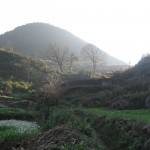 There is a possibility of constructing another reservoir below their current water system. The proposed reservoir will have a separate distribution system for animals to avoid contamination of their domestic water-use.
The self-organization and self-management within the community is important in protecting the source and maintaining the storage and distribution. This is necessary so that the open-access approach like the old area is not the same when the new water systems are developed.


