
 Second of two parts
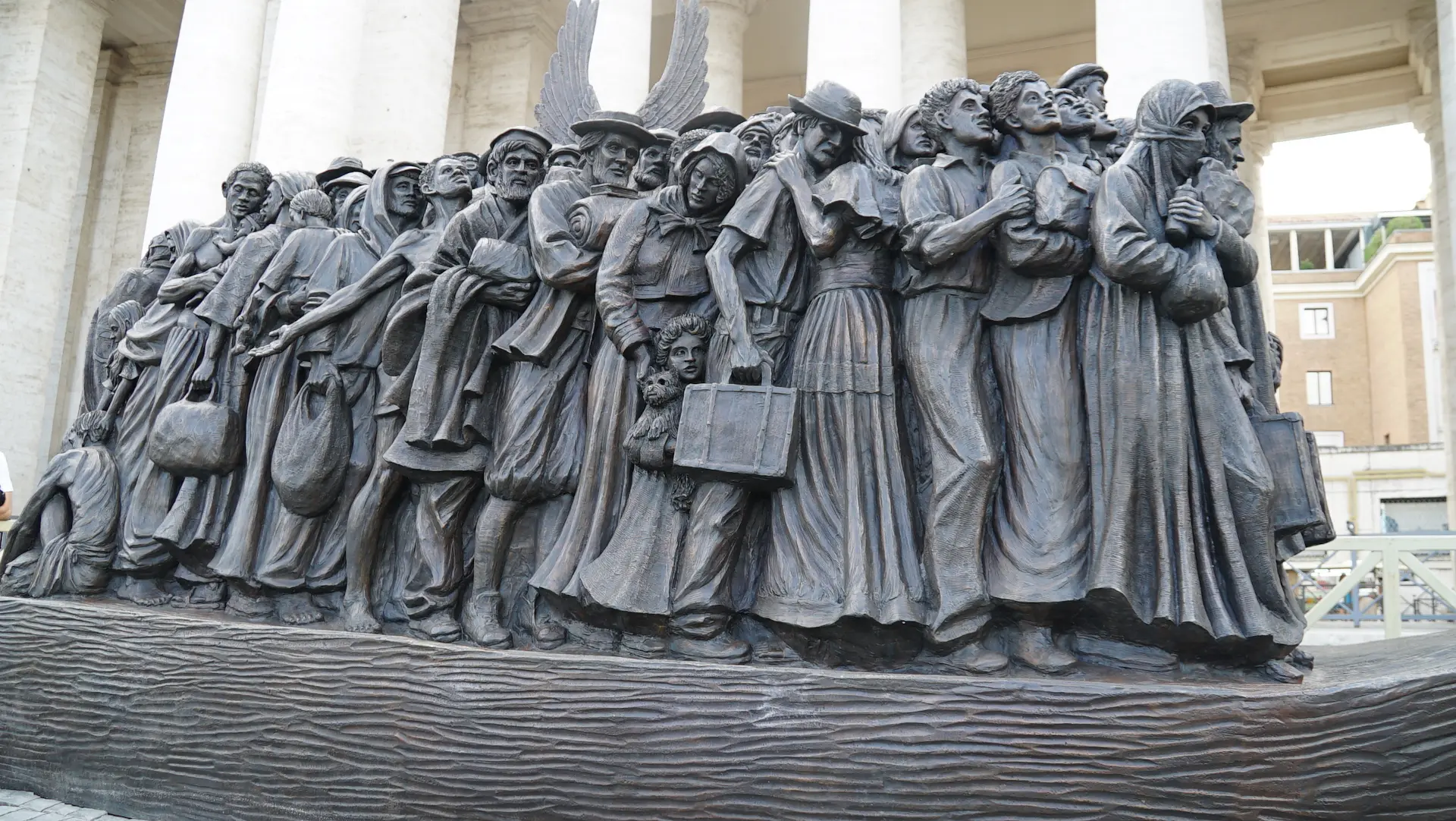
One of the most original contributions of Magnifica Humanitas is its invitation to see forced migration not merely as a humanitarian emergency but as a symptom of deeper structural injustice. People do not normally leave their homes, their families, and their communities unless circumstances leave them with no meaningful alternative. Migration becomes “forced” when the conditions necessary for a dignified life have been destroyed.
Throughout history, war, persecution, and natural disasters have driven people from their homes. Today, however, new forces are producing the same result. Extreme economic inequality, environmental degradation, climate change, land grabbing, corruption, irresponsible business practices, and technological disruption increasingly push millions of people toward uncertain journeys. The digital revolution has created extraordinary wealth for some, yet it has also widened the gap between those who benefit from technological change and those who are left behind.
Pope Leo XIV reminds us that authentic development must never be separated from justice. Economic growth that excludes large portions of society cannot be considered genuine progress. Likewise, technological innovation loses its moral value when it creates new forms of poverty, unemployment, or social exclusion.
This reality is especially visible in vulnerable communities. Small farmers lose their land because of large-scale industrial projects. Coastal communities lose their livelihoods as ecosystems are damaged. Indigenous peoples are displaced from ancestral territories. Young people enter labour markets where stable employment has become increasingly difficult to find. Entire families are compelled to migrate, hoping that another place will offer the opportunities denied to them at home.
Yet migration itself is not the problem. Throughout history, migration has enriched cultures, strengthened economies, and contributed to the development of civilisations. The Church has always recognised the right of people to seek safety and a better future when circumstances require it. The tragedy begins when migration is no longer a free and informed decision but the consequence of injustice, poverty, fear, or environmental collapse.
For this reason, forced migration should be understood as a moral question rather than simply a political or economic issue. Every person forced to abandon home because of avoidable injustice raises a question for the conscience of humanity. Why have the conditions for a dignified life disappeared? Who benefits from systems that impoverish some while enriching others? What responsibilities do governments, businesses, local communities, and international institutions share in preventing such displacement?
These questions move the discussion beyond emergency responses. Humanitarian assistance remains essential, but charity alone cannot solve structural injustice. Lasting solutions require policies that protect human dignity, create decent work, strengthen local economies, safeguard the environment, and ensure that technological innovation serves the whole human family.
The Church therefore approaches migration not only through compassion but also through justice. To accompany migrants is an expression of Christian charity. To remove the causes that force people to migrate is an expression of Christian justice. Both belong inseparably to the mission of the Gospel.
Within this context, Magnifica Humanitas offers a deeper understanding of human trafficking. The Encyclical does not present trafficking merely as organised crime. It identifies it as one of the clearest signs that contemporary society continues to tolerate forms of slavery incompatible with the dignity of the human person.
Human trafficking flourishes wherever vulnerability exists. People who have lost their homes, livelihoods, legal protection, or social networks become easy targets for criminal organisations. False promises of employment, education, marriage, or a better future often conceal systems of forced labour, sexual exploitation, domestic servitude, organ trafficking, and other forms of abuse.
The Holy Father therefore states unequivocally that human trafficking is a form of modern slavery and a grave violation of human dignity. His words challenge not only criminal networks but society as a whole. Whenever governments fail to protect vulnerable people, whenever economic systems tolerate exploitation, whenever consumers ignore abusive labour practices, or whenever communities remain indifferent to the suffering of migrants, the conditions that sustain trafficking continue to exist.
The digital revolution has also transformed the methods used by traffickers. Social media platforms, encrypted communications, fraudulent recruitment websites, and artificial intelligence can all be manipulated to identify, deceive, recruit, and control victims across national borders. Technology that should strengthen human relationships is sometimes used to deepen exploitation.
Yet technology itself is not the enemy. The moral question concerns how technology is used and for whose benefit. The same digital tools employed by criminal organisations can also strengthen international cooperation, improve victim identification, support law enforcement, educate vulnerable communities, and coordinate global networks such as Talitha Kum. The challenge is therefore ethical rather than technological.
For Talitha Kum, this distinction is crucial. The network’s mission extends far beyond responding after trafficking has occurred. Prevention is equally important. Every educational programme that helps young people recognise deception, every initiative that empowers women economically, every campaign promoting safe migration, every effort to strengthen local communities, and every collaboration among religious congregations, civil society organisations, and public institutions reduces the vulnerability upon which traffickers depend.
Seen in this light, the struggle against human trafficking begins long before the crime itself. It begins wherever human dignity is protected, opportunities are expanded, communities are strengthened, and hope replaces desperation. The most effective response to trafficking is not only rescuing victims but also creating societies in which fewer people become vulnerable to exploitation in the first place.
This broader vision represents one of the greatest strengths of Magnifica Humanitas. Human trafficking is not an isolated social problem. It is the visible consequence of deeper injustices that wound the human family. To confront trafficking effectively, the Church must therefore defend human dignity at every stage of life, from the protection of creation and the promotion of decent work to the defense of migrants, families, and vulnerable communities.
Read the first part, “Magnifica Humanitas and Talitha Kum: Building a world free from forced migration and human trafficking”.