

Roma Shamshad, a young Christian woman coordinating the Jesuits’ mission at the Loyola Hall Research and Spirituality Centre in Pakistan, writes about the experience of Christian women in her country, reflecting on their resilience, quiet endurance, battles against discrimination, and the sacred dignity with which they continue to rise despite the odds.
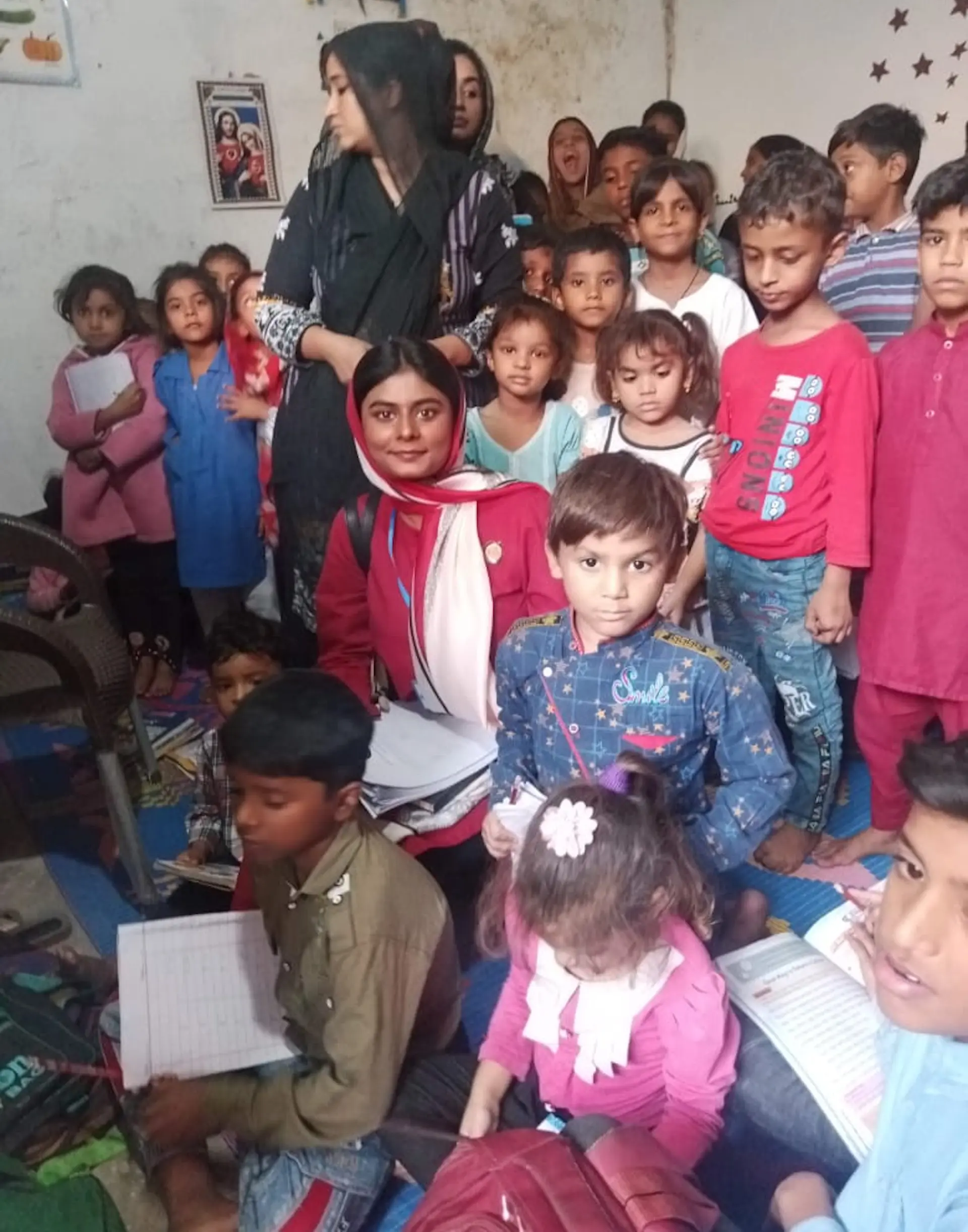
The author with a Christian teacher and her students
I have been working with the Jesuits for more than a year now, and in this time, I have learnt lessons that shape not only my work but also my way of seeing the world. The greatest of these is the Ignatian call to “find God in all things” – to hold life with open hands, without letting its challenges make me bitter, and to live with magis – the desire to do more for God and for others.
As a Christian woman in Pakistan, the teachings of St Ignatius resonate profoundly. In the deep margins of Pakistani society, where stories are often buried in silence, Christian women live lives of quiet endurance. Born into the dual vulnerability of being both a woman and a member of a religious minority, our lives are shaped by struggles from the very first breath to the last. And yet, amidst discrimination, poverty, and obscurity, we carry within us a quiet and sacred dignity—a grace that does not shatter under pressure but rises, again and again, from the ashes.
When a Christian girl is born in Pakistan, particularly in a low-income household—as is the case for the majority of the Christian population—her birth is often met not with joy but with concern. Not only does she inherit economic hardship, but she also bears the burden of being “the other” in a country where Christians form less than 2 per cent of the population. Before she learns how to speak, the world has already begun to speak for her—deciding her worth, questioning her faith, and predicting her limitations.
In a culture that places immense pressure on dowries and marriage, many families view their daughters as a significant financial burden. Education and skill-building are rarely prioritised—a painful reflection of both poverty and systemic neglect. Still, some girls push through. They walk to school wearing torn shoes or dirty clothes but carrying hopeful hearts. They sit in classrooms where teachers scold them for their surnames, and classmates avoid touching their lunchboxes. They feel the weight of being unwanted, but they keep going. From these early years, they begin to embody a form of grace that doesn’t shine like the sun but burns like the faint flame of a candle.
As they grow older, Christian girls face new forms of fear. High school is often the final stop in their education. Beyond that lies a world their parents are afraid of—universities filled mostly with non-Christian men, potential harassment, and interfaith dangers. With few Christian boys pursuing higher education, Christian girls become isolated in these institutions. Parents worry not only about their daughters’ safety but also about their reputations. Many are pulled out of education, told that it’s time to prepare for marriage or start working. But those who persist do so at great emotional cost. They become painfully aware of how their identity defines their limits. They are stared at, questioned, and warned. And yet, they continue to study. They hold onto their dreams with quiet determination, struggling to build a future even as everything around them seems to fall apart.
Graduating doesn’t mean the struggle is over. For many Christian women, entering the workforce simply begins a new chapter of exclusion. Despite having degrees and talents, they are often denied fair employment opportunities. Some workplaces subtly push them aside—refusing them promotions, offering lower pay, or excluding them from social circles. In many instances, the bias is visible and unapologetic. Many women are forced to hide their Christian identity just to be treated equally.
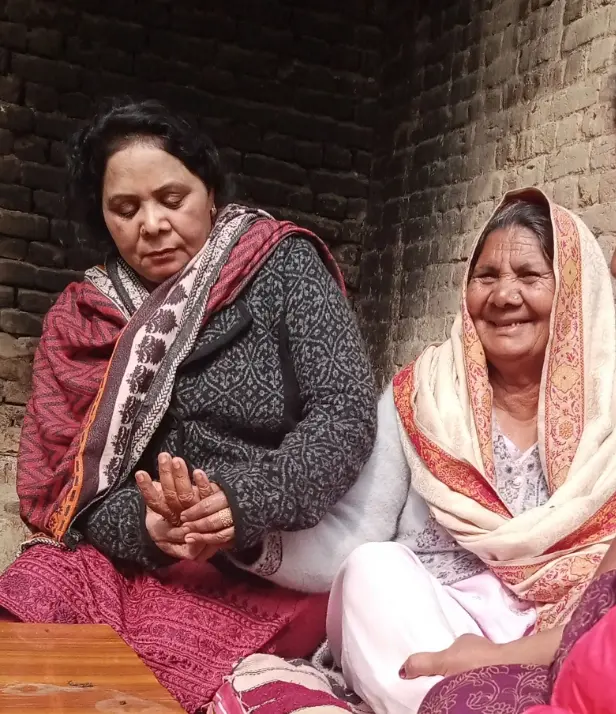
A Christian nurse caring for an elderly woman
Fields like domestic work, sanitation, low-grade factory labour, and sometimes nursing remain the most accessible options for Christian women—often not by choice, but as a last resort. Most of these jobs offer no protection, low pay, and a high risk of abuse. Even in the workplace, the pressure to convert persists, presented as the only way out of difficulty. For some, the weight becomes unbearable. “Forced freely,” they enter into marriages with Muslim men in search of a better life, luxury, and respect from society. Often, these relationships are built on promises of safety—but many end in emotional, spiritual, and even physical trauma.
Those who don’t compromise are left with another kind of loneliness. Belonging is no longer enough reason to give up the independence they’ve spent a lifetime fighting for. Many choose solitude not out of bitterness, but because they have built their lives alone for so long that they have learnt to carry their grief, their faith, and their hope without help. They rise like a phoenix from the ashes, and that is when grace becomes their armour.
Even in death, the dignity of Christian women remains at risk. Graves are sometimes desecrated and cemeteries encroached upon. Families fight for burial rights, for land, for a simple place to grieve. The struggle does not end with one’s last breath; it echoes in mourning and passes on to their children as a lifelong battle.
Do we need solutions? Yes. But before seeking help from outside, we must first take action ourselves. And we have. Throughout our lives, women hold onto grace – a grace that is neither loud nor performative but resilient. It lives in a mother who works two jobs just to send her two daughters to college, in a teacher who hides the Bible in her bag but opens her heart to her students, and in a widow who still wears a cross around her neck despite the risk of being targeted.
These women are not merely victims—they are survivors. We are not waiting to be rescued; we are asking to be recognised—beginning with our own families and extending to the whole of society. Our lives, woven with pain, purpose, and quiet bravery, deserve more than just tolerance as a “protected gender”. We deserve justice, dignity, and visibility.
The inspiration of St Ignatius has shown me that grace is not just something we receive in peaceful moments; it is something we choose to live amid the trials. As Jesus Himself said, “If the world hates you, keep in mind that it hated me first” (John 15:18, NIV). These words, though painful, carry a promise: that following Him will bring opposition but also strength. And this strength, for me, is the very grace I see in the lives of Christian women—a grace that endures insult without losing dignity, meets injustice without surrendering hope, and, like the Jesuit spirit, seeks God’s presence even in the ashes.
It is time for Pakistan to confront the deep-rooted biases that shape the lives of its minorities, particularly its women. It is time to rewrite the narrative of Christian womanhood from one of silence to one of strength. Dignity lies in recognising the struggles of these women. These women—born in the margins, shaped by ashes, and lifted by grace—are not a burden to society. They are the backbone of their families, their communities, and, if given the chance, the nation itself.