

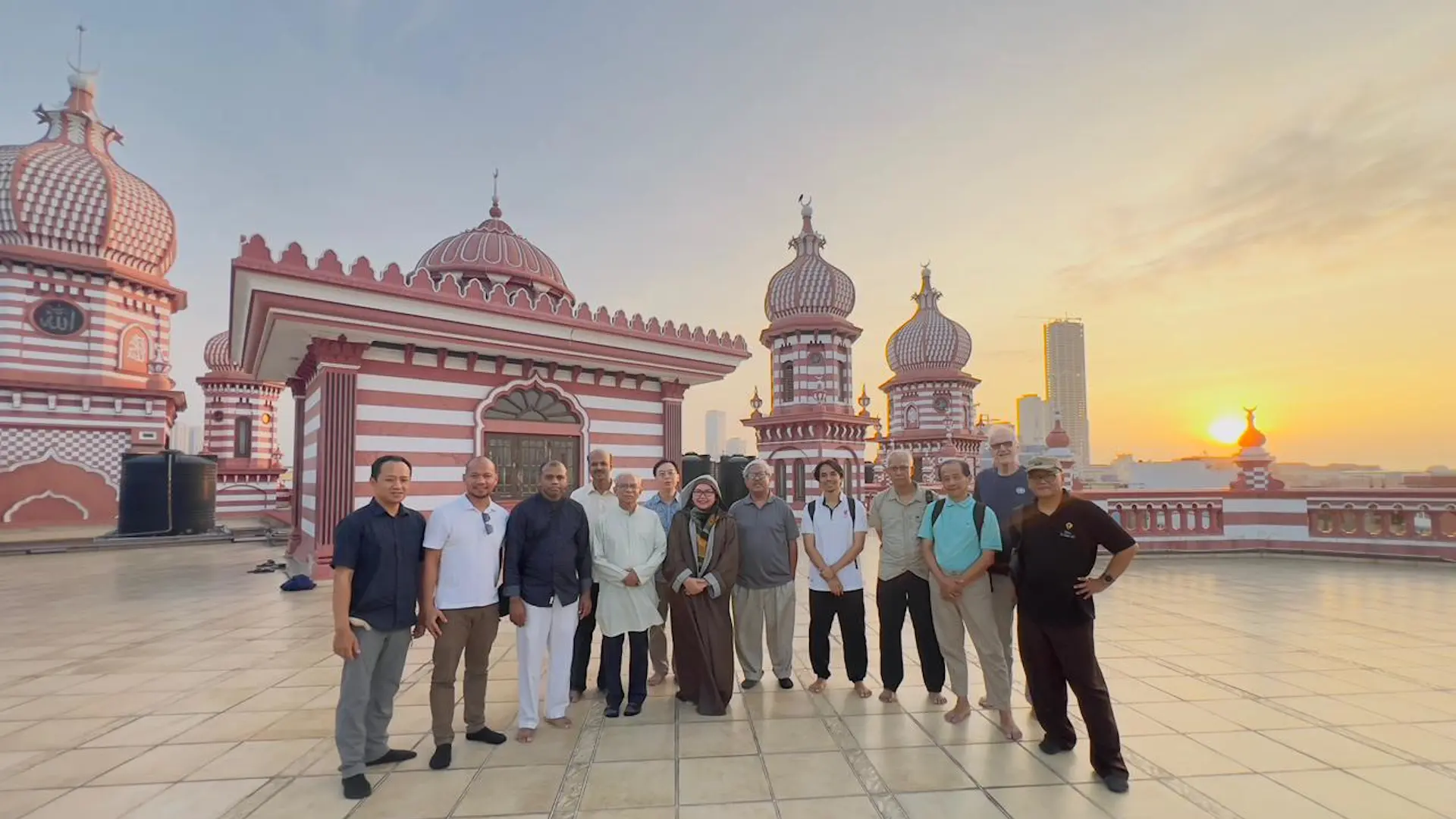
 In the quiet transition between Christmas and the New Year, a small but dedicated group of 13 individuals convened at Caritas Sri Lanka – SEDEC in Colombo for the Jesuits Among Muslims in Asia (JAMIA) biennial gathering. Participants represented seven nations across Asia: India, Indonesia, Pakistan, Philippines, Singapore, Sri Lanka, and Thailand, bringing together the Jesuit conferences of Asia Pacific and South Asia.
Over four days, from 27 to 30 December, nine Jesuit priests, two former Jesuits, and two lay collaborators engaged in interreligious dialogue, seeking to transform “polemic eyes” into eyes of understanding and to discern new prospects for Muslim-Christian relations through shared experiences and spiritual conversations.
The gathering drew inspiration from the legacy of Jesuit missionaries who pioneered Muslim-Christian relations across Asia, especially Victor Courtois and Paul Jackson, who fostered heart-level dialogue with Sufi spirituality; Christian Troll, whose work addressed Muslim inquiries with theological clarity; Robert Bütler, who established a library to facilitate personal interactions with Muslim intellectuals in Pakistan; and Thomas O’Shaughnessy, whose philosophical contributions deepened understanding of Islam. Central to the spirit of the meeting was the passionate encouragement of Fr Thomas Michel SJ, who passed away in November. He devoted his life to fostering understanding and urged young Jesuits to seek the “greater need” in interreligious mission, particularly in Muslim-Christian relations.
The thematic sessions challenged participants to move beyond the boundaries of traditional theology, beginning with an exploration of how Christ is presented in an Islamic context. Dr Herman Roborgh and Dr Rene Oliveros invited us to view the Qur’an through a lens of comparative theology rather than conflict. Discussions centred on how the Qur’an acknowledges Christian identity and how the concept of Christian Trinity, even amidst distinct dogmas, might be understood as a complex expression of Tawhid or the oneness of God, highlighting shared reverence for the Spirit (Ruh) and Mary (Maryam).
 The dialogue then shifted to the lived realities of multireligious societies, where Muslim-Christian relationships are often marked by tension and risk. Fr Cedric Prakash SJ spoke about the hostility faced by Muslims in India. He proposed a framework of “Four Fs”—Fear, Fostering, Forgiving, and Fraternal sharing—as a way of moving beyond a violent social environment. Meanwhile, Fr Greg Soetomo SJ shared the Indonesian experience of “Dialogue of Spirit,” in which shared silence and attentiveness to the Holy Spirit have moved students from personal reflection to collective spiritual awakening. He suggested that deep, contemplative listening during the spiritual conversation could serve as a model for high-level encounters between religious scholars.
Environmental challenges were also addressed. Fr Gil Donayre SJ presented on “The environmental crisis through the lens of Islamic and Christian positions: a comparative theological study of religions’ approaches to the environmental problem”. He emphasised the importance of decentralisation of the human person and recognising the intrinsic value of creation in both faiths. Further, he urged a reimagining of Christian stewardship and a transformative vision for the global economy.
These intellectual inputs were balanced by spiritual practice through the daily celebration of the Eucharist and examen and spiritual conversations grounded in personal experience and reflection.
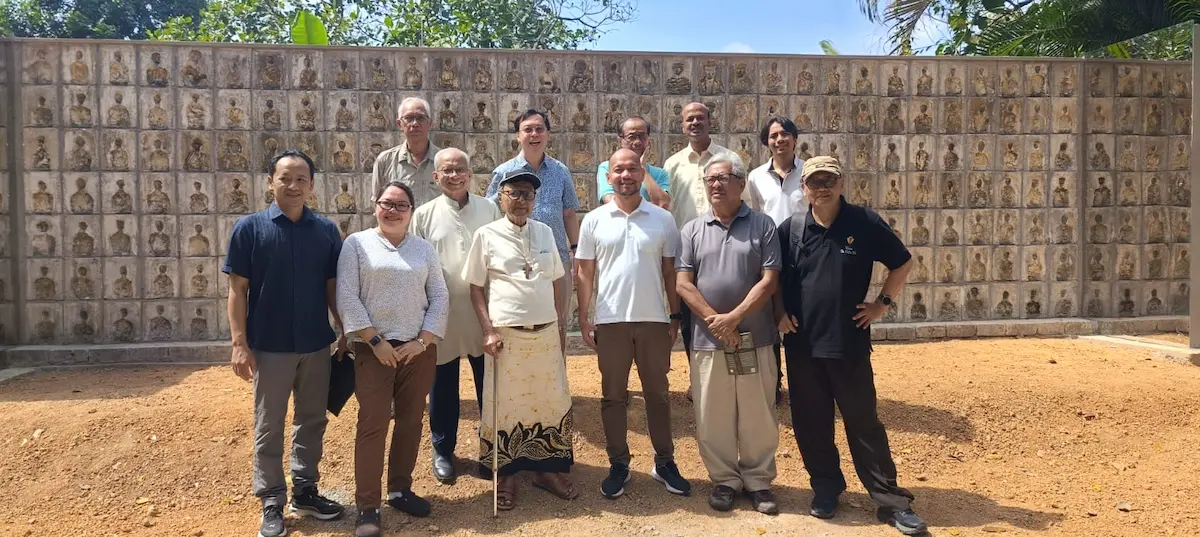
JAMIA with Fr Aloysius Pieris SJ (centre)
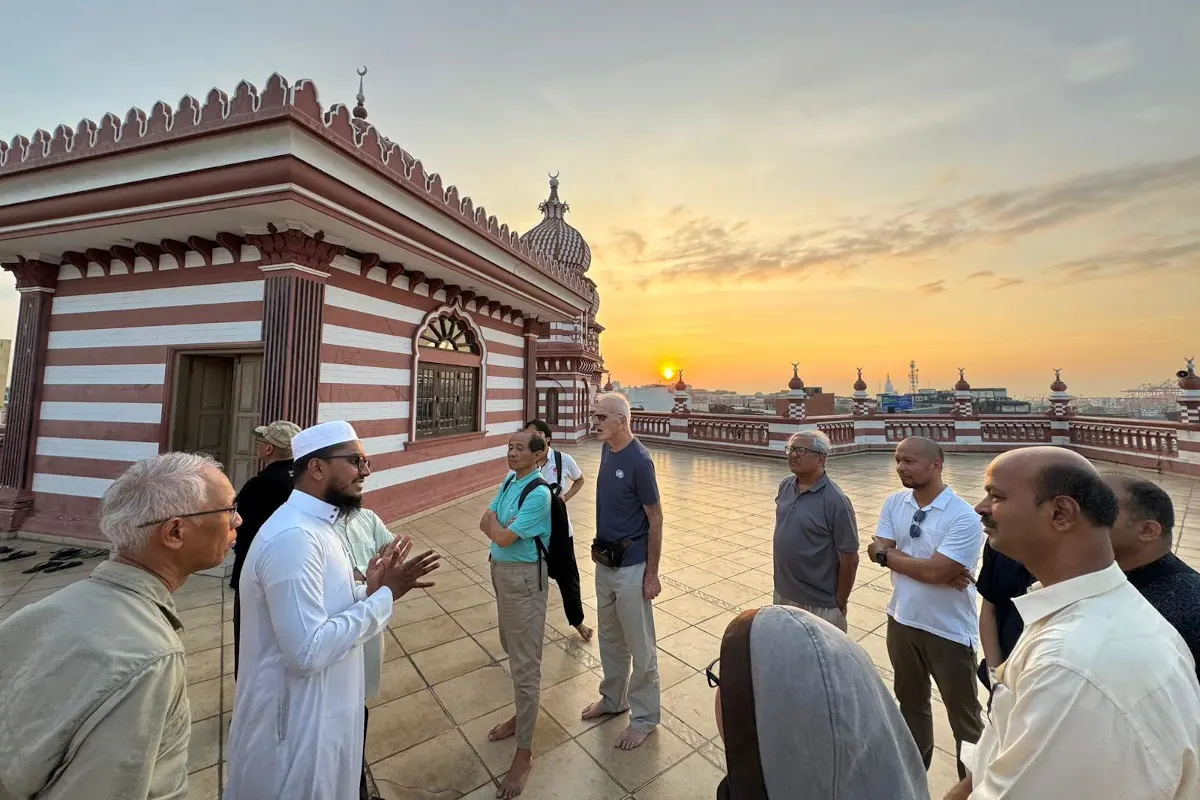
Tangible encounters with the diverse religious landscape of Sri Lanka further enriched the meeting. Facilitated by Fr Dileep Eranda, a diocesan priest from the Diocese of Anuradhapura and the Secretary to the Catholic Episcopal Commission for Interreligious Dialogue and Ecumenism, the group visited the ancient Kelaniya Raja Maha Vihara Buddhist Temple and the iconic Red Mosque of Colombo (Jami-Ul Alfar Masjid). We also visited the St Anthony of Padua Shrine, a symbol of resilience following the 2019 Easter Sunday attacks. We paid a courtesy call to renowned Jesuit theologian Fr Aloysius Pieris SJ at the Tulana Research Center and listened to the provocative synthesis of Dr Shanti, who enlightened us on the distinction between “near others” (Muslim-Christian) and “far others” (Buddhist-Christian) in the political dynamics of majority-minority relations in Sri Lanka.
Looking ahead, we focused on the mission’s sustainability within Asia’s small Christian minority. Key upcoming activities include the Asia Pacific Theology Encounter Program, to be held in Jakarta in July and expanded to include non-Jesuits; the global Jesuits Among Muslims (JAM) meeting in Nairobi in 2027; the next JAMIA gathering in 2028; and a publication project to produce a commemorative booklet of the meeting and a scholarly volume honouring Fr Michel’s legacy.
The meeting’s success reflected strong collaboration—Fr Soetomo, who stepped in for Fr Victor Edwin during his recovery from major heart surgery; the Jesuit Province of Sri Lanka, led by Provincial Fr Sujeewa Pathirana SJ; Fr Luke Nelson Perera, the National Director of Caritas Sri Lanka-SEDEC, who opened his facilities for our meeting; Fr Dileep Eranda; and international sponsors Fondazione MAGIS, Associazione NOSTRA AETATE, and Forum Intergentes, with which Fr Edwin’s colleagues Professor Ambrogio Bongiovanni and Professor Gaetano Sabetta are associated. Their support made this frontier mission possible. We parted on New Year’s eve with a profound sense of gratitude and commitment to the frontiers of Muslim-Christian relations in Asia.