

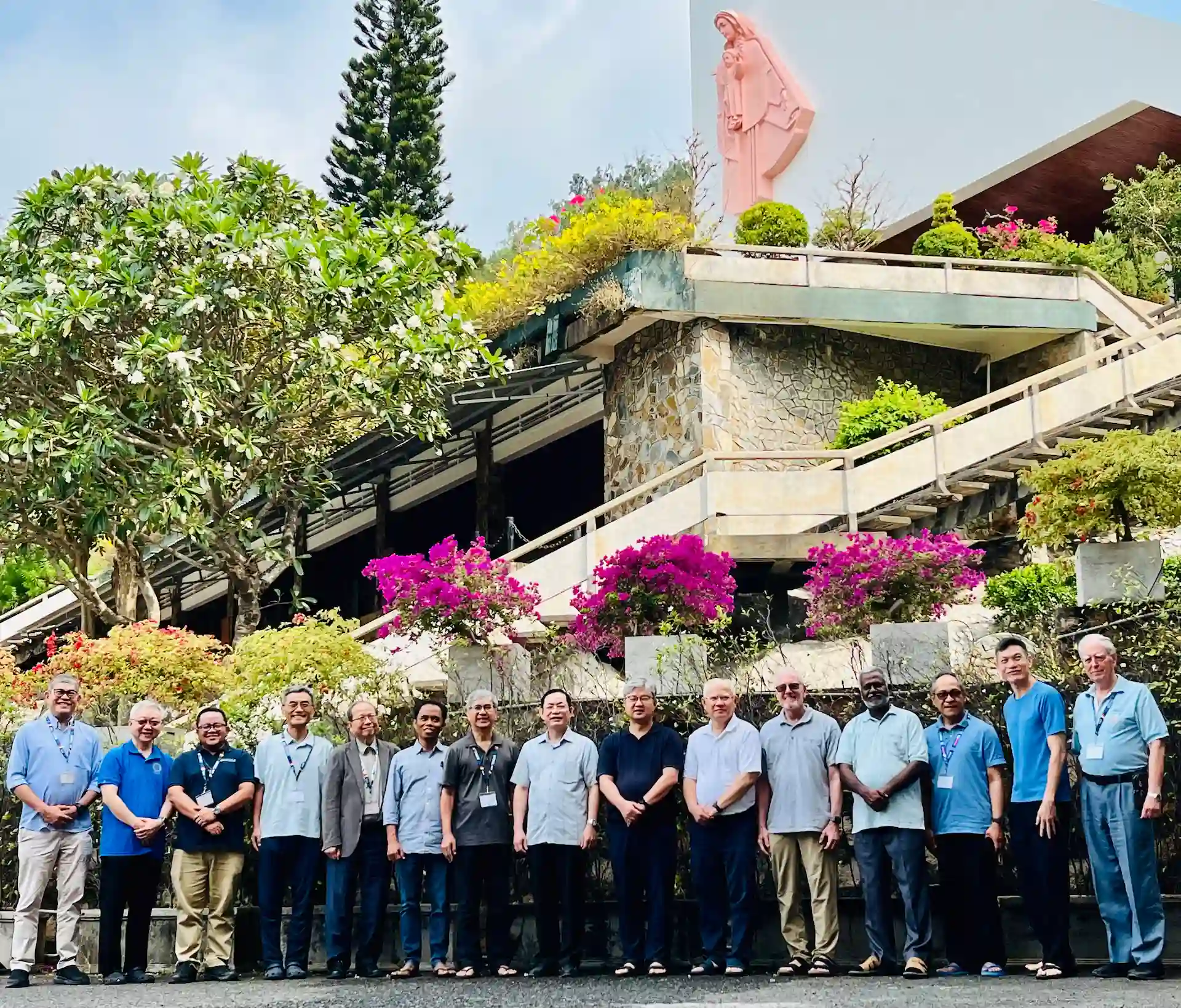
 As Vietnam bloomed with flowers and decorations in preparation for Tet—the Lunar New Year—the Major Superiors of our Jesuit conference gathered at Vũng Tàu, a charming seaside town a few hours away from Ho Chi Minh City. This coastal region in southern Vietnam is home to a growing migrant population, and the Diocese of Bá Ria-Vũng Tàu, the youngest diocese in Vietnam established in 2005, has a pastoral orientation for fishermen, migrant workers, and the marginalised communities. The assembly was held at the Bai Dau Pastoral Center, distinctly marked by a Marian Shrine, a place of popular devotion for Vietnamese Catholics who visit Vũng Tàu. Spirituality is deeply rooted in the lives of the Vietnamese people, and their culture respects religious life.
Indeed, there is strong evidence of the Catholic faith all over the country, which has a population of over 100 million, with roughly seven million Catholics. The first Jesuits arrived in 1615 from Japan, and over the next one hundred and fifty years, Vietnam was a mission of the Provincia Extreme Orientis of the Society of Jesus. In 1773, during the suppression, the Jesuits exited Vietnam and were only asked to return in 1957 at the request of the bishops from the south to oversee formation and education. By 1970, Vietnam became a part of the Chinese Province as a dependent region. But when the Communist Party took over the entire country in 1975, all Jesuits were exiled from Vietnam. Until 1990, it was a silent time for the Jesuits: those who were scholastics in the late 1970s were involved in non-combatant military service or were education volunteers. In the 1980s, Jesuit communities were not allowed, and it was only towards the end of that decade when scholastics could resume formation, and non-Vietnamese Jesuits were allowed into Vietnam to help with formation. By 2007, it finally became a full-fledged province and today is blessed with abundant vocations. Vietnamese Jesuits are sent all over the world and are present in parishes, community and cultural centres for Vietnamese migrants and are involved in social work and higher education.
 Some of the highlights of the assembly included an update from MAGIS Asia Pacific’s coordinator, Fr Alexander Koko Siswijayanto SJ, who reported on the recent gathering in Taiwan at the end of December 2026 and early January 2026 with 90 participants from all over Asia Pacific. There is a new energy in the Young Adult ministry, as many look forward to MAGIS 2027. Korean Jesuit Fr Lorenzo Hak-joon Kim, general coordinator for the project, gave the Major Superiors an overall picture for MAGIS 2027, with the theme “Living Hope, Igniting Peace”. It will be held in Seoul during the summer of 2027, right before World Youth Day. The Korean Province has created a team of seven Jesuits, along with two lay employees and two part-time religious sisters, who are working hard to bring together a meaningful experience for around 1,000 participants expected to join the gathering that serves as Ignatian formation for young people before World Youth Day. Sogang University’s campus will serve as Villa MAGIS for the nine-day event, and Fr General Arturo Sosa SJ is expected to celebrate the closing Mass. World Youth Day—to be held for the first time in a non-Christian country—is expected to draw a million pilgrims to South Korea and will begin on 3 August and end on the 8th. This huge undertaking necessitates collaboration not only with the laity, but also with other congregations and different sectors of society.
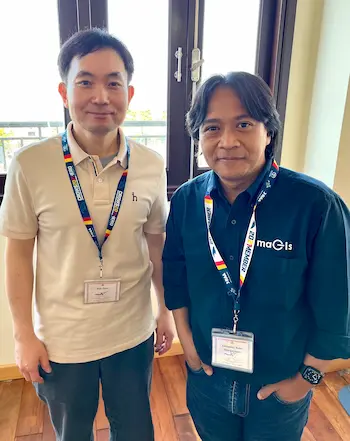
Fr Lorenzo Hak-joon Kim SJ, MAGIS 2027 coordinator, and Fr Alexander Koko Siswijayanto SJ, JCAP Secretary for Young Adult Ministry
Another guest was American Jesuit Fr Sean Michaelson, who joined the assembly virtually and shared his presentation on Collaboration and Mission Partnership. He called it “an examen on collaboration” and delved into the dimensions of collaboration between the Jesuits and mission partners. By continuing to reflect on collaboration and by deepening our understanding of it, it is evident that maturity and competence of both Jesuits and collaborators are necessary, along with humility and openness. Spiritual conversations ensued after Fr Michaelson’s presentation, a rich source of both insights and questions on the realities of collaboration.
Perhaps a solid example of collaboration happens in the Pakistan Mission. Fr Noel Jayanathan SJ, acting Mission Superior, gave a clear picture of the challenges they face in Pakistan, which is the youngest mission in JCAP. The mission was under the care of other provinces: Sri Lanka, and before that Australia and Germany. Three years after the Pakistan mission was entrusted by Fr General Sosa to the conference, it is thriving—from book club meetings to film screenings, from bringing solar energy to the schools to introducing philosophical discussions to the youth—thanks to the collaborative efforts of Jesuits and mission partners, who are aligned in living out the missio Dei, bringing a sense of hope in a place where they serve those in need, no matter where in the world.


