

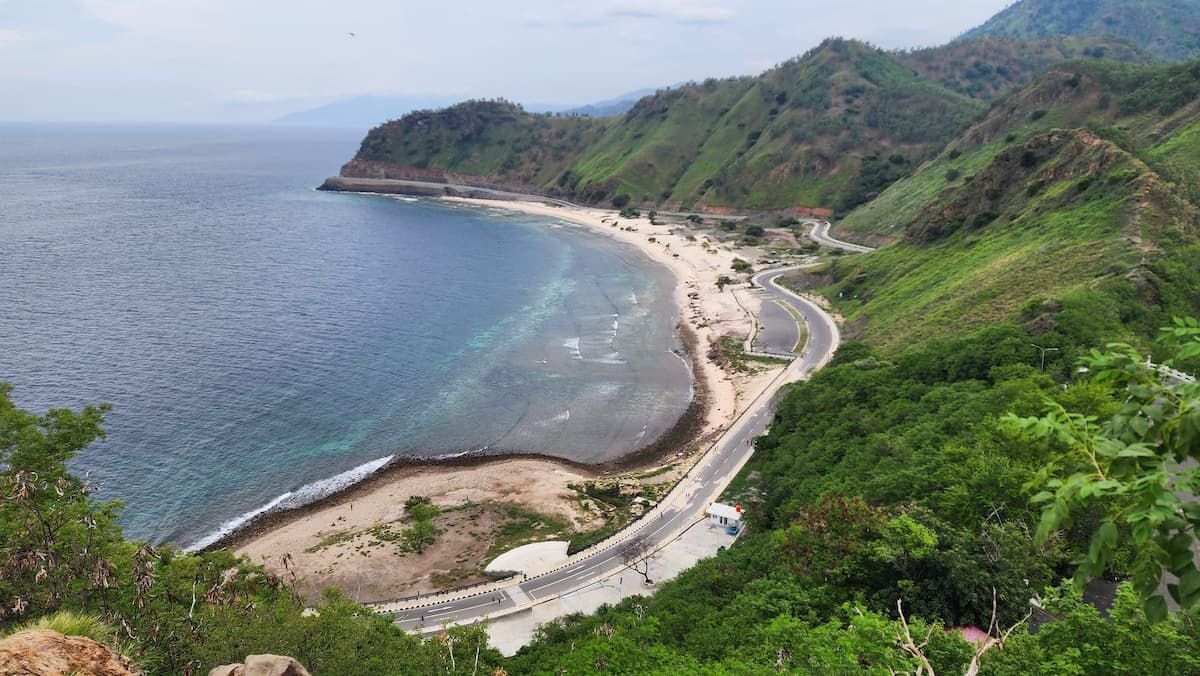
A bird’s-eye view of Dili’s coastline | Photo by Matthew Hsu SJ
Dili’s scenic coastline and rugged hills served as the backdrop for the gathering of Jesuit and lay coordinators for migrants and refugees across Asia Pacific from 3 to 6 March. Nowhere did the issue of migration resonate more profoundly than in Timor-Leste, a country shaped by complex prehistoric migration, colonial rule, independence struggle, and, in more recent years, labour migration and climate displacement.
The invitation was clear from the outset: we cannot fix everything, but we can be faithful to what is asked of us now. Fr Jun Viray SJ, Conference President, underlined this call to humble collaboration, echoing the spirit of Gandalf’s wisdom from The Lord of the Rings: History does not ask us to do it all. “All we have to decide is what we do with the time that is given us.”
Further, Fr Viray shared an important lesson on collaboration from Rowena Soriaga, an ecology partner: “Collaboration is learnt by doing, under pressure and within imperfect conditions.” Progress comes from paying attention to what works and what does not. Her insight dovetailed with planning consultant JP Villanueva’s invitation to local- and network-level spiritual conversations to help shape the next conference apostolic plan.
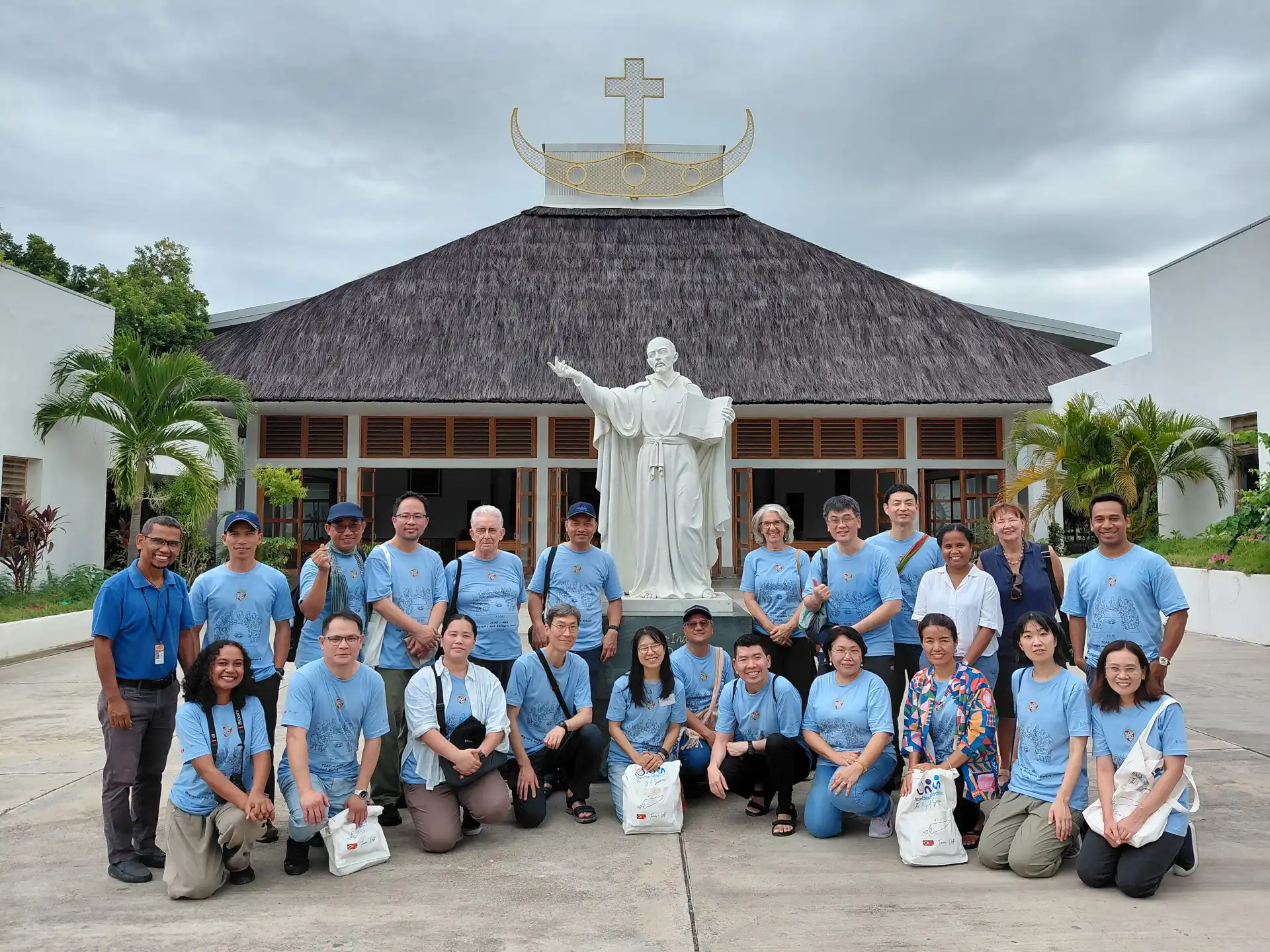
The gathering’s core was ecology as the wide lens through which many other issues come to the fore. Louie Bacomo, JRS Asia Pacific Director for Climate and Forced Displacement, led the delegates in a simulation exercise that brought into focus the critical issue of decision-making in climate displacement among vulnerable communities. JCAP Ecology Coordinator Fr Gabby Lamug-Nañawa SJ proposed a view that considers three nested circles: ecology as the broadest circle, then society within it, and economy as the smallest. He reflected on how human societies and economic activity are actually held within the larger gift of creation. In this view, care for migrants, refugees, and Indigenous communities is not an “extra” concern but part of healing the whole web of relationships.
Local resource speakers shared about their experience of climate displacement. Changing weather patterns, climate-dependent agriculture, and environmental degradation are already pushing people to move. A young climate diplomacy advisor, Dircia Sarmento Belo, spoke of the Timorese youth’s determination to protect their land and seas and to be at the table where decisions are made.
The meeting also gave space to the stories of Timorese seasonal workers who had gone to Australia. Remittances from migrant workers have become the second largest source of income for the country. Two former workers shared about the strain on mental and emotional well-being, as well as how they overcame these struggles to find success. This prompted a discussion among the delegates on the need to accompany migrant workers to fully understand their rights and the labour laws of the host country.
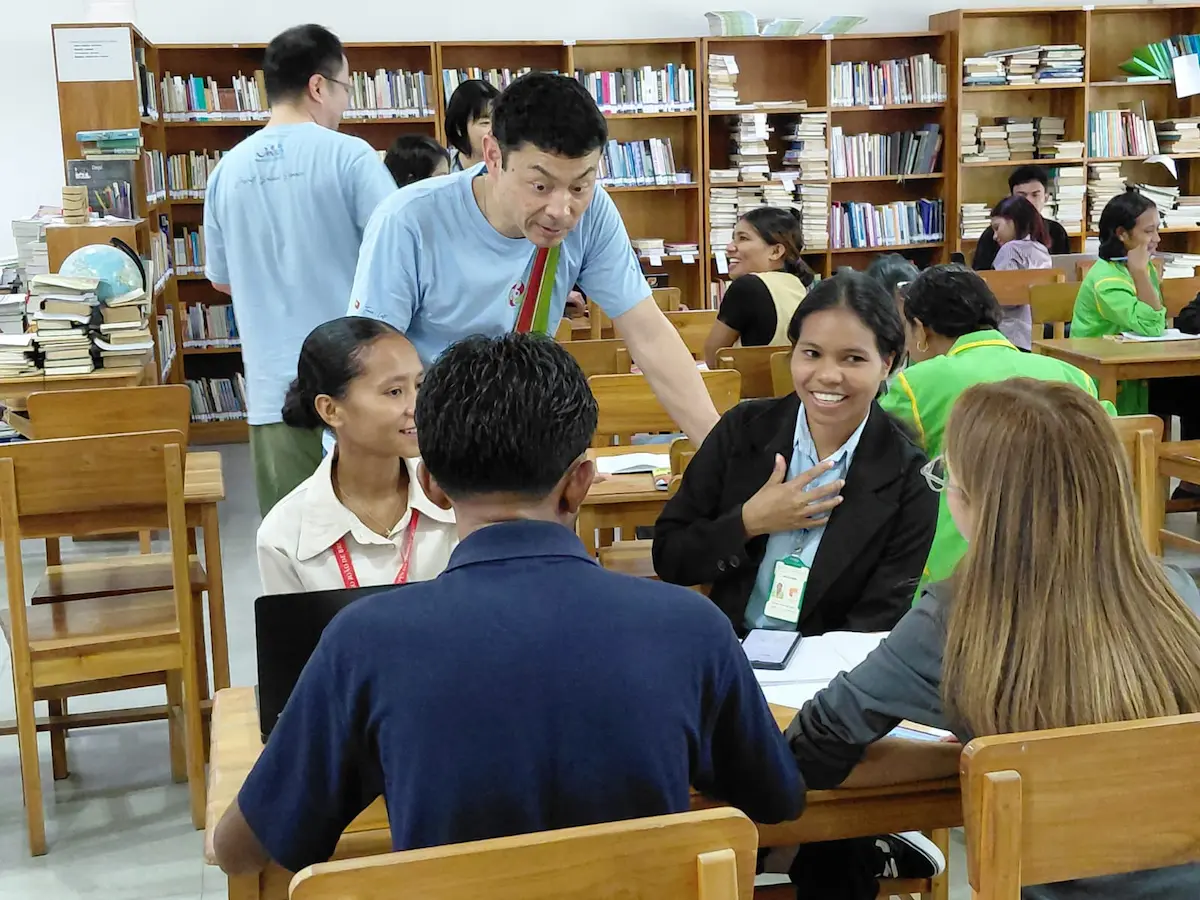
JCAP Migrants & Refugees Network Coordinator Fr Jun Nakai SJ with students from Instituto Sao Joao de Brito
An entire day was devoted to visiting Jesuit apostolates in Timor-Leste, which offered a more concrete sense of how mission takes flesh. The group visited the secondary school, Colegio Sto Inacio de Loiola; the teacher education institute, Instituto Sao Joao de Brito, which recently celebrated its 10th year; and the medical clinic, which serves students from both schools and nearby communities.
During visits to the Chega! Museum and the Santa Cruz Cemetery, the delegates further learnt about Timor-Leste’s bloody struggle and courageous fight for independence.
The group’s last day together was a joint meeting with the delegates of the social ministries. Julie Edwards, the Secretary for Social Ministries, presented a vision of a grounded, interconnected, and integrated conference social apostolate. This brought the meeting full circle, renewing the call to collaboration and shared mission on the first day.
“We are very much encouraged by the Migrants and Refugees Network,” shared Yukako Matsuura, who serves in the Arrupe Refugee Center (ARC) in Japan. “Since joining the network, we have become very much aware of what is happening,” she said. “Just last week, we helped a pregnant Indonesian woman return to her home country safely through Talitha Kum, whose connection was facilitated by this network.”
Then, looking around the room, Yukako continued, “That is real collaboration.”


