

Vatican Media
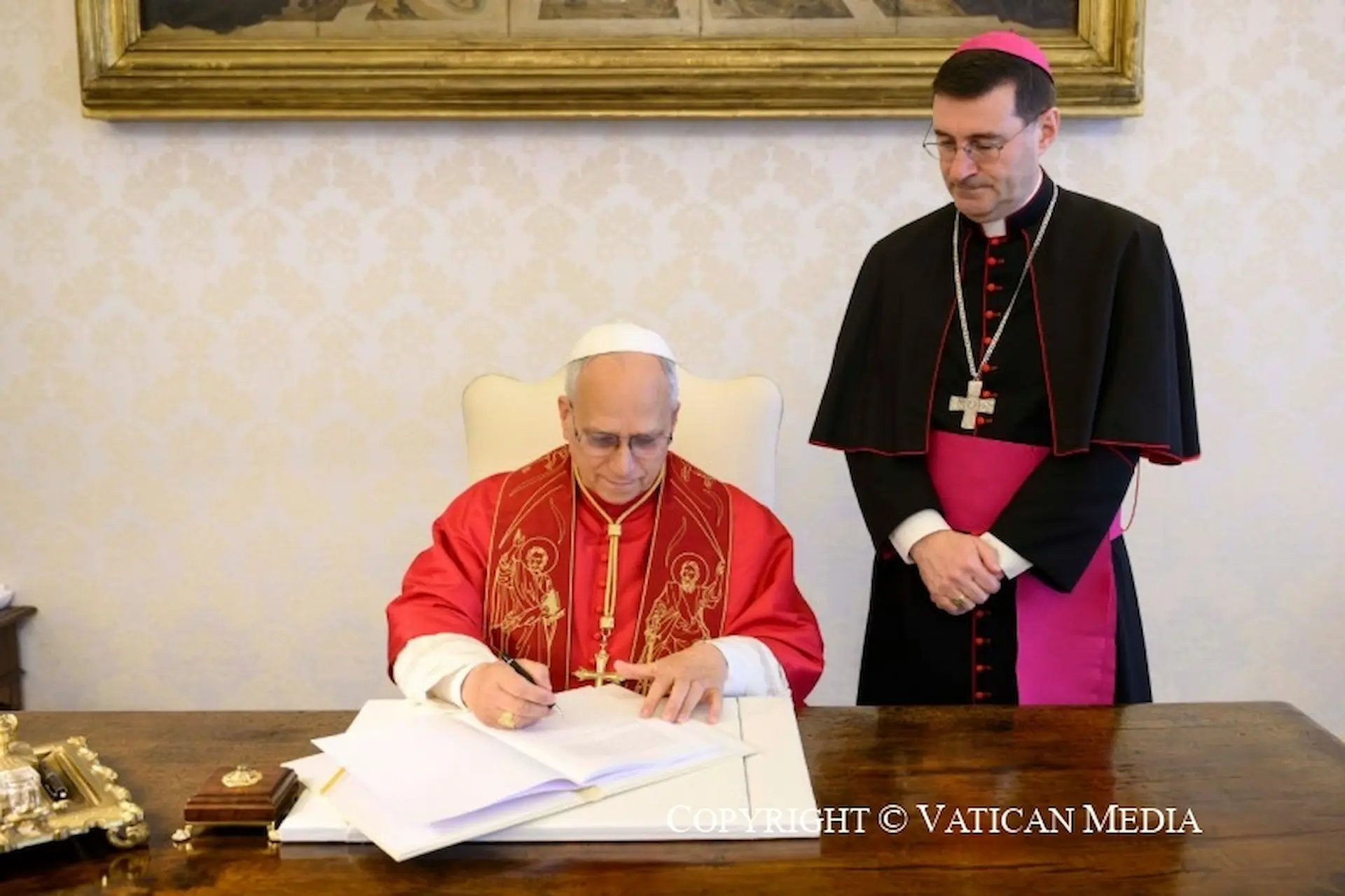
Pope Leo XIV published on 25 May his first encyclical, Magnifica Humanitas. Signed on 15 May, the document is consciously linked to Rerum Novarum, Pope Leo XIII’s groundbreaking social encyclical issued on the same date in 1891, marking its 135th anniversary.
Magnifica Humanitas continues the tradition of social encyclicals dealing with “new things”—in this case digitalisation, artificial intelligence (AI), and robotics. It is the first encyclical to address these new technologies and is a conscious contribution to Catholic Social Doctrine. As Pope Leo XIV explicitly says, “I therefore wish to add my own voice to this living tradition.”
Pope Leo begins the encyclical with two biblical images: the Tower of Babel and the rebuilding of the walls of Jerusalem by Nehemiah. He writes,
“Humanity, created by God in all its grandeur, is today facing a pivotal choice: either to construct a new Tower of Babel or to build the city in which God and humanity dwell together” (#1).
In Babel, humanity attempted to build out of pride without reference to God. In Jerusalem, however, the community built with humility, shared responsibility, and God at the centre. Technology, as it becomes more advanced, needs to be discerned, regulated, and used well lest it dehumanise us. The focus is on integral human development and how we can become more discerning, more faithful, and more human.
“Artificial intelligence […] should not be considered as merely yet another theme to be studied or a crisis to be managed, but rather as a development that challenges the categories of Social Doctrine from within, calling for their further development in fidelity to the Gospel (#17).”
Pope Leo grounds his reflection on foundations and principles of the Church’s Social Doctrine, in particular social justice as characterised by the “capacity for social, economic, and political order” to ensure a dignified life for all, “begin[ning] with the least among us” (#78).
In this light, artificial intelligence is seen with promise but also poses serious risks to human dignity. Pope Leo warns against the prevailing technocratic paradigm, when we begin to govern our lives on the logic of efficiency, control, and profit.
“When [technology] becomes the standard by which everything is judged, it begins to dictate what matters and what can be discarded, reducing creation to an object of exploitation and human beings to mere cogs in a system driven toward ever greater efficiency” (#92).
The document stresses that AI is not neutral: it is designed, shaped, and programmed by humans, so it can carry their biases and values, and even when it seems personal or makes life easier, it cannot replace genuine interpersonal relationships, and overreliance on it can erode our humanity.
In this sense, we cannot be satisfied with merely calling for “moralising machines,” or speaking abstractly of AI alignment with human values, without also having the courage to insist on openly discussing the ethical frameworks, making algorithms and processes more transparent, and subjecting them to shared standards of social justice.
The pope calls for “disarmament,” not to reject technology but to free it from monopolistic control and the appearance of armed or competitive tech races. He rejects the assumption that technical power automatically grants the right to rule, advocating instead for technology to be human-friendly, open to discussion, and rooted in the plurality of human cultures and ways of life.
“Our task today is not only ethical or technical. It is ecological in the deepest sense, for it concerns a new dimension of our common home. AI is already an environment in which we are immersed, as well as a force with which we must engage. For this reason, merely regulating it is insufficient; it must be disarmed, welcoming and accessible” (#110).
Pope Leo also critiques the dominant narrative of progress that assumes we can eliminate uncertainty, exert total control, or create a utopia of endless bounty, noting that such a vision can become anti-human.
“When efficiency becomes the ultimate measure of value, human beings are tempted to see themselves as a project to be optimized rather than as persons called to relationship and communion” (#112).
“The quality of a civilization is measured not by the power of its means, but by the care it is able to offer, by its ability to recognize the other as a face not merely as a function.” (#114)
The encyclical affirms that truth is a common good, and so we should be good stewards of it by building an “ecology of communication” that guards against disinformation, a problem especially acute with non-symbolic AI, which relies on statistical and probabilistic judgments and can contribute to the disintegration of shared reality.
Toward this end, Pope Leo calls for greater transparency, the protection of civil rights and privacy, and a pedagogy of education in how we use these tools, since children exposed uncritically to AI risk becoming passive and “alive” only in a superficial sense; instead, we must learn to be good stewards of technology.
At the same time, the Pope highlights the value of work, acknowledging that AI is displacing workers and transforming workplaces. Overdependence on AI can deskill us, causing us to lose important competencies. Technology, therefore, should refine and strengthen human agency rather than replace it.
“Our first task is neither to demonize nor idolize technological tools, but to utilize them on the basis of a fundamental principle, namely that truth is a common good and not the property of those with power or influence” (#137).
The encyclical addresses the protection of freedom against new dependencies and forms of dehumanisation, alerting us to physical and psychological addiction and the way technologies exploit human weakness and woundedness. The Church’s call is to live in a “civilization of love” by breaking the chains of new forms of slavery enabled by these tools.
“The civilization of love will not arise from a single or spectacular gesture, but from the sum total of small and steadfast acts of fidelity that serve as a bulwark against dehumanization” (#213).
The encyclical also touches on the issue of war and the way AI can make weapons more deadly, lethal, and destructive. It can distance individuals from moral responsibility and foster a culture in which enemies are reduced to data, errors are normalised, and collateral damage becomes something merely predicted rather than truly confronted.
He points to a troubling revival of war as an instrument of international politics even as traditional limitations on war erode and peace becomes, in his words, “a fragile interval between conflicts”. Yet peace, Pope Leo insists, is not naive; it offers an opportunity for personal and collective conversion. He calls us to disarm words, build peace through justice, adopt the perspective of victims, cultivate a healthy realism, and revive dialogue and multilateralism.
“Humanity possesses far more effective and capable tools for promoting human life and resolving conflicts, such as dialogue, diplomacy and forgiveness. The use of force, violence and weapons reflects a relational poverty that always has disastrous consequences for civilian populations” (#192).
The encyclical concludes with the Incarnation and an invitation to contemplate the “grandeur of humanity”.
“The flesh of the Son, poor and vulnerable, evokes the flesh of so many brothers and sisters stripped of their dignity and reduced to silence. Through the Lord’s closeness, the gift of peace enters into the world in a paradoxical way…. In this wounded yet beloved flesh, the Father shows us the true humanity of a life fulfilled through openness and communion, which leads us to desire that his will be done on earth as it is in heaven” (#231).
Pope Leo presents Mary as a model of prayer and enjoins us, with the same faith as Mary, to be “weavers of hope”. Returning to the image of rebuilding Jerusalem, we as believers are called to be builders of lasting peace.
“Like Nehemiah, we too are called to unite listening and courage, prayer and responsibility, so that, even when a technocratic mentality or partisan interests seem to prevail, the human city may become a more fitting place to live” (#241).