

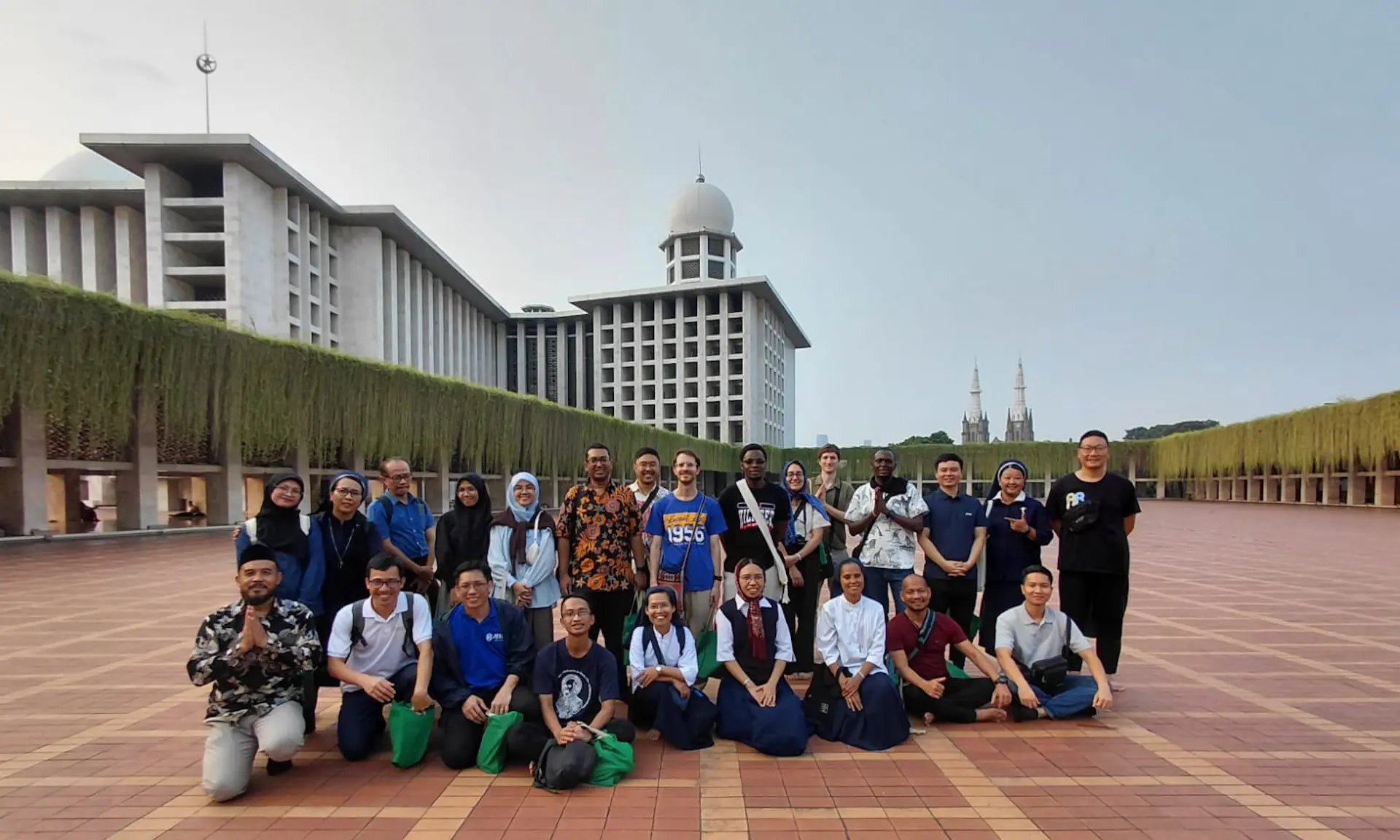
APTEP participants at the courtyard of Istiqlal Mosque; the mosque’s dome and the cathedral’s spires are visible in the background
The Asia Pacific Theological Encounter Programme (APTEP) commenced in the first week of July with a series of academic lectures at the Graduate School of Universitas Islam Negeri (UIN) Syarif Hidayatullah Jakarta and guided visits to two of Jakarta’s most significant religious landmarks.
APTEP is the Jesuit Conference of Asia Pacific’s response to General Congregation 35, Decree 2, No 24, which calls Jesuits “to plunge ourselves more deeply into that dialogue with religions that may show us that the Holy Spirit is at work all over the world that God loves”.
The three-week programme is hosted at multiple locations across Indonesia, home of the world’s largest Muslim population. This gives participants a unique opportunity to engage deeply with the country’s religious, social, and cultural diversity while reflecting on the practice of contextual theology and interreligious dialogue.
This year’s cohort comprises Jesuits from Vietnam, Korea, Indonesia, Myanmar, the United States, Italy, and Kenya; a Xavierian missionary from the Democratic Republic of the Congo; and five Indonesian women religious representing the Society of the Sacred Heart, Sisters of Charity of St Charles Borromeo, and the Order of St Ursula. They are guided by Fr Gil Donayre SJ, APTEP coordinator, and Fr Greg Soetomo SJ, conference coordinator for dialogue with Islam.
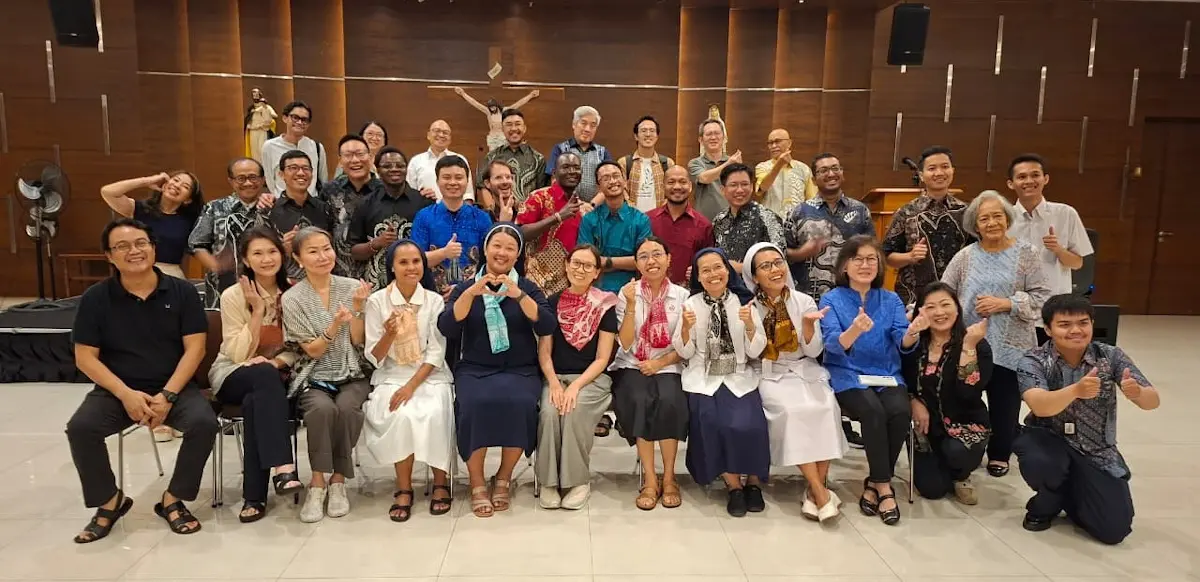
Parishioners of the Jesuit-run St John the Evangelist Church with participants wearing batik shirts and scarves presented to them as gifts by the parish community.
The opening week focused on helping participants understand the history, diversity, and lived realities of Islam through readings and reporting on Hugh Goddard’s Christians and Muslims: From Double Standards to Mutual Understanding, as well as discussions with Muslim scholars at UIN.
Some of the topics covered included Islamic Sufism by Professor Zulkiflli, Director of the Graduate School at UIN; pesantren, Indonesia’s Islamic boarding school system that predates the Dutch colonial rule, by Professor Arif Zamhari; Islam Nusantara, a model of Islamic thought grounded in the culture, traditions, and local wisdom of Indonesian society, by Professor Hamdani; Islamic legal perspectives on non-Muslims, underscoring both textual and contextual approaches, by Professor JM Muslimin; the history of the Qur’an and its various interpretations by Professor Yusuf Rahman; and the practice of philanthropy and the role of women by Professor Amelia Fauzia.
View this post on Instagram
The academic lectures were complemented by visits to Jakarta Cathedral and Istiqlal Mosque, two national symbols of Indonesia’s commitment to peaceful religious coexistence. Participants walked through the Tunnel of Friendship, which connects the two houses of worship. Pope Francis, during his apostolic visit, described the tunnel as an “eloquent sign” of fraternity and solidarity. Inside the passageway, the group heard the deep, rhythmic booming of the beduk from the mosque and the clanging of the bells from the cathedral. The intertwining sounds of the drum and the church bells beautifully captured the interreligious harmony the tunnel represents.
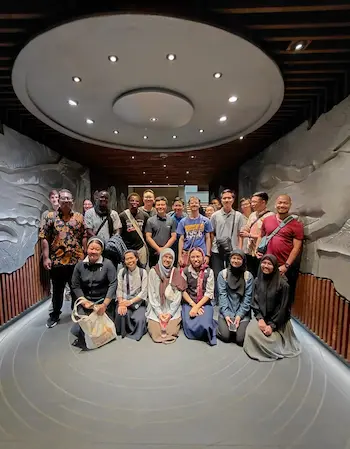
Inside the Tunnel of Friendship
The participants also visited the Indonesian International Islamic University, where, at the invitation of the Islamic Studies Student Association, Fr Donayre gave a talk on “The Ecological Crisis through the Lens of Islam and Christianity”. The group then had the opportunity to interact with graduate students from Pakistan, Egypt, and Bangladesh.
The experience of the opening week offered rich material for reflection in matters of contextual theology and mutual understanding. Reflecting on the experience, Jeff Miraflor SJ, a scholastic from the United States, remarked with a smile, “We are same, same but different!”
A few graduate students from UIN also participated in the lectures and visits to the cathedral and mosque. Mifta, who is studying Qur’anic Exegesis, said it was her first time visiting a Catholic church and her first sustained interaction with people of a different religion. “I had Catholic friends, but we never really talked about religion. Here, I have had the opportunity to learn much more about the Catholic faith,” she shared.
She added that the experience challenged some of her assumptions.
“I also discovered that Catholics have a very high level of tolerance and openness towards people of other religions. Before, I thought this was something unique to Islam, but I have learnt that Catholics also value tolerance very highly.”
In the coming week, the programme moves to Purwokerto, Central Java, where participants will take part in a live-in experience with Muslim students at a pesantren to experience their daily life and deepen interreligious exchange. The final week will be held in Yogyakarta and will concentrate on research, reflection, and the writing of participants’ final papers.


