

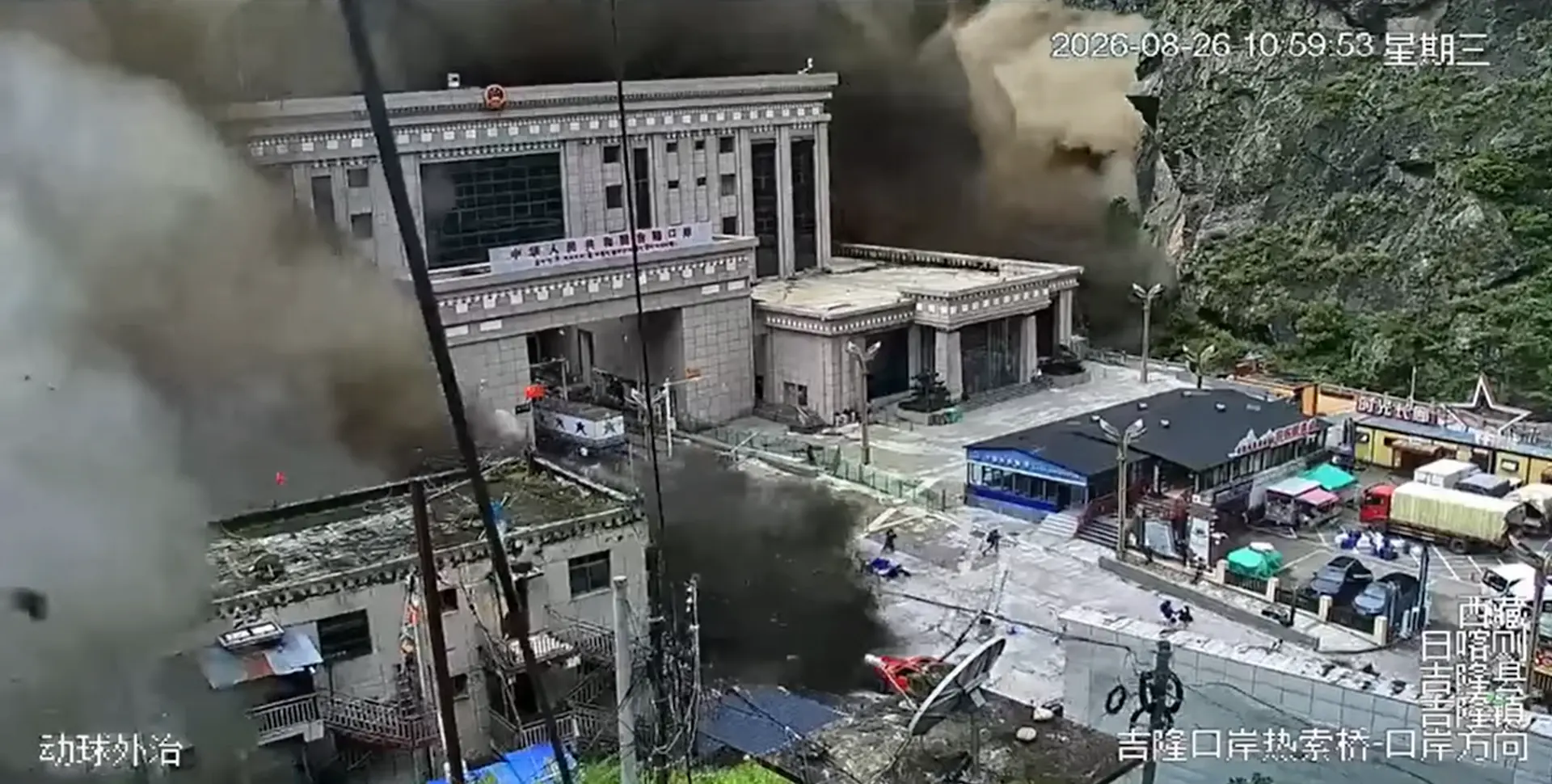
Screenshot at 30s of the CCTV footage of the 2026 Nepal floods in Gyirong Port (view to the south, downstream) | By Unknown author (Public Domain)
“The flood is terrible,” Titi remarked. “We lost 111 people from my community in Rasuwa. I think around 15 people from Ruby Valley also. People are being slowly rescued. My grandparents were brought to Kathmandu the day before yesterday, admitted in hospital.”
A Slack group of 85 leading natural hazard researchers and the Kathmandu-based International Centre for Integrated Mountain Development posit that global warming played a role in the Himalayan tragedy. The Himalayas—spanning Nepal, India, China, Bhutan, and Pakistan—are warming twice as fast as the global average, putting the region at increased risk of avalanches, landslides, and floods.
As high-altitude permafrost gradually thaws, the ice that once bound rock and snow together, acting as a buttress for the mountain, weakens. Meltwater seeps into the bedrock beneath the glacier, destabilising it. This triggered an avalanche of rock, ice, and sediment which scooped up river water downstream, forming a lethal tsunami. The surge burst the banks of the Trishuli River, with its tributary, the Lhende Khola River, most severely affected. Homes, roads, bridges, buildings, power plants, livelihoods, and lives, including those of workers, women, and children, were swept away, along with critical biodiversity.
Even as we await a clear scientific nexus between climate-induced global warming and the Himalayan tragedy, we can already discern how it is related to the moral and spiritual crises (LS §9) of our time. This has spurred the global transdisciplinary scientific community to collaborate in the search for answers.
The tragedy has also awakened the international community to the relevance of integral ecology (IE). IE calls for a personal and communal experience of ecological conversion (LS §218), leading to the profound insight that reality is interrelated so much so that the cries of the Earth are inseparable from the cries of the poor (LS §139), for “everything in this world is connected” (LS §16, §70b, §73, §91, §111, §117, §138).
Critics of the dominant economic and spiritual paradigms, drawing on the wisdom of the primal and world religions, find recourse in IE as a countercultural paradigm. They call for a change of lifestyle of “less is more” (LS §218, §222) so as “to grow in transcendence, solidarity, responsibility, and compassionate care of the poor and creation” (LS §210).
The shift to the IE paradigm calls into question the ethics of the existing power sovereignty of the “technocratic paradigm” (LS §101, §§106-114, §122). Most problematic is this “undifferentiated and one-dimensional paradigm … which in itself is already a technique of possession, mastery, and transformation” (LS §106) that aims, “in the final analysis neither for profit nor for the well-being of the human race” but ultimately at “power [as] its motive – a lordship overall” (LS §108).
Critiques must be levelled against proponents of the neoliberal economic model (LS §51, §56) and stakeholders of unlimited progress and trickle-down or spillover economies: Can the exercise of power over the planet and its people, driven by profit for the few (FT §168) to the detriment of the ecosystems of our wounded earth, still be considered morally justified?
Does the Himalayan tragedy not expose the avaricious excess of a “tyrannical anthropocentricism,” with its “iron-clad” technology and dehumanising deprivation (LS §§106, 107 & 109 ), and the “culture of relativism (LS §184) and consumerism” (LS §§122 & 123) that depletes the global commons like the glaciers, mountains, and waters, while eroding the inherent value of the Earth’s rich biodiversity and ecosystems?
Are such climate-induced tragedies not a recurrent clarion call to seriously include civilisational wisdom in governance and management of the human and natural resources of Mother Earth?
In this Season of Creation, in communion with the spirits of the 1,300 people who have died and the 5,000 who remain missing, numbers that continue to rise, and in solidarity with our wounded Earth, may we turn to the wisdom embedded in our knowledge systems to guide governments in the formulation of policies for a climate-stricken world.
Current and future development pathways need to always be reverential of the “various beings” with whom we are called to relate (Querida Amazonia §42) within our cosmic web of life, created-sustained by the Creator. This reverence is affirmed in primal religion; in the sacred Buddhahood of all things and the interdependent co-origination of reality in Buddhism; in Ahimsa and Dharmic approaches to governance and relationship with all creatures of Devi Vasundhara (Mother Earth) in the intimate affinity of River Narmada as Matta with womanhood/menstruation in Hinduism; and in Islam’s concept of Amanat–the primordial covenantal bond of Trust, interrelated with Tawhid—the unity principle, Fitra—the creation principle, Mizan—the balance principle, and Khalifa—the responsibility principle.
Reverence for transcendence restores the “dignity of every person and the common good of all people” in our pursuit of progress (Fratelli Tutti §122, Dignita Humanitas §80). This value regards nature as sacred and divine, for “nature cannot be regarded as something separate from ourselves” for “we are part of nature, included in it and in constant interaction with it” (LS §139). More so, “nature is God’s art” (LS §138), always “projected towards divinisation” (LS §236) to become a new creation at the eschaton.