

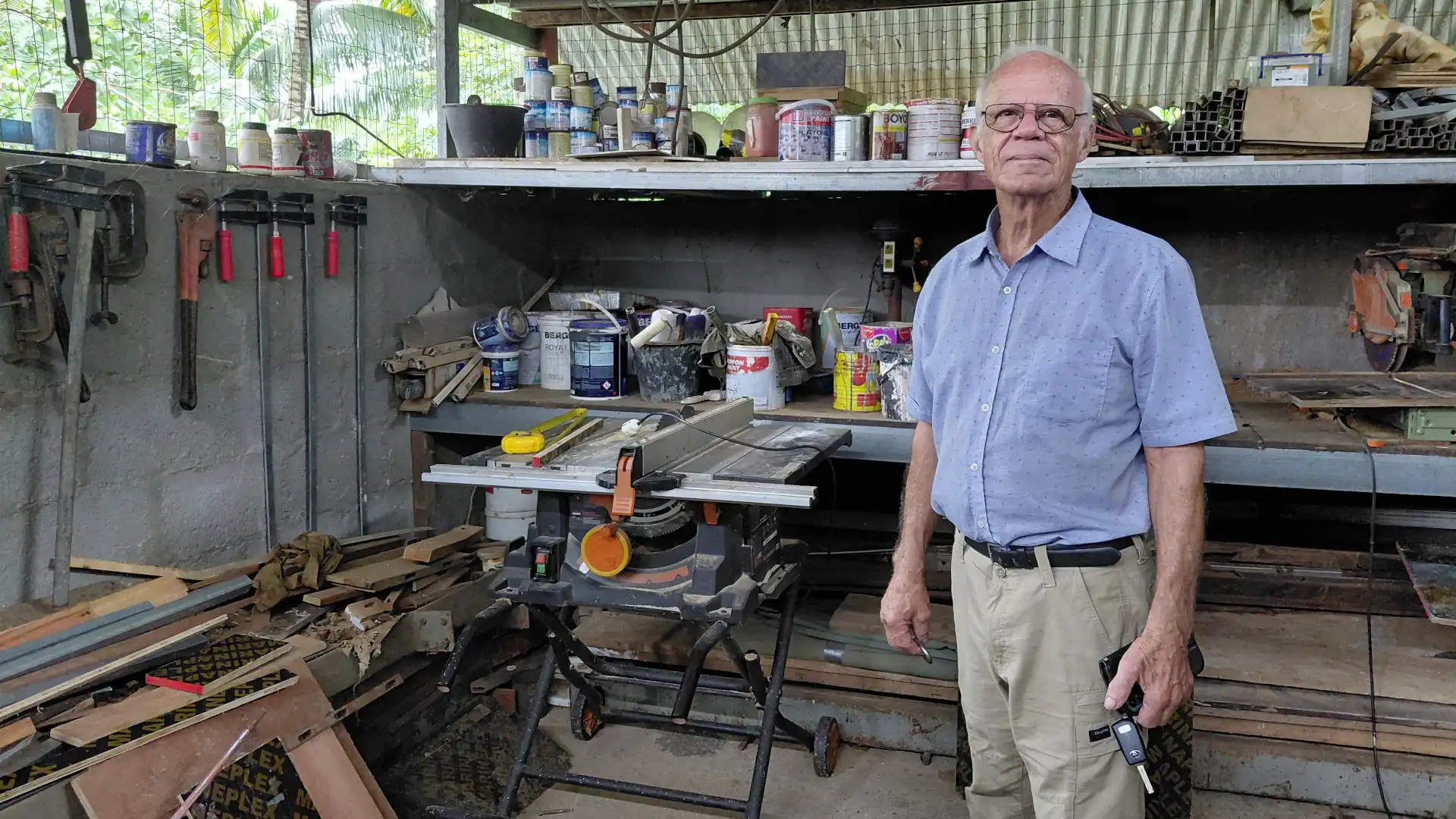
Michael Cutajar in his workshop in Railaco
For most of his life, Michael Cutajar earned his keep with his hands. He built tables, fashioned bed frames, and repaired doors that people opened and closed without ever knowing his name. Now, he is building again, 3,000 kilometres away from his home in Sydney, in the mountainous village of Railaco, where young East Timorese boys study and sleep in a dormitory he helped build.
It is quiet work, the kind that rarely makes the headlines. But carpentry has always been that way. The Gospels teach us that before he preached, Jesus was known simply as a carpenter. And like Jesus, Michael, too, is a carpenter’s son.
He was born in Malta, the eldest of eight siblings. His parents came to Australia when he was five. He went to school in Sydney but left school at 14 to work in carpentry with his father. “My father was a good carpenter,” he says matter-of-factly.
Even as a young man, he felt drawn to serve. “I’ve been volunteering for the church, not in a big way, but yeah, I like to help.”
In 1998, he volunteered in Australia’s Kimberleys with Aboriginal communities for five years. That’s where he met the Jesuits. “I got to know one Jesuit in particular, Fr Nguyen Hoang Trung, who was still studying to be a priest at the time and had written an article in the Catholic Weekly about providing funds for a clean water project in Timor-Leste. And I got interested in that.” He started donating generously, and in 2017, he finally visited Timor.
Fr EJ Gerilla, then treasurer/development officer and now regional superior, picked him up at the airport and showed him the missions. “We went to Railaco, and I said I wouldn’t mind doing some voluntary work here.”
The boys’ dormitory at the Jesuit-run Escola Secundaria Católica Nossa Senhora de Fátima (NOSSEF) caught his eye. In Timor-Leste, where education plays a significant role in its post-conflict nation-building, this parochial school fills a critical void by bringing quality secondary education to rural communities that had none before. At the time, the dormitory was made of thin corrugated sheets that offered poor living conditions for the dormers. “That’s what really got me interested in doing something about doing a proper building,” says Michael. In fact, he funded most of its construction. “I think that’s why they call it St Michael’s Dormitory,” he chuckles.

The NOSSEF boys’ dormitory in 2017

The present dormitory
That was late 2017. From 2018 onwards, he started coming to Timor regularly. At first, for only three months at a time. He was still working in Sydney. People there still asked for his jobs, but then there was plenty to do in Timor. Now, he returns three times a year, splitting his time between Sydney and Railaco. “It works good for me to go back to Sydney and see my family and friends and look after my garden. But they keep me busy here. I do work in the parish. I do work in the school.”
In the nine years since, Michael has built 350 tables for students, a cabinet for the church to keep their video equipment, 10 large mosquito screens and window frames for the novitiate of the Sisters of St Paul de Chartres, and bed frames for mosquito nets (dengue is a real threat here). His latest masterpiece is a round 10-seater dining table that took two weeks. The wood came from Same, a town in the eastern part of the country. The mechanism for the turntable he bought in Sydney. The table, which will be used by the Jesuit community in their new residence, has been blessed by the bishop. “I really enjoyed making it,” he smiles. As for his process? “You just feel your way along.”
Most days, though, he tackles small maintenance jobs, which can vary from hour to hour. “Sometimes in the church, a door doesn’t close properly, so I fix the lock, or else the roof is leaking, and I fix the roof.” Sometimes, the dormers come to help. “The only problem is, they’re too many, and it derails the process,” he laughs. He laments the unannounced power outages that can last more than a day. “They blame the rain or a tree falling on the wire. I think they don’t produce enough electricity.”

Michael showing his latest piece: a 10-seater dining table for the Jesuit community
Did he ever imagine, as a boy in Sydney, that he’d end up in Timor-Leste? “How would you ever know?” he smiles. “But I have always wanted to do things for the church. Always been close to the church. I’ve often helped, even in the parish or at home, voluntarily.”
Michael, who just turned 81 and never married, once thought of joining the Capuchins. But then again, “That’s not really the life for me,” he muses.
On a Sunday morning, he makes the short walk from the Jesuit house to the parish for Mass. A young girl sings the Psalm melodiously, “Karik ohin imi rona Na’i nia lian, keta halo toos imi nia fuan.” If today you hear His voice, harden not your hearts.
Michael heard the voice of God, and it has carried him far and keeps him here still.


