

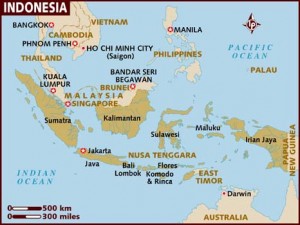
Flores is an island that has sub‐climates. The mountains in this island are highly volcanic in origin, so water can permeate and infiltrate into the ground effectively. There is good storage capacity but there is no clear understanding of how much water is available on the ground. Volcanic earth has certain nutrients that are valuable but when we get to plant, it may not have the right combination of nutrients and the water needed. Therefore, there is a need to look, not only at the basic nutrients of Phosphorous, Nitrogen, and Potassium but also at the other micronutrients in order to get the balance.
At present, there are two weather stations available in the area, one is at the airport of Flores and the other is located at Adaga Culture. According to records, 2010 has been very special in such a way that rainfall is spread all throughout the year in the island. It has been La Niña last year while it has been El Niño during the previous year. La Niña was experienced in 2010 and often it will go back after 5 to 7 years. Significantly, the rainfall pattern is important to know as well as the rate of soil absorption in order to determine appropriate processes or practices on the land.
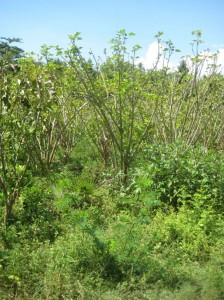
 Local crops or trees that grow in Flores are mete (cashew), ketek, asam (tamarind). Farmers plant Jatropha as fence however, their system is very tight, about 30 centimeters apart. This system however, does not allow root systems to grow with limited fruits produced. Jatropha, on one hand is good as it has low water demand.
Jatropha needs soil and water. In the soil are the nutrients. It is important to know the seasonality: when does the rain come and where is the rain stored, and how does it go out to the sea?
Water is stored in a water table, where people usually placed pump to draw up the water for distribution. This relates to energy – gravity distribution. Many of the rivers in Flores have no surface water so water is flowing below. To understand the different (natural) water storage, there is a need to know first the calendar of the seasonal water or rainfall. Then water distribution can be decided.
Understanding the volume of available water helps determine the type of distribution. If there is enough water available, canal system is feasible however, if the volume of water is limited, dripfeeding can make distribution. Increasing the absorption of the soil on the plant is critical to know the appropriate combination of specie or variety to grow. Although cutting can propagate Jatropha, it is also good to propagate them by seeds to allow better root systems that would be beneficial to the soil nutrients.
 During rainy season, surface flow can be diverted where in water flow is regulated to avoid deep channels or canyons as it goes into the river. The water table is at the river base. There is a need to look into the water table and identify if it is perch then decide whether to maintain or diffuse it. The water drains effectively into the river channels and outlet. Uncompacted vegetation helps delay the process of delivery of water to river channels and at the same time reduces the channeling of water.
Increasing soils potentiality to sustain crop production can be done through intercropping i.e. Jatropha and coffee. Adding organic material and keeping soils uncompacted is very good for the immediate soil temperature and potentiality of soils. This approach also creates microclimate and canopy that retains moisture.
The community is venturing into Jatropha plantation to increase their income from coconut farming as well as to improve their agroforestry system in the area. Jatropha has benefits to farmers yet it should not compete with food production. It should have an added value on the land where in farmers look at other combinations (intercrop) to keep the balance between food security and livelihood as well as soil nutrients. On one hand, the community needs to address first their issues on water, soils, and sewage before they could plant Jatropha.
(This documentation is developed during the field visit of Pedro Walpole SJ in November 2010 to Flores Island. Bambang Triatmoko SJ along with other international specialists on renewable energy and community development and enterprising facilitated the visit.)


