
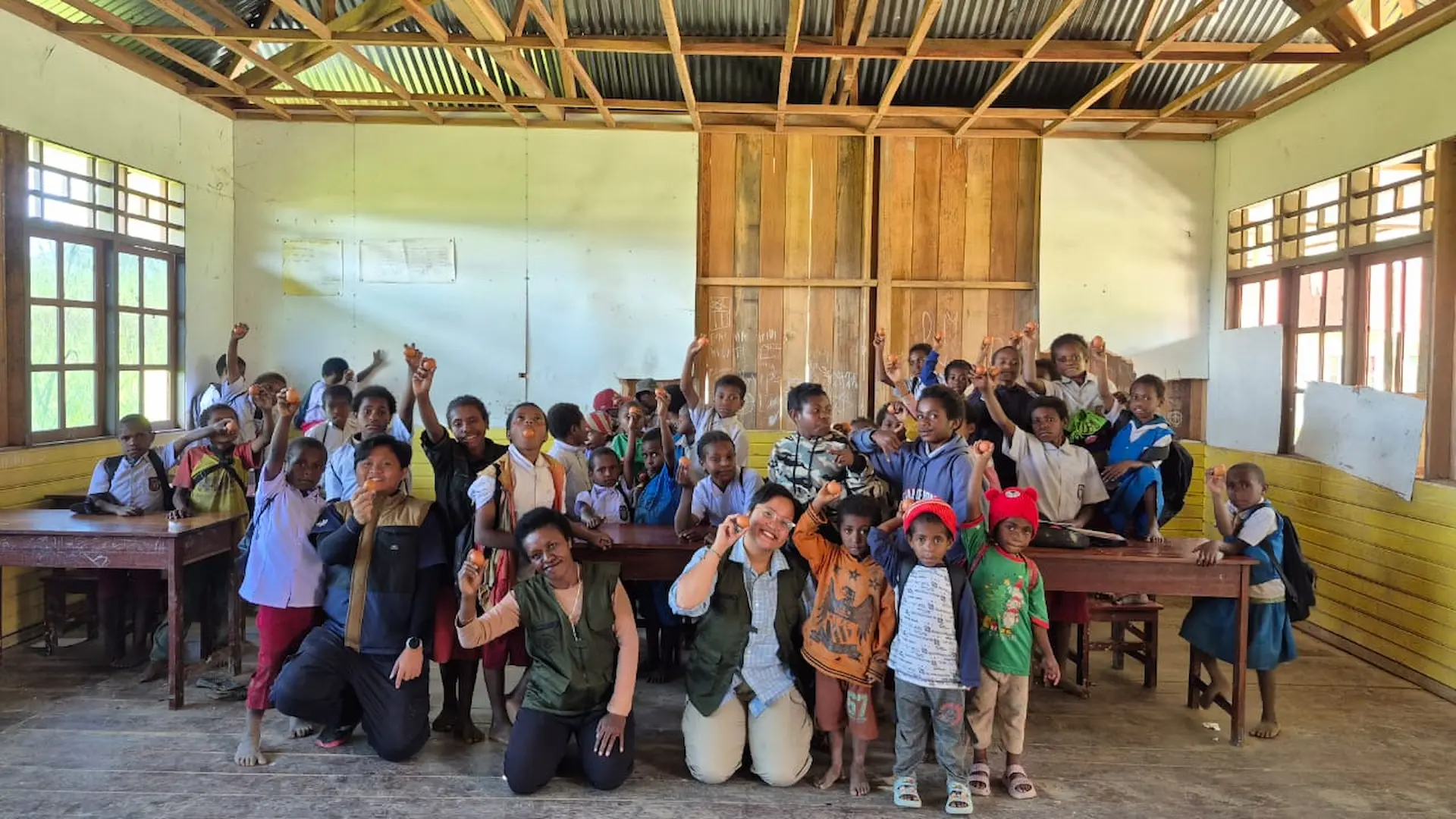
Schoolchildren with volunteers at Kigou Station holding boiled eggs as part of the parish’s feeding programme
This first-year theology semester break brought me a surprising opportunity: an immersion experience outside Java. Since there were only three of us first-year theology students at Kolese Santo Ignatius (Kolsani), the annual Arrupe Month was moved to next year. This opened a surprising opportunity for us to participate in a new immersion programme, which seeks to give scholastics in formation for the priesthood an experience of priestly life through immersion in parish ministries.
While my confreres, Alfred and Kepas, were excitedly preparing for West Kalimantan, where they would be serving at Mother Mary, Mother of God, in Botong, I was anxious to go to Papua after hearing news that it was unsafe. But I surrendered to God and began my journey.
Immediately, I was met with flight delays that tested my patience. However, I also found precious moments in enjoying local food, such as Coto Makassar, and an unexpected meeting with Fr Sudriyanto SJ at the airport.
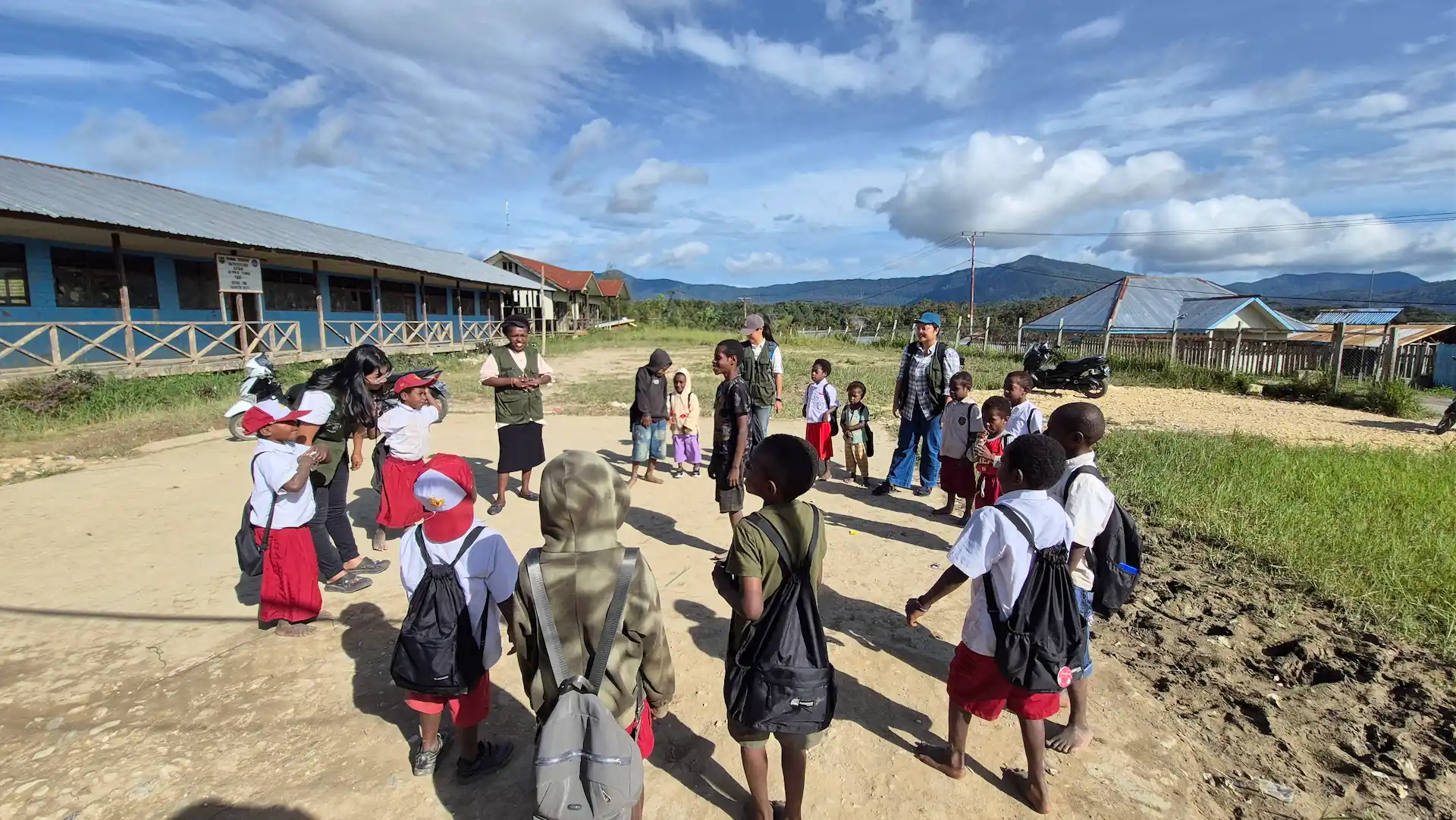
Volunteers and children gather before their school lessons at Yaba mission station
I arrived in Nabire to the warm welcome of the Jesuits. I met Fathers Purwantoro and Adi Bangkit and witnessed the Jesuits’ active work in instilling faith, hope, and love there. From this experience, Papua, which had been a distant concept in my mind, became a reality.
The trip to Waghete took eight hours by road. I was accompanied by a new volunteer, a parishioner, and a Torajan driver. I learnt later that my friends, Alfred and Kefas, also encountered difficult travel conditions. The distance between their parish and the station chapel was not far, but the muddy, uneven roads significantly delayed their journey, sometimes doubling the time expected. One trip back from the station took nearly six hours due to slippery roads after rain. The road conditions also strained their finances, as vehicle repairs were costly.
Back in Waghete, Fr Peter Devantara and two volunteers were already waiting for me at the rectory of St John the Baptist Parish. My tasks here were very practical: being the school warden and accompanying the children as they cut grass, which made them feel proud to write my name in their diaries.
The biggest challenge was repairing the reverse-osmosis water filter machine and the broken pipes. When clean water flowed again, the children’s joyful cheers brought me great happiness. In addition to my household duties, I also taught at the parish stations of Yaba, Yagu, and Kigou elementary schools. I would tell the children “Mei sekolah” (“Let’s go to school”) to encourage them to learn the basics of reading, writing, and arithmetic. In class, I discovered that Papuan children live in a rich land but lack shoes and teachers.
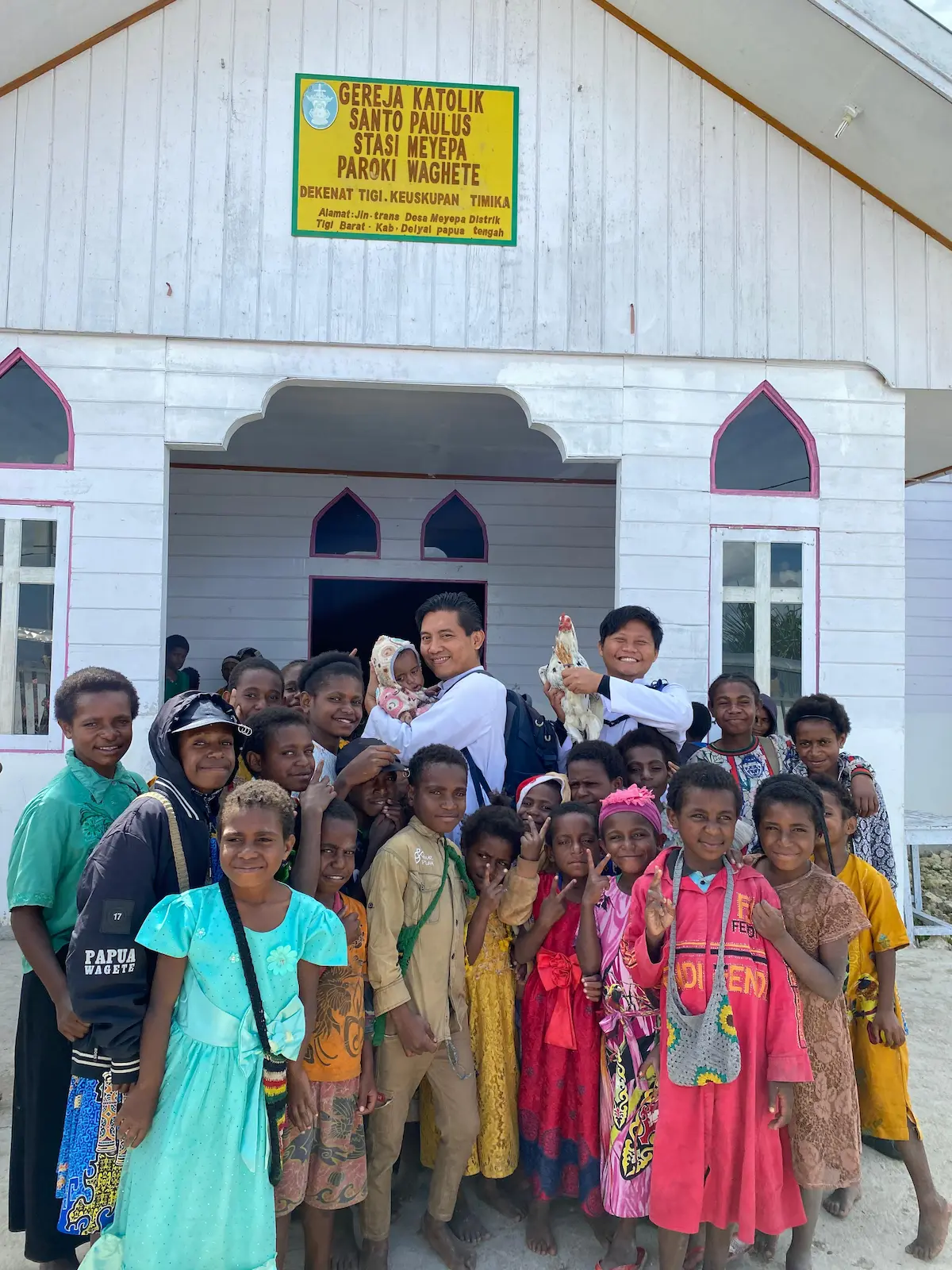
Scholastic YK Septian Kurniawan SJ holding his chicken with parishioners of Meyepa station in Waghete, Central Papua, during his farewell. Beside him is Fr Peter Devantara SJ.
The education system in Papua struggles from poorly managed policies under special autonomy. The lack of formal education and frequent teacher absenteeism in both public and private schools leave children without proper education and self-care skills. Even so, formal education may not be a priority at this time.
The Waghete Church is trying to help by bringing in volunteer teachers and providing nutritious food, such as boiled eggs and milk, at four parish stations: Yaba, Kigo, Yagu, and Meyepa. Additionally, the parish offers dormitories for junior high students from rural areas. However, security remains a concern for volunteer teachers.
Despite these difficulties, the parish priest in Waghete shows great enthusiasm and commitment, persistently advocating for education alongside his religious duties.
After three weeks with the community, I had to say goodbye. A local inhabitant gave me a chicken as a token of gratitude.
Daud Kefas Raditya SJ helped write this article.